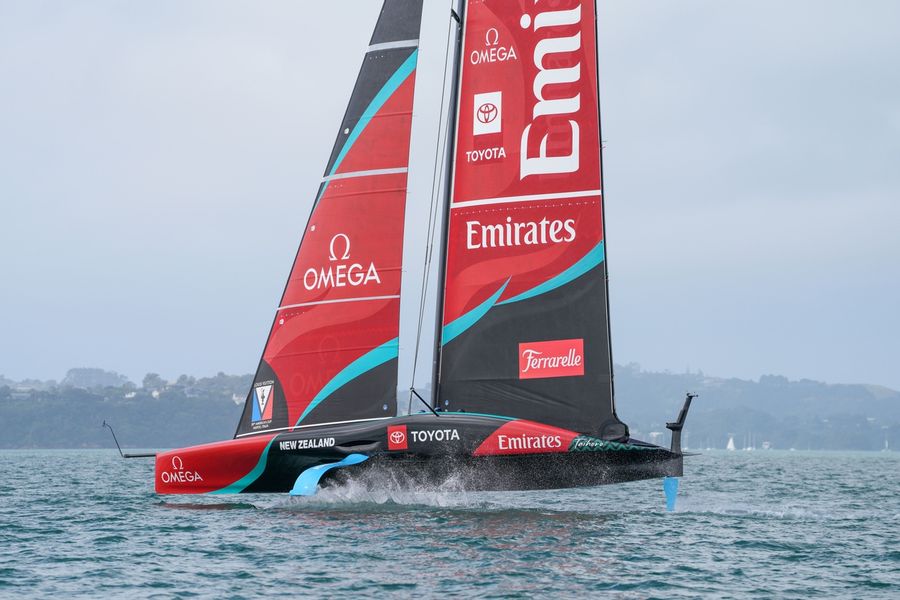
Emirates Team New Zealand took Taihoro out onto the Waitematā Harbour for a five-hour session covering everything from system commissioning through to full race simulations and pre-start practice, giving the sailing team its first proper extended opportunity to put the reconfigured AC75 through its paces.
The day began with system checks shortly after 11am, and Taihoro cleared the dock at 11.30am bound for Course E, the sailing area that lies inland of Waiheke Island. A north northeast breeze started at around 7 knots and built gradually to 12 across the afternoon, with flat water throughout making for manageable conditions in which to work through the boat's systems and manoeuvres.
After a tow out to the course and some early technical work on the water, sails went up just before 1pm. Taihoro was sailing on starboard tack by 1.40pm and took a short period to settle into consistent foiling flight before the crew began working through a structured sequence of manoeuvres.
The initial sailing phase included several tacks and adjustments to the jib foot line, before the team moved into a two-lap race simulation. That segment saw eight tacks and five gybes completed alongside bear aways and round ups, with systems checks and boat handling drills running in parallel throughout.
Around the midpoint of the afternoon the team paused to swap from a J3 jib to the larger J2. The change lifted the tempo of the testing that followed considerably, with a further race simulation completed across approximately 24 minutes and incorporating 11 tacks and eight gybes.
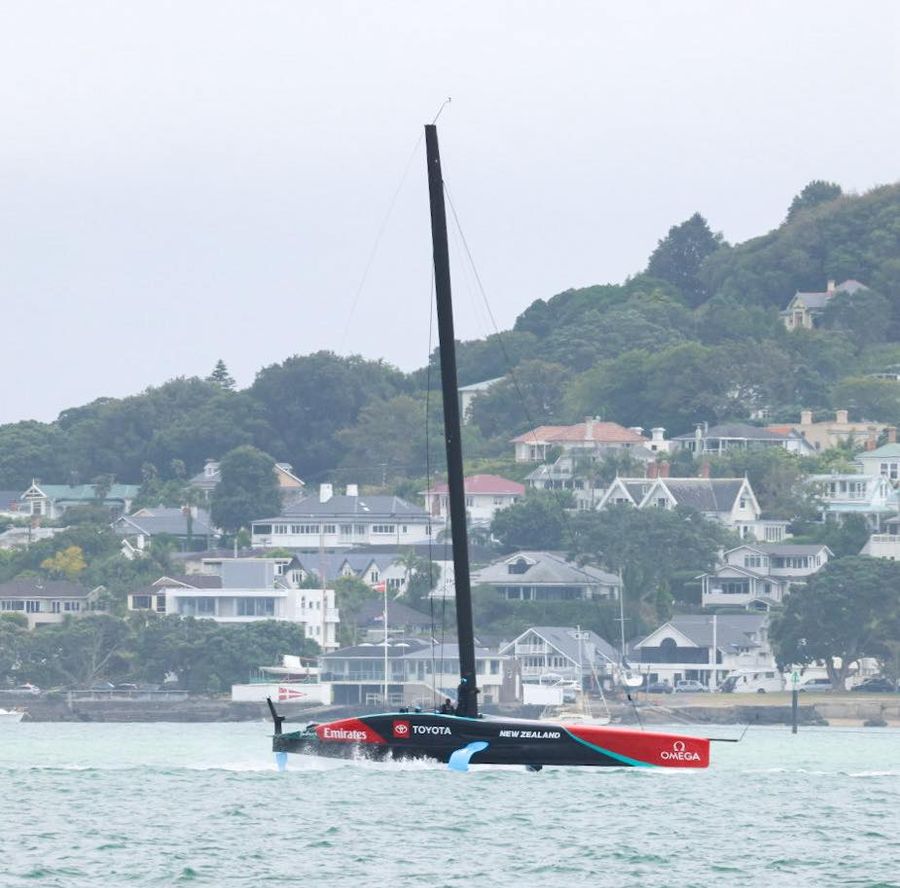
To round out the session, the crew ran through practice pre-starts, entering the start area once on port tack and once on starboard before bringing the sails down. Taihoro was back alongside the dock by 4.39pm.
Nathan Outteridge and Seb Menzies shared the helm across the day, with Blair Tuke and Iain Jensen on trimming duties. Olympic champion Jo Aleh filled a newly created fifth crew position, stationed behind the starboard helmsman with a focus on performance monitoring and systems management.
Emirates Team New Zealand observer Pierluigi de Felice noted that, despite three crew members stepping aboard an AC75 for the first time, Taihoro looked settled in a straight line and the standard of manoeuvres climbed steadily as the hours progressed. Several technical features drew attention during the session, including the mainsail traveller fairing and the foil cant control logic being applied through tacks and gybes.
Outteridge described the day as an encouraging first step for the campaign, acknowledging that the team had waited patiently for a suitable weather window to open up. By the time Taihoro returned to the dock, the crew had progressed from initial commissioning work through to completing full race laps and pre-start practice within a single outing.
He also spoke to the new battery-powered control systems that have taken the place of the previous generation of cyclors, saying they appeared well balanced within the rules. The lighter AC75 configuration showed promising signs of improved acceleration in the softer breeze conditions encountered during the session.
For several crew members the afternoon represented their first time aboard an AC75, and Taihoro's first foiling laps marked a shift in the campaign from early-stage commissioning into more deliberate performance development work.