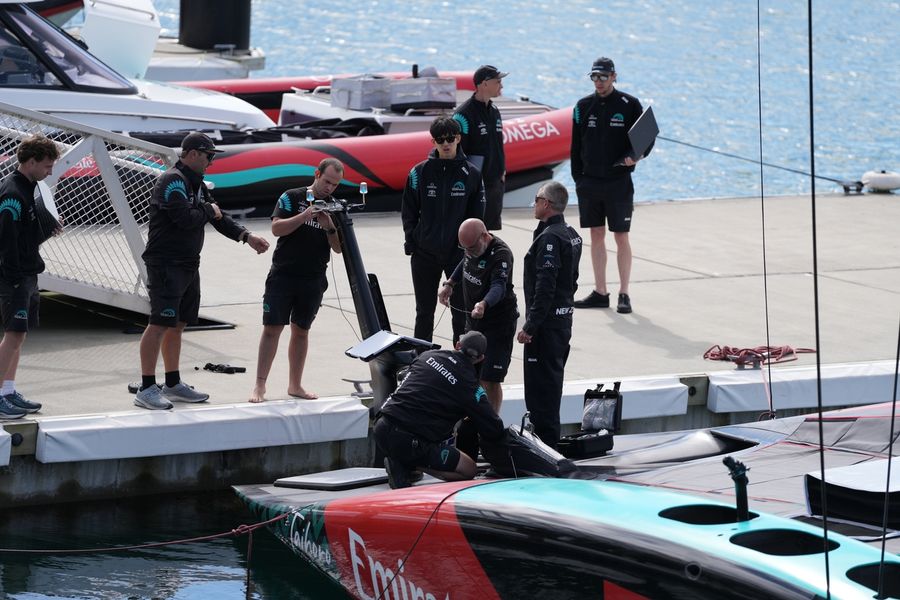
Emirates Team New Zealand wasted no time getting back on the water in Auckland this week, launching straight into a new training block days after limping home from Naples as beaten finalists in the Louis Vuitton Prelim Regatta.
There was no lingering on that result. Taihoro, the Cup-winning boat from 2024 and Defender of the Louis Vuitton 38th America's Cup, was out of the shed early on the first morning of the spring block, and under close watch for any sign of new kit.
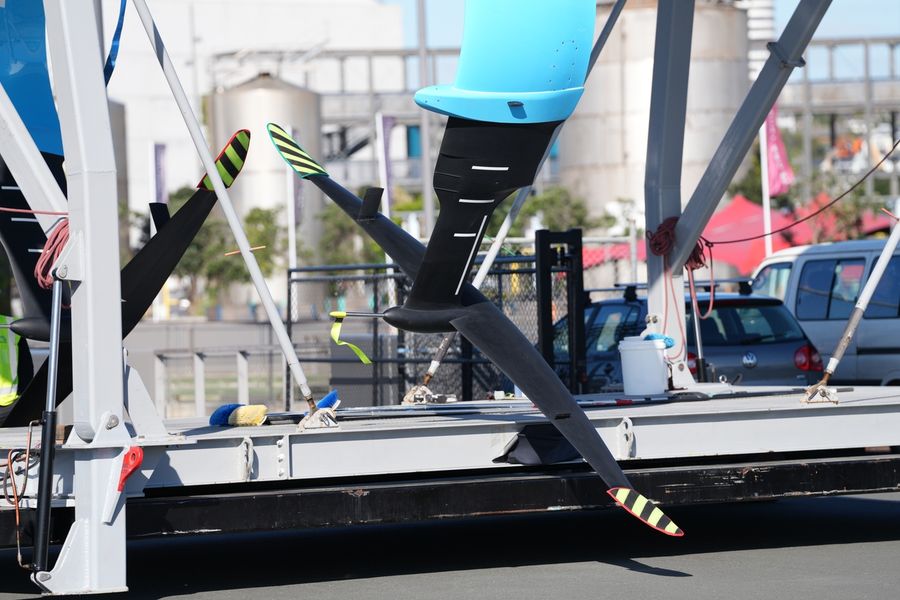
The foil area told its own story. Cameras were mounted on the foil arm looking down onto the outer wing, with fresh test stripes applied, and stand-cameras fitted on the inner wings in line with pitot tubes at the front of the bulbs. All of this points to heavy foil iteration work, even though the team are still running 2024-spec wings and flaps.
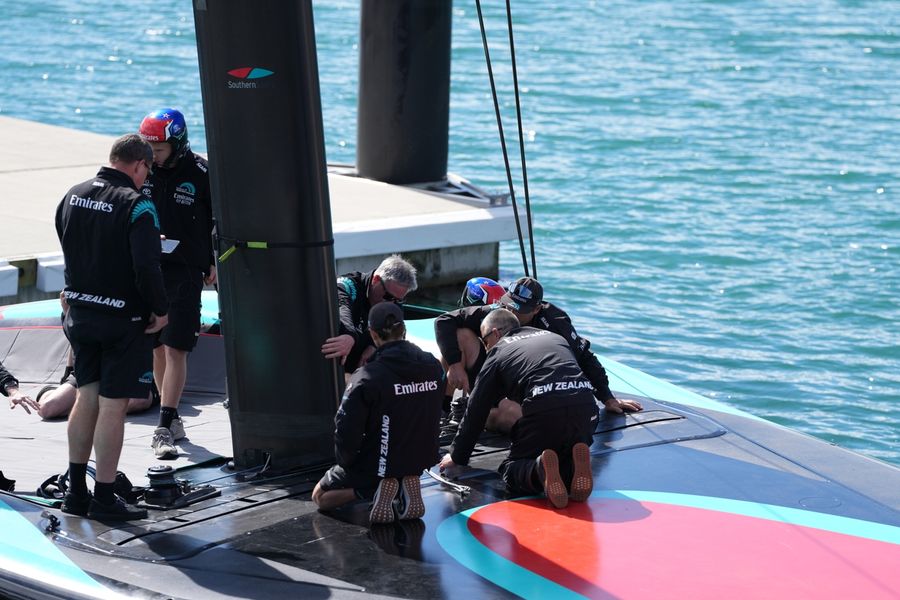
At launch, the shore crew were busy fitting wiring and a disc-shaped sensor or transmitter to the rudder tower at the stern. Plenty of attention also went into what looked like a new jib traveller system, with grooves cut into the aero-combing and clear trim marker points. Control systems aligned with aero matter hugely on an AC75, and every team is chasing gains there, in both jib and mainsail setups.
Onboard was the regular AC75 crew: Nathan Outteridge, Seb Menzies, Andy Maloney, Iain Jensen and Jo Aleh. In the Guest Racer seat was Josh Armit, a trimmer from the Youth Team.
The day split into two clear jobs. First, long straight-line sailing to gather data, then a session of harsh figure-of-eight manoeuvres as the team worked on pre-start control, an area ETNZ know needs sharpening after effectively losing both match-race finals at the Preliminary Regattas in the pre-start exchanges.
Seb Menzies didn't hide from the difficulty of the conditions, a choppy 12-17 knots that made life hard for everyone. "Obviously, there's a lot less margin for error. Everyone's trying to get the boat super-low to the water, so as soon as there's waves, you are either weighing up the risk of touching a wave or getting the boat nice and close to the water. So that's a lot to work through for everyone and it gets generally quite a bit harder to sail the boat as soon as there's any waves. But it's a good way to test yourself and obviously in Naples we didn't see a huge amount of waves, but it's always good to check back in."
On the aggressive figure-of-eight work, he explained the thinking behind it. "We're basically preparing for a match-race start where the boats have to do real aggressive turns, so checking through a number of different things with that. But yeah, we're anticipating the boats having to do high turn rates and a lot of low-speed manoeuvres as well. Obviously, the starts being probably the most important part of the race."
First day back. Plenty to take away.
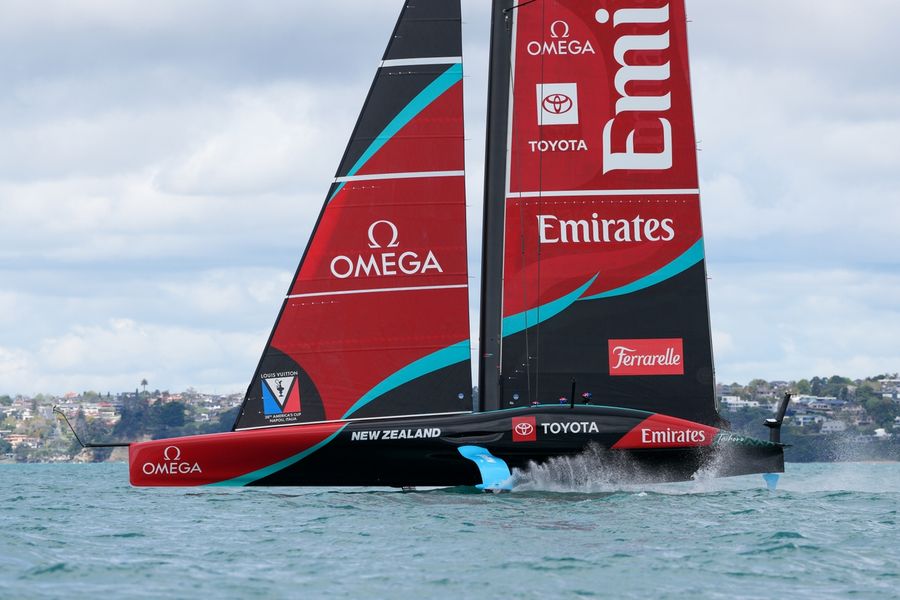
Conditions were cold and messy, with a sharp easterly chop that varied noticeably between the main channel and the shelter closer to Waiheke Island. ETNZ rolled out of the shed at 9.25am carrying the short rudder last seen at the end of the previous training block, and splashed down just after 10am.
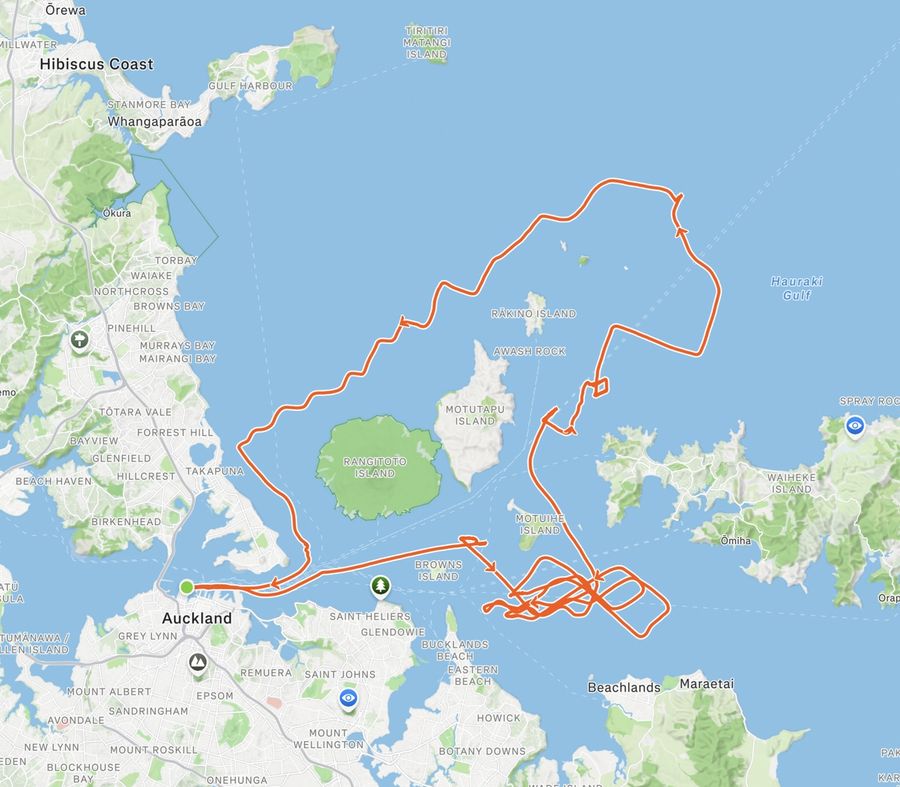
Considerable time went into the rudder tower and the new jib traveller system before sailing even began, which Menzies later confirmed was part of commissioning the new gear. Off the tow near Motuihe Island by 11.32am, the team hoisted their M2-0 main and J3-1 jib and began sailing at 12.01pm in 12-17 knots.
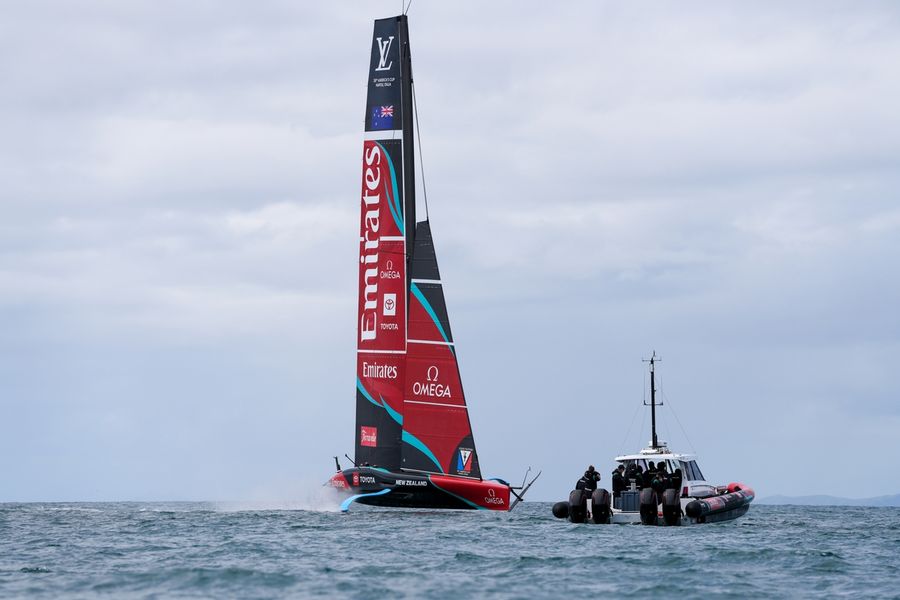
It was the J3-1 jib on the day, not the J3-3 that dominated the previous training block.
A short stop at 12.19pm to adjust the jib tack, then back out. That first session was mostly straight-line work. The second, from 1.02pm, added some tacking and gybing, with the team appearing to hold the board down longer through the gybes and glide further before raising it at a rate that kept heel steady. There looked to be some testing around boat pitch too.
By 2.04pm, in a lighter 10-14 knots, the focus shifted entirely to figure-of-eights, progressively more aggressive, though without any simulated race starts. This was structured manoeuvre testing at the lighter end of the J3's wind range. The breeze kept dropping, down to 7-10 knots by the time that session wrapped at 2.30pm.
A switch to the J2-1 jib followed, another slightly unusual choice given the team has mostly favoured the J2-2. The sea state stayed awkward even as the wind eased, short and steep from a mixed direction, which made it tricky to push ride height without the hull touching the water.
After a short break just after 3pm, the team sailed on down the north side of Rangitoto to Takapuna Beach, where the water finally flattened out. They finished off North Head at 3.53pm and were back at the dock by 4.25pm.
It was a solid first day of the spring training block, making good use of a breeze that started strong and steadily faded. No VIPs on board, no organised prestart drills, just hard, deliberate testing. The message from Auckland was clear: the Defenders are deadly serious about winning back the Cup in Naples.