
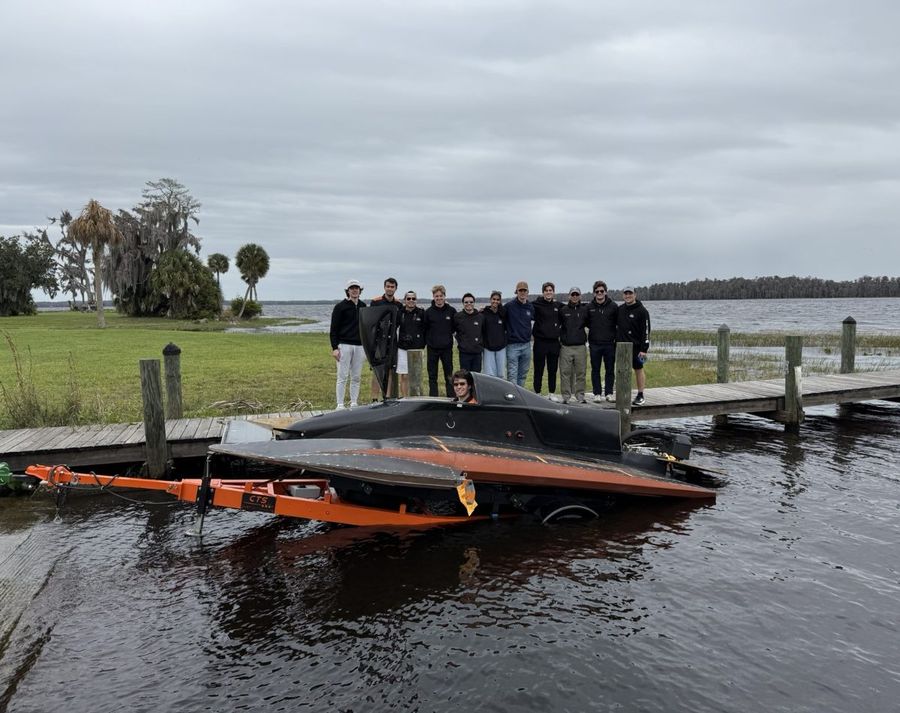
Princeton University's Princeton Electric Speedboating (PES) team completed a week of high-performance testing at Mercury Racing's Lake X facility in Florida during March, moving the programme closer to its next world record attempt.
The boat at the heart of the programme is Eagle 1, a 16.5-foot all-electric hydroplane conceived and constructed by PES in collaboration with JW Myers from Black Sheep Racing. At 7.5 feet wide and clad in carbon fibre across its entire deck span, Eagle 1 carries two battery modules rated at 356.4 V nominal and 388.8 V maximum. The powertrain is built to deliver more than 300 HP and hold speeds above 145 mph for up to one minute, with John Peeters in the driver's seat. Reaching that performance bracket for the first time during the Lake X sessions made this test week a landmark in the programme's history.
Safety engineering runs through Eagle 1 from the ground up. The vessel carries system status indicator lights covering both high-voltage and low-voltage systems, emergency stop provisions, a seven-point harness, an air tank, and a deployable airbag, all intended to protect the driver and any divers working around the boat during testing.
The Electric Kilo Hydro marks a genuine step forward in hydroplane design, pairing advanced electric propulsion with a modified Mercury Racing SSM4 gearcase and drawing on experience accumulated across earlier development platforms.
{{MEDIA_1}}
Chris Jenks, Mercury Racing's Development Engineering Manager, spoke about what it meant to welcome the programme to Lake X. "Lake X has always been a place where new ideas are put to the test," he said. "Partnering with Princeton University on their Electric Kilo Hydro program was a great example of how academic innovation and high-performance marine engineering can come together. We were excited to provide a controlled environment where their team could gather meaningful data and continue pushing the boundaries of electric propulsion."
PES President Evan Callas described what the week represented for his team. "Testing at Lake X is a major milestone and honor for our program," he said. "It gave us a rare opportunity to validate our electric propulsion system in a world-class environment while pushing performance limits and collecting critical data as we prepare for our next world record attempt later this year."
Jenks also addressed the wider value of academic and industry partnerships. "Programs like this demonstrate how the future of marine performance will be shaped by collaboration," he said. "Whether it's electric propulsion, new materials, or advanced control systems, bringing together university research and industry experience benefit everyone involved."
Beyond the raw performance numbers, Lake X provided a controlled setting with on-site safety, rescue, and technical support that allowed Princeton's engineers to work through their testing programme methodically. Safety protocols were specifically tailored to the demands of an electric race boat. Experienced rescue divers Dakota James and Shawn Steinert, both widely recognised from their work at U.S. Offshore racing events, were present throughout the week.
APBA President Kurt Romberg attended as well, bringing a background rooted in NASCAR aerodynamics and taking part in one of the test sessions. "Electric propulsion is pushing the sport into a new era, requiring safety and performance to evolve together," he said. "This week at Lake X showed how the next chapter of powerboat racing is being built, through engineering, testing discipline, and strong safety leadership."
In 2023, the team set the official world speed record for an electric boat at 114.20 mph. Founded in 2020, PES now draws together more than 100 undergraduate and graduate students and operates as a fully student-run organisation within Princeton University. With Mercury Racing's backing confirmed for the upcoming attempt and Eagle 1 having met its target performance figures at Lake X, the team looks well placed to push that record higher before the year is out.
%20of%20the%202026%20Lucas%20Oil%20Australia%20Hydroplane%20National%20Drivers%20Championship-900x427.png)