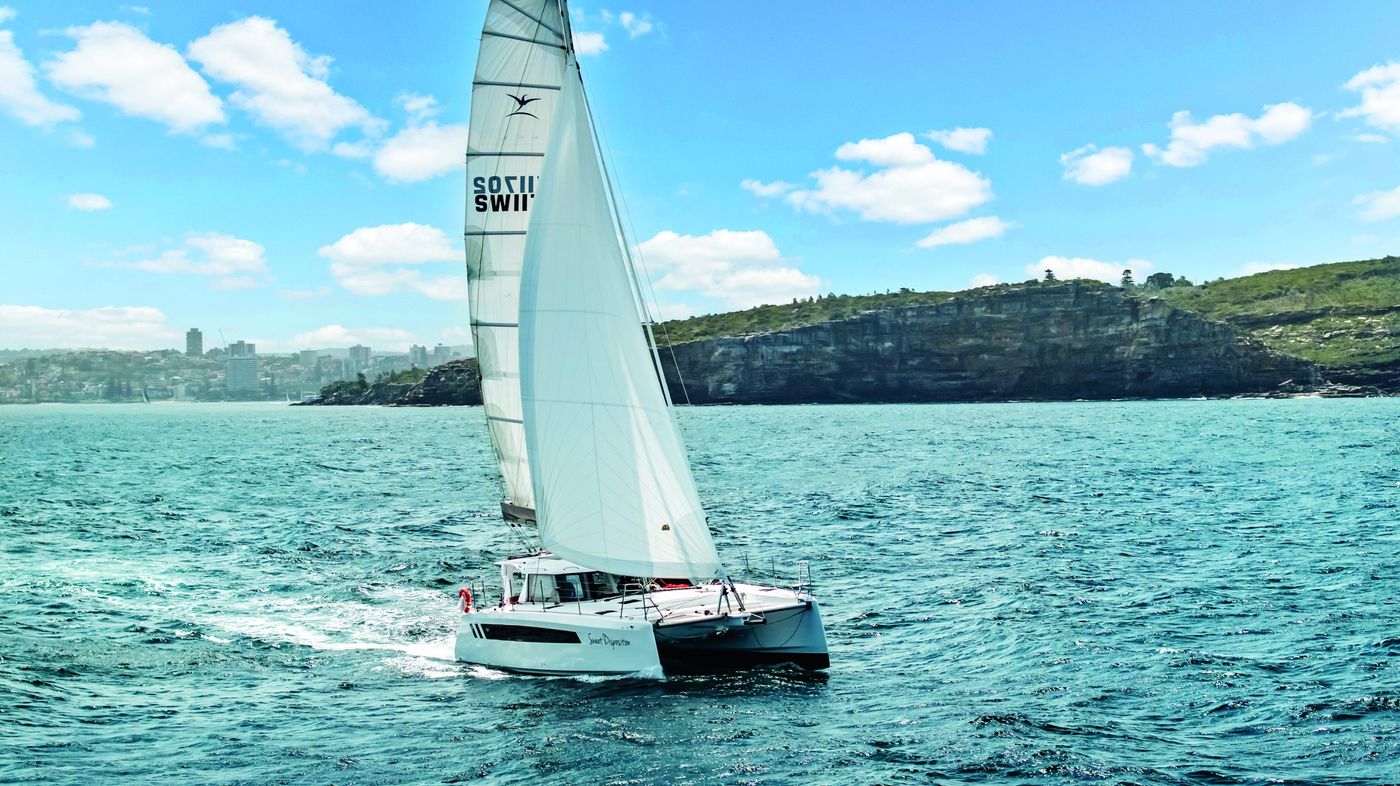
Somewhere out on the Tasman Sea, nearly 1,200 miles from Sydney, the Seawind 1170 Sweet Disposition was doing something more than making passage. She was being put to the test.
Bound for the Auckland Boat Show, Sweet Disposition departed Sydney with Brent Vaughan of Multihull Central and skipper Tom at the helm, bows pointed toward Cape Reinga. The plan was simple enough in concept: deliver the boat to Auckland. But Vaughan had made clear before departure that the crossing represented something more than a logistics exercise. "We're actually going to have the opportunity to really test the Seawind 1170 in those conditions with varied winds and varied seas and see how she goes."
The early miles gave little cause for concern. Winds running at 16 to 18 knots pushed Sweet Disposition along consistently in the sevens, occasionally nudging into the mid-eights, in what Vaughan described as a comfortable sea state. "Very comfortable, nice sea state so overall the boat's performing well," he reported.
That comfort was tested as darkness fell. Overnight, the breeze climbed to around 30 knots, with seas becoming lumpy on the nose at roughly 40 degrees apparent. Three reefs went into the main in the dark. Rather than exposing weaknesses, the conditions revealed what the design was built for. "Really good test for the bows, you just feel them punching through the swell and riding over them," Vaughan said. By morning the wind had dropped back into the low twenties and Sweet Disposition settled into a steady eight-knot beam reach.
The next significant shift came in the early hours, when a southerly change arrived at 4.30am after several days of working to windward. Winds sat at 25 to 30 knots through the day and the sea built accordingly, but Vaughan noted the boat was "handling really well" as the crew shaped a more direct course toward New Zealand.
Life aboard during the crossing underlined the 1170's credentials as a genuine offshore cruiser. Tom found the galley in the starboard hull a practical working space at sea, describing it as "a really usable space at sea… you feel really enclosed in here with real good visibility." Provisioning had been kept sensibly straightforward, with frozen meals, canned backups and plenty of snacks on hand. "Make it as easy as possible," Tom said.
At the nav station, the crew had PredictWind routing, Starlink connectivity and a swivelling chartplotter within reach, all of which allowed watchkeeping from inside the saloon without stepping out into the elements. "We can keep watch here day and night quite comfortably," Vaughan explained, adding that it was possible to lean back and check sail trim through the tall cabin windows.
The twin helm arrangement earned its keep offshore too. Vaughan noted that crew time on the helm at sea is rarely about pure sailing. "Most of the time when you come out here on the helm offshore, it's not for sailing generally, it's actually for shaping reefs out or putting reefs in." That task could be managed "without actually exiting the cockpit at all and exposing ourselves to the conditions." Wide side decks, 800mm safety rails and flat working surfaces meant that when moving forward was necessary, it could be done safely even in 2.5-metre seas.
With around 200 miles left to run, attention turned to the approach. Forecasts were showing 25 to 30 knots and swell of 3.5 to 4 metres around North Cape, making routing decisions increasingly important. Tom described how they were working with the software to account for conditions ahead. "You can enter your boat's polars into the programme and then basically get it to chart you a weather course to your destination."
By the time the New Zealand coastline came into view, Sweet Disposition had done more than change ports. She had completed a full Tasman crossing, tested across a genuine range of offshore conditions.
Seawind Catamarans will have the award-winning Seawind 1170 at the Auckland Boat Show from 5 to 8 March. Named Multihull of the Year at the British Yachting Awards and built at Seawind's European facility in Turkey, the 1170 marks the start of a new generation of performance-focused cruising catamarans for Kiwi sailors.