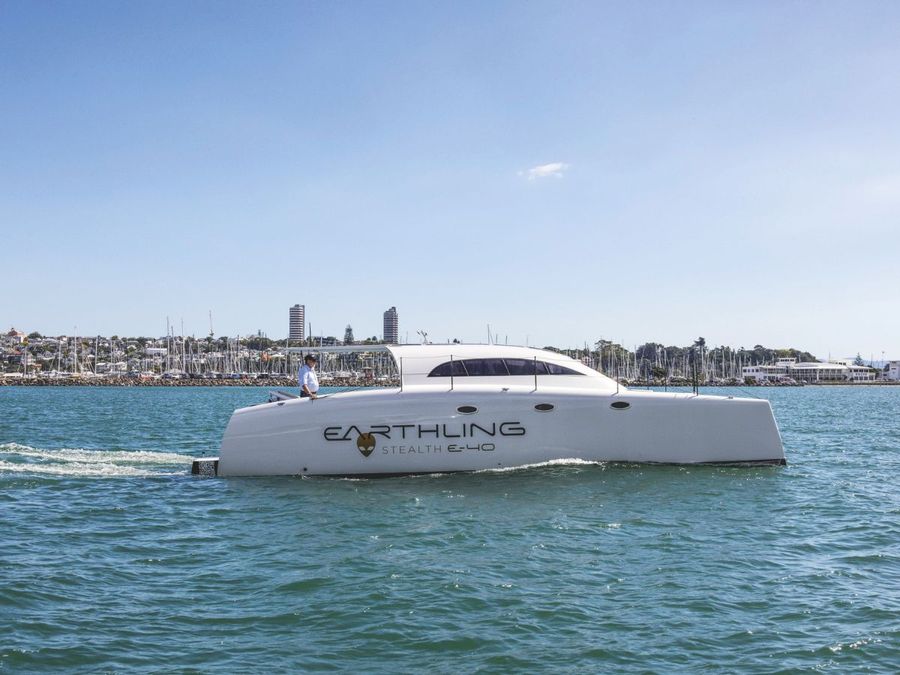
New Zealand's Earthling E 40 hybrid powercat will make its French show debut at the International Multihull Show 2026 in La Grande Motte, arriving with a systems-led approach to hybrid electric boating that distinguishes it from the concept-driven vessels that tend to dominate attention at events of this kind.
The 12-metre powercat is the work of New Zealand engineer John McGettigan, whose background spans automated industrial systems and earlier high-performance multihull development. Rather than pursuing headline performance figures, McGettigan has channelled that experience into a vessel designed for coastal and island cruising, where integrated energy management and real-world efficiency take precedence over outright speed.
Central to the Earthling E 40 is a twin Molabo electric motor installation drawing from a 45 kWh lithium battery system. A large coachroof-mounted solar array feeds energy into that bank continuously, supported by twin Whisperpower DC charge generators. Together, these allow the vessel to operate on electric power alone in harbour and on short coastal passages, while the generators support longer passage-making at around 10 knots, consuming approximately 2.5 litres of diesel per hour combined. Full redundancy is built throughout the configuration, and the outcome is near-silent operation at anchor, with low noise and minimal vibration underway.
The hulls are fine and efficient, derived from the Stealth 36 platform and built in lightweight composite materials. The complete vessel weighs approximately 3.6 tonnes, a figure that directly reduces energy demand and extends range at moderate speeds. Propulsion, energy generation, and all onboard systems are unified through a proprietary digital interface, giving crew real-time oversight and simplified, integrated control.
{{MEDIA_1}}
The Earthling E 40's appearance at La Grande Motte comes at a time when hybrid and electric propulsion is gaining real visibility across the multihull sector. The vessel brings to that conversation not a concept or a prototype, but a considered case study in efficiency-driven design, reduced emissions, and integrated energy management suited to practical cruising use.