Amphibious freedom without getting your feet wet
Few problems in recreational boating are as universally frustrating as the boat ramp. Wet feet, bogged trailers, solo launches gone wrong, the long walk back from the car park — it's a ritual most boat owners know well and few enjoy. New Zealand marine technology company Tectrax has spent years working on a better answer, and what they've arrived at is genuinely surprising: not a new boat, but an entirely new way of moving one.
Tectrax's focus has never been on hull design. From the beginning, the company has concentrated exclusively on the wheel systems that allow vessels to move between land and water under their own power. The result is an electric amphibious platform so refined that, in practice, the transition between beach and ocean barely registers as an event at all.
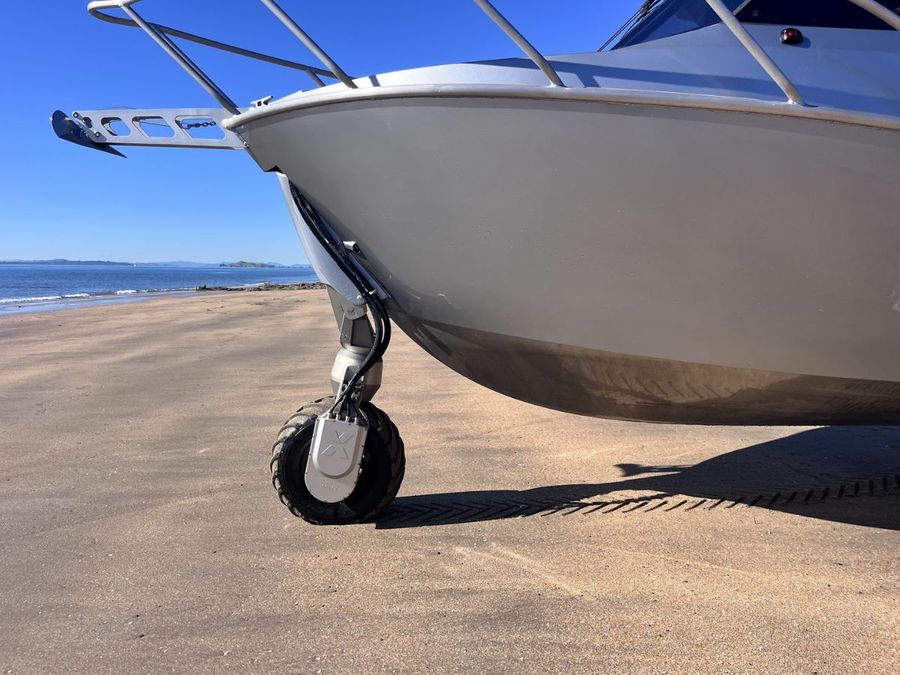
"We're not trying to be a best-in-breed boat with wheels," said Greg Macdonald, Tectrax Project Manager. "We're a best-in-suite technology platform — the wheel system can go on anything." That philosophy has now found its most ambitious expression yet.
The test day took place aboard a FlyFin 700 HTA, a plate alloy boat built in Papamoa by Fenton Marine. It's the smallest vessel the Tectrax system is fitted to, though nothing about the experience felt compromised. The ride offshore was smooth, the control interface required almost no explanation, and moving from water to land felt less like a mechanical operation and more like pressing a lift button.
The real headline, however, was what arrived on the beach alongside it.
Meet the Boat Launcher
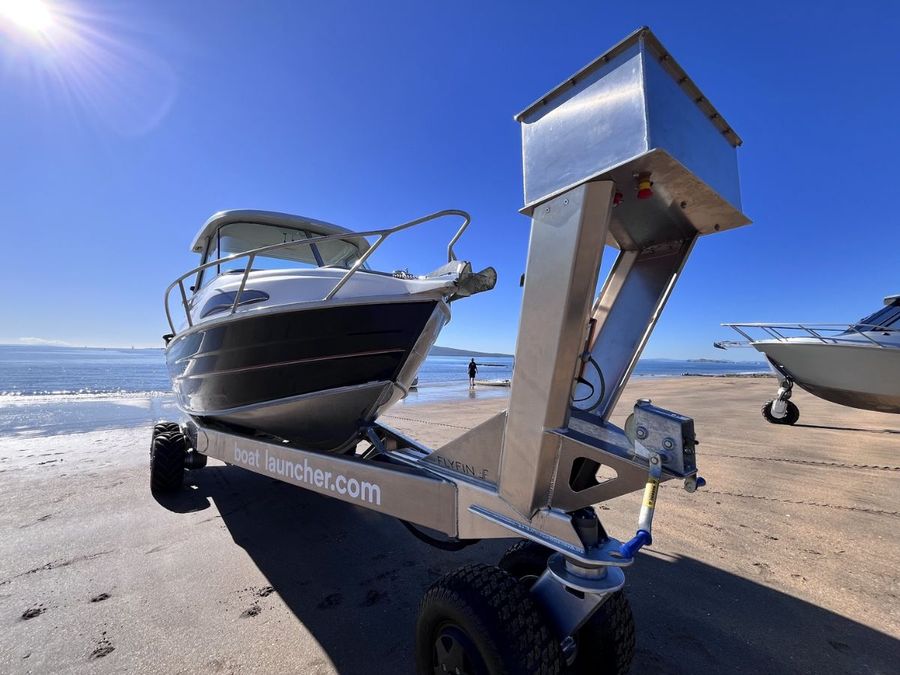
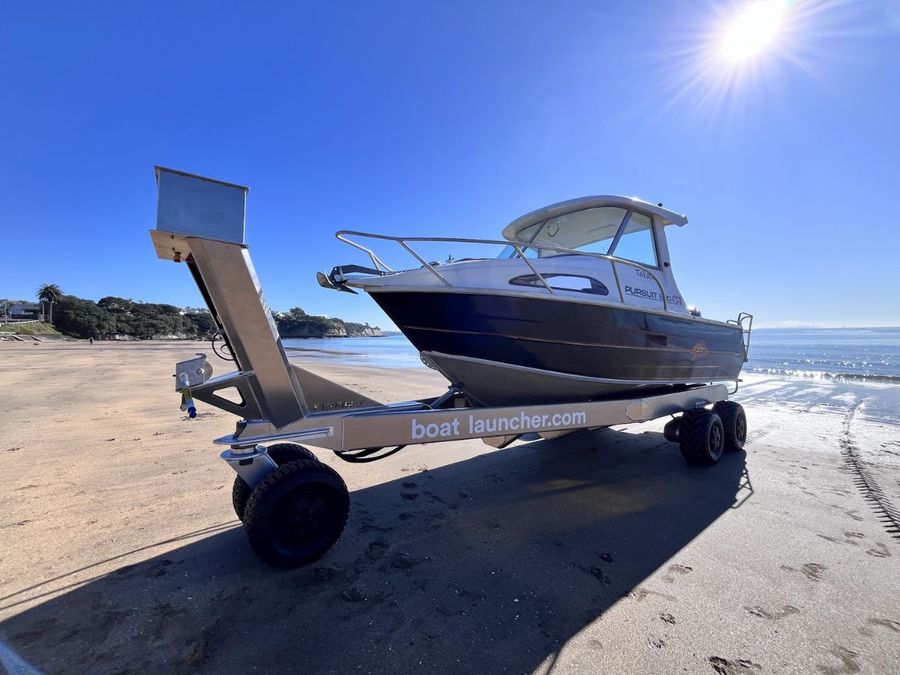
Tectrax's newest creation is an autonomous, remote-controlled amphibious trailer the company calls the Boat Launcher, and it reframes the question of who can benefit from amphibious technology entirely.
Consider the standard trailer boat launch. You reverse the vehicle and trailer down the ramp, trying to read the gradient, avoid soft sand, and stay out of the deeper water. Someone has to get out, guide the boat off, wade it to a depth where it floats freely, then tie it off before trudging back ashore. The driver parks the vehicle, walks back down to the water, and climbs in. At the end of the day, the whole sequence runs in reverse, usually when everyone is sunburnt and tired and the tide has shifted.
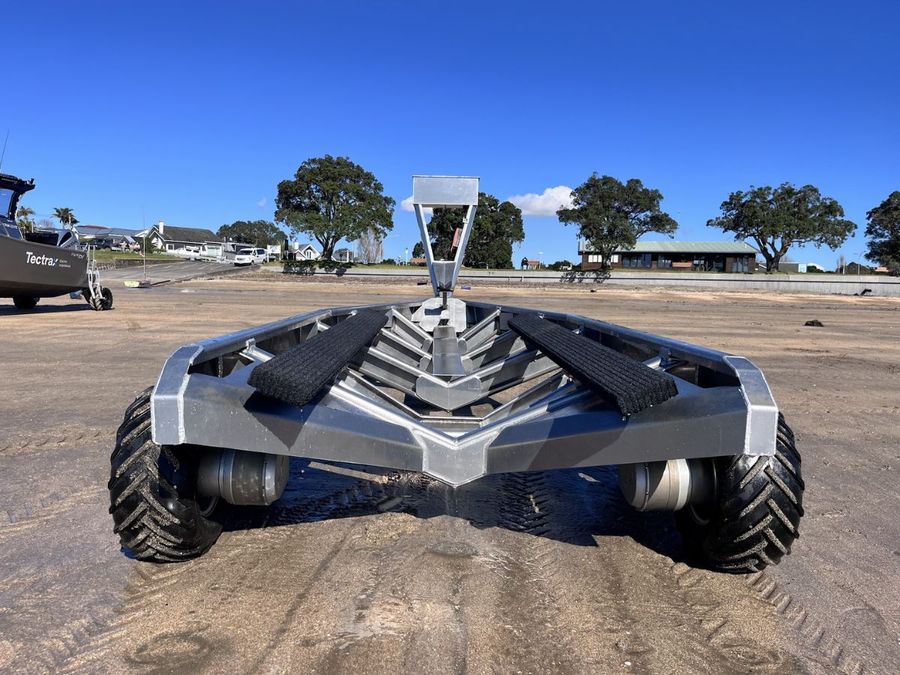
The Boat Launcher replaces that sequence entirely. It is a self-propelled trailer system that the boat owner operates by remote control from the helm. While you wait on the water, you navigate the trailer from its parking spot, across the beach, and into the shallows. Once it is submerged to the right depth, you motor your boat onto the cradle, press a button, and the trailer carries everything back to dry land. Nobody gets wet. Nothing gets bogged.
The appeal goes beyond convenience. Because the Boat Launcher works with any vessel, owners are free to choose whatever hull suits them best on the water, without making any structural modifications. Amphibious boats built with integrated wheels involve design compromises from the outset. This system adds the same land-side freedom, beach launching, ramp independence, no marina fees, to a boat that was built purely with water performance in mind.
Each leg of the Boat Launcher is driven by an electric motor, and the steering and drive systems are entirely electric. There are no hydraulic lines, no oil to top up, and nothing that requires particularly specialised servicing. GPS and onboard sensors allow the trailer to be driven and parked from up to 500 metres away, which means the owner remains dry and in command throughout the entire process.
Built for real-world boating
The demonstration took place at Narrow Neck Beach. Under remote control, the Boat Launcher rolled steadily into the water, held position as the boat motored aboard, then carried everything back up the beach and parked cleanly beside another rig. It is the kind of technology that prompts an immediate question: why has this taken so long?
The vessel used for the Tectrax demo fleet is an older-style Fyran, while the FlyFin 700 HTA represents the current generation of partner boats. FlyFin builds plate alloy hulls that are rugged, well-balanced, and finished to a high standard by Nick Fenton's team in Papamoa, operating under the Fenton Marine umbrella. FlyFin also manufactures the chassis for the Boat Launcher itself. The welds are clean, the components feel deliberately over-engineered, and the whole system carries the kind of solidity that inspires confidence before you even put it in the water.
Tectrax is clear-eyed about who this technology is for. The customer base includes older boaters, people with limited mobility, and beachfront property owners who want to keep using their boats without the physical demands of conventional launching. As one customer put it to the Tectrax team, the system had given them "another 15 years of boating." That kind of feedback shapes the development priorities as much as any engineering brief.
Engineered from the ground up
The current generation of the Tectrax system, referred to internally as Gen 2, was a clean-sheet redesign rather than an evolution of the original. Hydraulic pumps, fluid lines, and steering arms were removed entirely. In their place, each wheel is powered by an individual electric motor with high-torque gearing, delivering faster deployment, a tighter turning radius, and substantially reduced maintenance requirements. The legs lock solidly into position with no sagging or leaking, and the boat can be stored ashore without cradles.
All functions are managed through a small control screen and joystick. Battery charge, leg deployment, stowage, and manual height adjustment for levelling on uneven ground are all accessible at a glance. Cruise control and auto-launch functions are currently in development, with both scheduled to be available soon.
Power comes from a bank of three lithium batteries housed beneath the seats, with an optional fourth available. Charging can be done from shore power, solar panels, or the outboard's alternator. Over the course of a multi-hour test that included an offshore run, a beach exit, and the full Boat Launcher demonstration, the system consumed just four percent of battery capacity.
Designed, built, and supported in New Zealand
The Tectrax system is developed and supported entirely within New Zealand, with most of the engineering and programming completed in-house. The company works closely with ZeroJet on electric motor and battery integration, pairing Tectrax's amphibious expertise with ZeroJet's electric propulsion knowledge.
Where some competitors have taken an incremental approach by replacing combustion-driven hydraulic pumps with electric equivalents, Tectrax built its system as fully electric from the beginning. The absence of oil, fumes, warm-up time, and mechanical noise is immediately noticeable. The FlyFin 700 HTA's Honda 250 outboard handled propulsion on the water, but once ashore the Tectrax system moved everything quietly and without fuss.
Production coming very soon
The Boat Launcher moves into production in September, with early units already spoken for by buyers who committed following the Hutchwilco Boat Show. Several variants are planned, including heavy-duty versions with tracks in place of wheels for steeper gradients or softer terrain. The underlying idea, however, stays constant: genuine amphibious freedom for any boat, without asking the owner to compromise on the vessel itself.
Tectrax builds no boats. What they have built is one of the most practical ways yet devised to move them between land and sea.