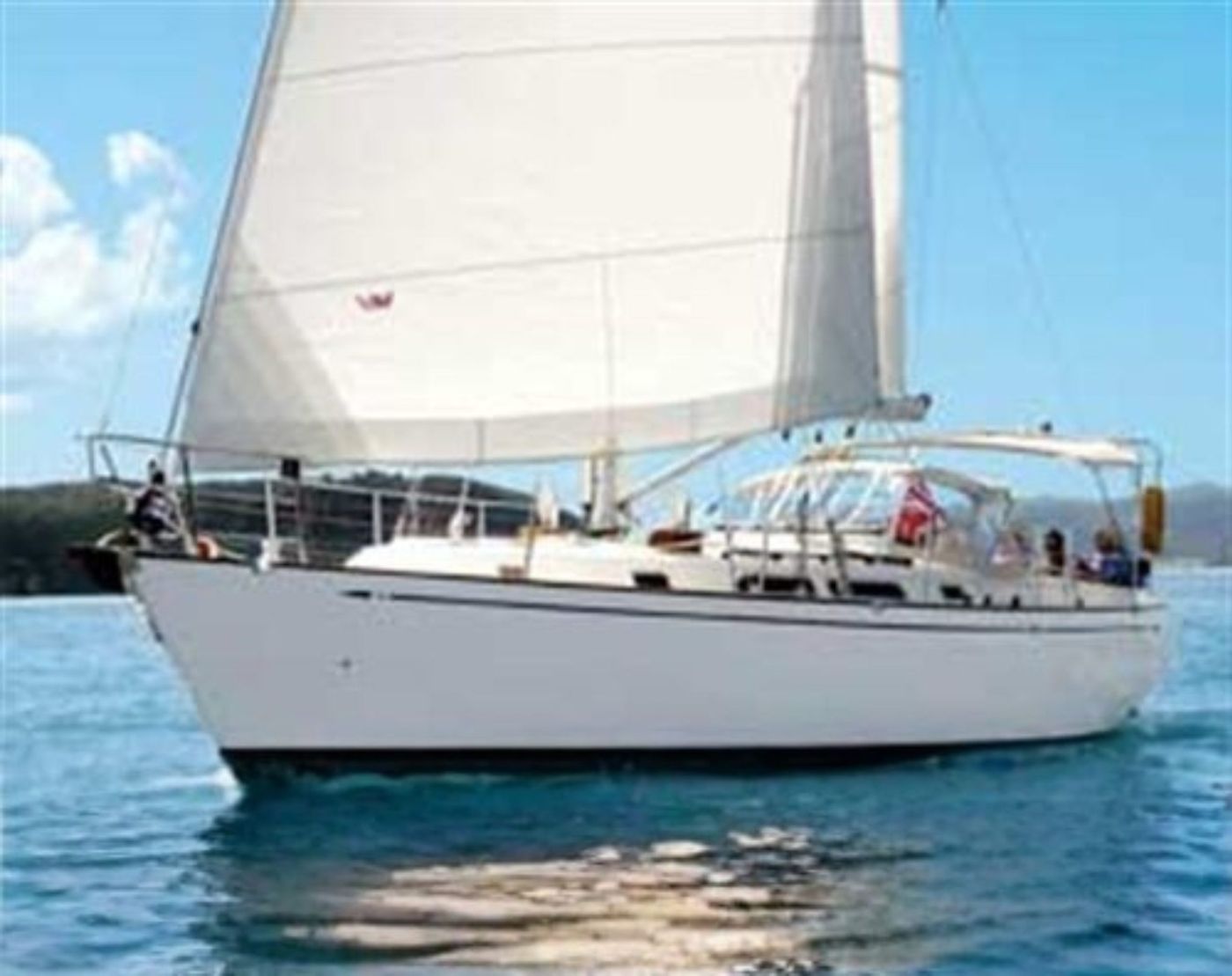
Three and a half years of dedicated work by John and Kate Driver produced Diva, a hand-built 13.5-metre timber cutter designed by Angelo Lavranos. Drawing on the warmth of traditional wooden boatbuilding while embracing modern construction technology, Diva is exactly the kind of vessel that explains why the launch of a new wooden boat was once considered a genuine occasion. Lindsay Wright went to meet her.
Before fibreglass changed everything, the completion of a handcrafted wooden yacht was reason enough to make a journey. Diva revives that sense of occasion.
The story begins with Concerto, the Drivers' previous boat, a Raven 26 hull fitted with a timber deck and cabin. She had served them faithfully for 24 years, including a passage to Fiji, and through her they came to understand exactly what a cruising yacht should be. John's relationship with boats went back much further, though. "My first boat was a 23 foot (7.1m) JOG boat I built in New Plymouth as a teenager," he recalls, "and our Christmas cruises were down to the Marlborough Sounds and back. After the 1967 Noumea race, a trans-Tasman delivery in a Falmouth Quay punt followed, and trips around the Pacific Islands, as far north as Hawaii." By the time the Drivers began thinking seriously about a new build, they had decades of hard-won cruising experience to draw on.
John and Kate's partnership had its own nautical origins. The 1980 Two-Handed Round North Island race brought them together: John was crewing for Martin Foster while Kate was working on the administrative side of the event. Their personal and sailing partnership grew from there, and the shared experience accumulated over the following years would eventually inform every decision made in the design and build of Diva.
John had long admired the Swans produced by Finnish yard Nautor, and found himself reasoning that there was no cause why he couldn't build something of comparable quality himself. Several early Swans had originated at Sparkman and Stephens, and Angelo Lavranos, a former S&S designer, was the natural choice when the Drivers began looking for someone to draw their new boat. There was already a connection. "I'd already met Angelo while we were building another one of his designs, Wizard, at Kevin Johnson Boatbuilders," John explains. "He's wonderful to deal with. We wanted a powerful, moderate displacement boat that sailed well to windward and performed well in light airs. She had to be comfortable in all conditions and have good internal volume. Angelo really listened to what we wanted and came up with exactly the boat. He's used to dealing with big projects, big factories building hundreds of production boats, but he was just as helpful to a modest Kiwi couple like us building our own cruising boat. In fact, his interest throughout the project was wonderfully encouraging."
While Kate maintained her role as PA with a leading New Zealand-owned fund manager throughout the build, John gave himself to the project completely, working full time from the back of Kevin Johnson's workshop. Lavranos supplied computer-generated mylar patterns for nine bulkheads, which could be cut directly from scarfed sheets of 18mm Meranti plywood and stood up as formers to shape the hull. The planking is clear Fijian kauri in 40 x 25mm strips with convex and concave edges, epoxy glued and fastened with silicon bronze boat nails. "There are two woods I really love, kauri and teak," says John. "They both have that rich, golden glow, and we wanted the hull planking visible inside the boat."
The keelson was built up from five 20mm laminations of kauri, tapered fore and aft, with an additional 100mm formed in a keel stub outside the hull. Nineteen 25mm diameter stainless steel keel bolts secure it to the four-tonne lead bulb at the bottom of Diva's 1.8-metre draught.
At around the twelve-month mark, with the hull well advanced, a layer of 850gm triaxial glass was applied to the outside, followed by a skin of 650gm kevlar and then six-ounce boat cloth for abrasion resistance, all set in epoxy resin. A further layer of 850gm triaxial cloth was added to the inside. "I spent hours in the bilges," John admits with a rueful grin. The care taken at every stage shows throughout the finished boat, the natural result of a vessel being built by the people who intend to sail her.
With the hull turned right way up, kahikatea deck beams were fitted to carry the plywood decks and cabin sides. The cabin top was laid up from a 9mm ply base, 25mm of high-density foam and a final 6mm ply skin with six-ounce boat cloth epoxied over the whole assembly. An 18mm gap between the cabin top and the deckhead liner provides both a wiring run and a useful layer of insulation. Laminated kauri floors were worked into the hull form, joinery began taking shape between the bulkheads, and a solid mast step was laminated from Iroko hardwood to handle the considerable loads the rig would generate.
At the eighteen-month point came an unexpected complication. The Devonport workshop where Diva had been taking shape was needed for another Lavranos project, Oddyseus. Hull and decks were trucked north to Gulf Harbour at Whangaparoa, a plastic horticultural shed was erected over them, and a friend's Lilliput caravan was borrowed. The Drivers moved in alongside the boat, with John's machinery relocated with them. Work on the balanced spade rudder continued in the new surroundings: it was built on a stainless steel web, constructed from 18mm laminated plywood layers, shaped and covered in triaxial glass with kevlar protecting the leading edge and toe. An 89mm diameter solid stainless steel stock manages the steering loads.
The pace never let up. "We were both working a seven-day week, the only way to get it done," says Kate. "We might have seemed rude to our visitors at times. But every hour counted for a one-man boatbuilding outfit and his project-managing wife."
Inside Diva's 4.2-metre beam, teak joinery filled the interior steadily. A double bunk occupies the port side of the forepeak, with standing room and a seat alongside. Moving aft, a large head and shower compartment finished in gleaming white reaction lacquer is fitted with a Lavac toilet and hand basin. A second, open-air shower is positioned on the aft platform.
The standard of craftsmanship throughout is exceptional. Timber grain flows continuously from fitting to fitting in a warm, unbroken sweep. The teak dining table commands the saloon, flanked by a horseshoe-shaped seat outboard and a centreline settee, with the whole arrangement comfortably seating six for dinner. To starboard, a settee and aft-facing chart table carry what John regards as a sensible electronics fit: sounder, sailing instruments, GPS and VHF radio. "I'm a bit of a traditionalist in that area," he says. "Having started with a sextant, I'm still wrapping my head around using the GPS. But it's pretty amazing."
A spacious double cabin sits under the cockpit to starboard. The port-side galley centres on a Broadwater Cutter gas stove, with an Isotherm 12-volt fridge and a separate freezer keeping provisions well-ordered. Fresh water is stored in two tanks flanking the saloon, totalling 1,000 litres, with a further 40 litres held in the engine exhaust hot water system.
Every aspect of the cockpit arrangement reflects the Drivers' cruising background. A large locker to port stows spare sails and deck gear and also houses a workbench with vice and ready access to the engine space. Watertight lockers surround the cockpit, and aft to starboard a ventilated vegetable locker keeps fresh produce in good condition at sea. The instrument panel, positioned ahead of the Suunto compass, swivels to face either side of the steering wheel. Steering is by a Whitlock King Cobra mechanical system that delivers lock-to-lock response in 1.5 turns, which John describes as extremely reliable and positive.
Engine selection followed careful research. The Drivers chose a Nanni/Kubota 5.280HE diesel. "We liked the fact that it's naturally aspirated, a good straightforward engine," says John. The installation includes a 130-amp alternator to complement two 90-watt solar panels mounted on the arch. The five-cylinder unit produces 62 horsepower (46.2kW), turning a 300mm three-bladed Maxprop through a 2:1 Hurth hydraulic gearbox. Fuel moves from a 300-litre tank in the fin keel to a 130-litre day tank and passes through matched Racor filter and water traps before reaching the engine. At a gentle 1,400rpm, Diva settles to around six knots.
The rig is a 17.5-metre Selden twin-spreader configuration, deck-stepped, supplied by Nordic and paired with Andersen winches and a Furlex furler. A cruising sail inventory was made at Simon Willis's loft in Kerikeri. Stepping the mast became a milestone in itself. "We worked really hard to get the mast ready to step on John's 50th birthday," says Kate. "That was a milestone."
On 24 July, three and a half years after those first conversations with Lavranos, Diva entered the water for the first time and settled precisely on her design waterline. Fitting out and sea trials continued at the marina berth before, in January, Diva spread her sails on a maiden cruise through the Hauraki Gulf and on to her home waters in the Bay of Islands.
Asked whether they would tackle such a project again, John doesn't pause long before answering. "Weelll, no," he says emphatically. "After all the hard work, we are just thrilled to have a boat which meets all the criteria we set out, and we just want to get on with sailing and enjoying Diva with all our wonderful friends who've helped, supported and encouraged us throughout the project. Not least, Angelo, and Kevin and Sue Johnson."
There is plenty of sea ahead for John and Kate Driver and Diva.
Diva Specifications
LOA: 13.5m DWL: 11.2m Beam: 4.2m Draught: 1.8m Engine: Nanni/Kubota 46.2kW 62hp Speed: 6 knots @ 1,400rpm Sail area, Mainsail: 41m² Light genoa: 70m² Furler genoa: 55m² Staysail: 23m² Gennaker: 143m²