Kevin Dibley's name is probably not the first that comes to mind when New Zealand boaties think of lobster boats, but the Auckland designer has spent years quietly reimagining one of America's most distinctive watercraft traditions for local waters. His Dibley Picnic Boats, a family spanning four designs from 25 feet to 52, draw their DNA from East Coast USA lobster boats and translate that heritage into something unmistakably Kiwi.
The lineage connects back to the Hinckley Picnic Boat, which caused a stir in the day-boat world when it arrived in 1994, combining lobster-boat sheerlines, jet-drive handling, and yacht-grade fit-out. Rare in New Zealand, it nonetheless caught Dibley's attention and set him thinking about what a homegrown version might look like, built for New Zealand waters and the way New Zealanders actually use their boats.
The P25: where the idea took shape
The range began with the P25, commissioned in 2008 by South Island yachtsman Lawrence Heath and built by Cresta Boats in Christchurch. Measuring just over seven metres, the P25 wore the curves of a 1920s runabout on a thoroughly modern hull. Part of its aesthetic reach came from an early twentieth-century design that Uffa Fox created as his own personal runabout, used on the waters around Cowes on the Isle of Wight.
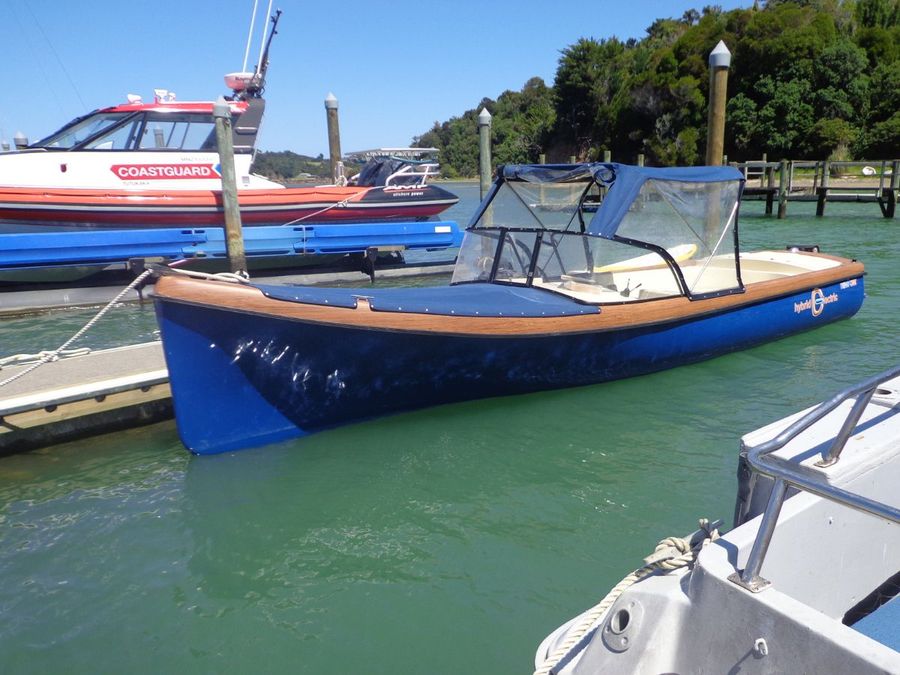
Heath put the P25 to work exploring lakes and coastal anchorages over a number of years before selling the boat to John McGettigan, who later converted her to full electric propulsion. McGettigan went on to establish his own electric powerboat company, the same operation that produced Earthling, the E-40 Powercat profiled in Boating NZ. From a petrol-powered classic to a fully electric vessel, the P25 story shows how adaptable the Picnic Boat concept really is. The aesthetic stays intact whatever powers it; the experience of simple, sociable time on the water remains unchanged.
The 28 Weekender: a personal project takes shape
The newest chapter in the Dibley Picnic Boat story belongs to Tim Lynch-Blosse, a former professional boatbuilder who later worked alongside Team New Zealand and Southern Spars. He commissioned the Dibley 28 Weekender for himself and his family, and is now well into the build.
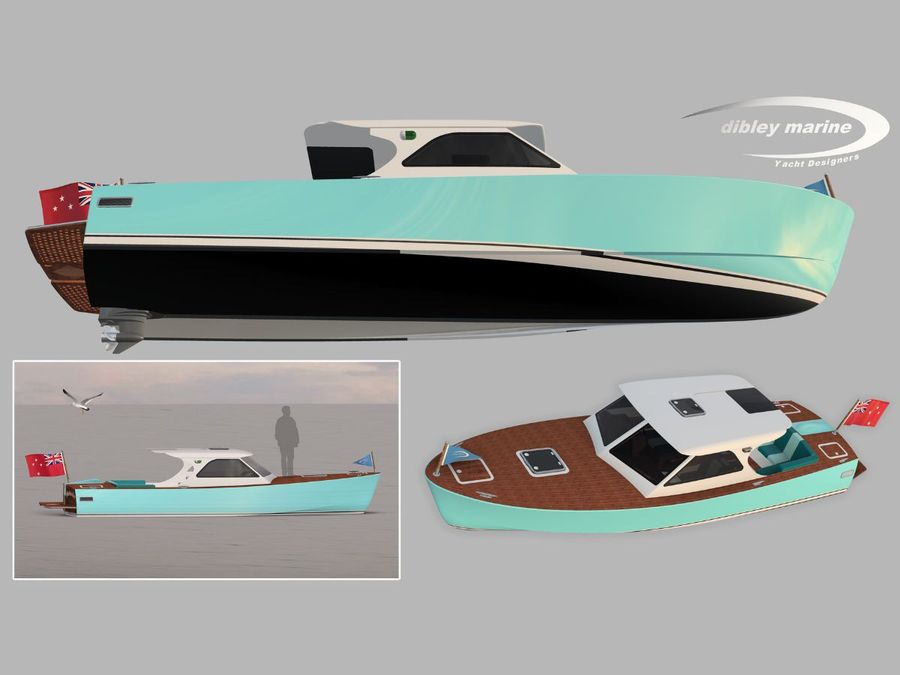
Work is still at an early stage. Hull frames have been cut by James Gell at Carbon Concepts in Tauranga, with further kitset components to follow. Lynch-Blosse is treating the project as a part-time build, with a timeline of somewhere between six and twelve months depending on how consistently he can focus on it.
The driving idea behind the 28 was simplicity in its purest form.
“This boat has been a fantastic collaboration between myself and Kevin. The boat truly reflects the word ‘picnic’. I wanted absolute simplicity. Lightweight, easily driven, and above all a boat you couldn’t stop looking at.” — Tim Lynch-Blosse
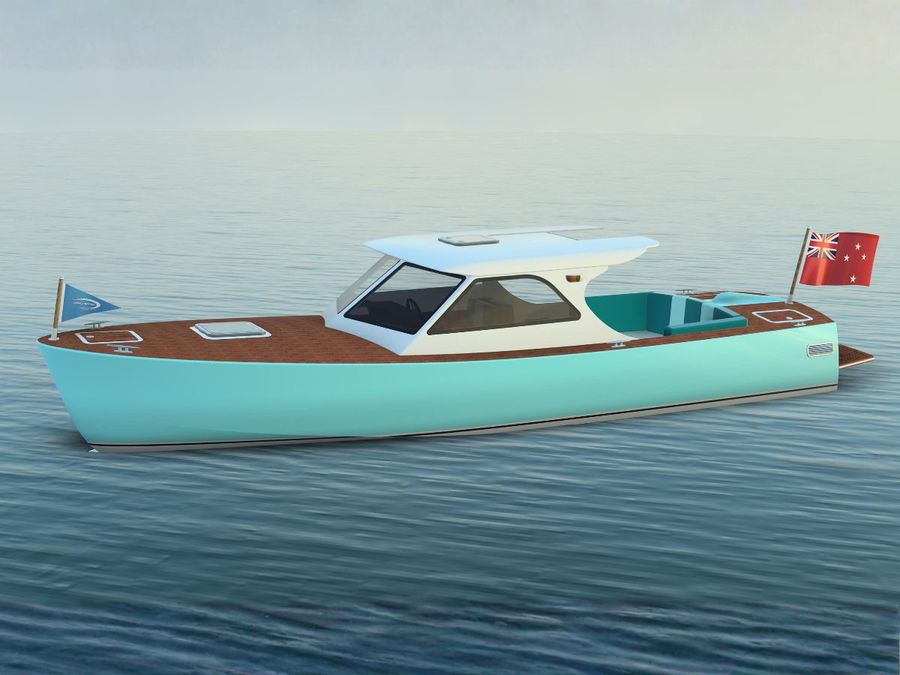
Intended for day trips and short weekends on Auckland's Waitematā Harbour and the Hauraki Gulf, the 28 Weekender draws its power from a concealed outboard, though inboard and jet configurations are also possible. With a lightship weight of just 900kg, performance is brisk, with a top speed of 23 knots available from 90 horsepower.
Dibley describes it as a "yachtsman's launch", a craft that borrows the elegance of classic runabout styling and delivers it in ply and glass construction, which opens the door to kitset building for those with the skills and the time. It looks as though it belongs to another era while handling entirely like a twenty-first-century vessel.
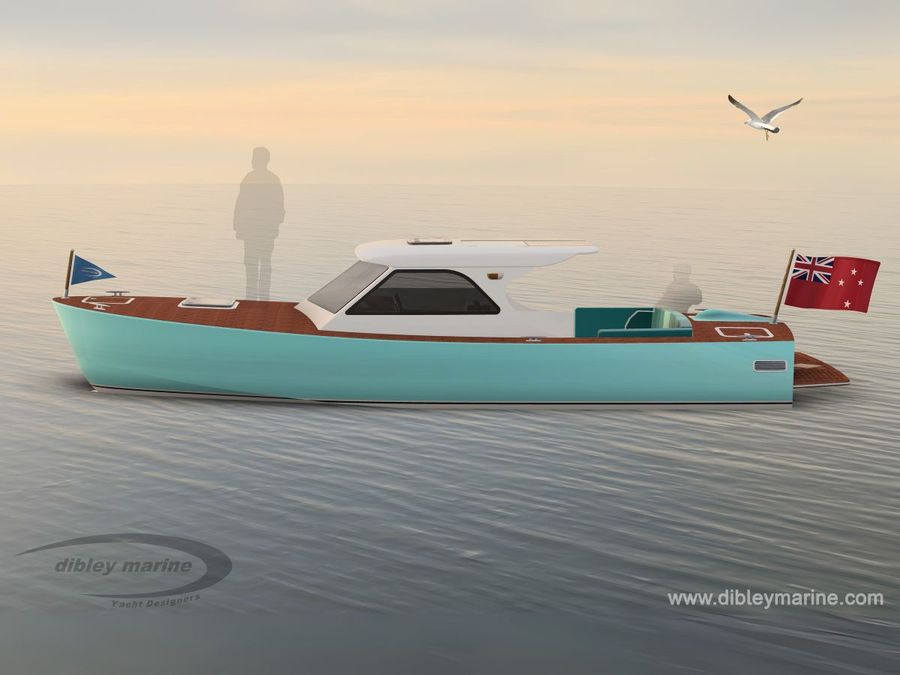
The 35 Weekender: tradition meets performance
Sitting between the compact 28 and the ambitious 52 is the Dibley 35 Weekender, a design conceived for owners who wanted something quick, comfortable, and classically proportioned. It carries the same blend of old-world looks and contemporary performance that defines the broader range, but at a scale that opens up genuine coastal capability.
A moderately deep-V hull, wide chine flats, and a restrained beam-to-length ratio work together to produce a settled, confidence-inspiring ride offshore. A single 315-horsepower jet drive sits at the heart of the powertrain, delivering a comfortable cruising speed of 25 knots and a top end of 35 knots.
Versatility is central to every layout option. Owners can choose between open social configurations and enclosed saloon arrangements, and most include a forward V-berth for two alongside a convertible saloon table that forms a second double berth. For rougher days, clears fitted aft of the saloon provide shelter, while the aft entertaining area offers barbecue options, flexible seating, and a boarding platform to make dinghy access straightforward.
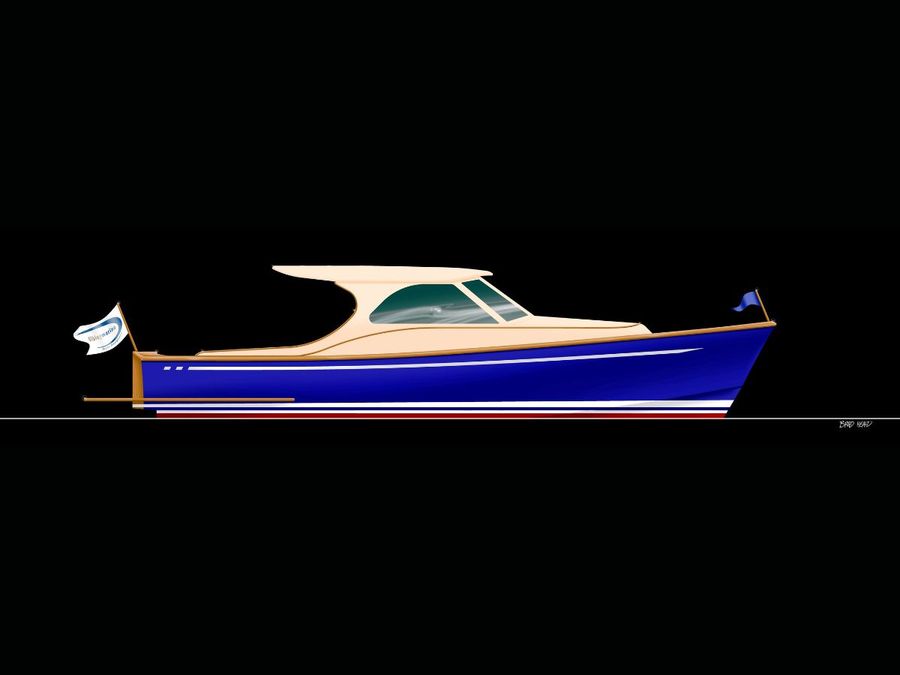
Jet propulsion is what makes the 35 Weekender genuinely useful across a wide range of destinations. Bays and harbours that traditional prop-driven launches cannot easily reach become accessible, and that freedom to explore sits neatly within Dibley's philosophy for the range.
The 52 Weekender: the grand ambition
The largest design in the family is the Dibley 52 Weekender, drawn up for an Auckland couple with Bay of Islands cruising in mind. Speed and seaworthiness were the twin priorities, and the specified construction, Kevlar and advanced E-glass laminates engineered by structural specialists High Modulus, would have made for a high-tech build with a projected top speed of 34 knots.
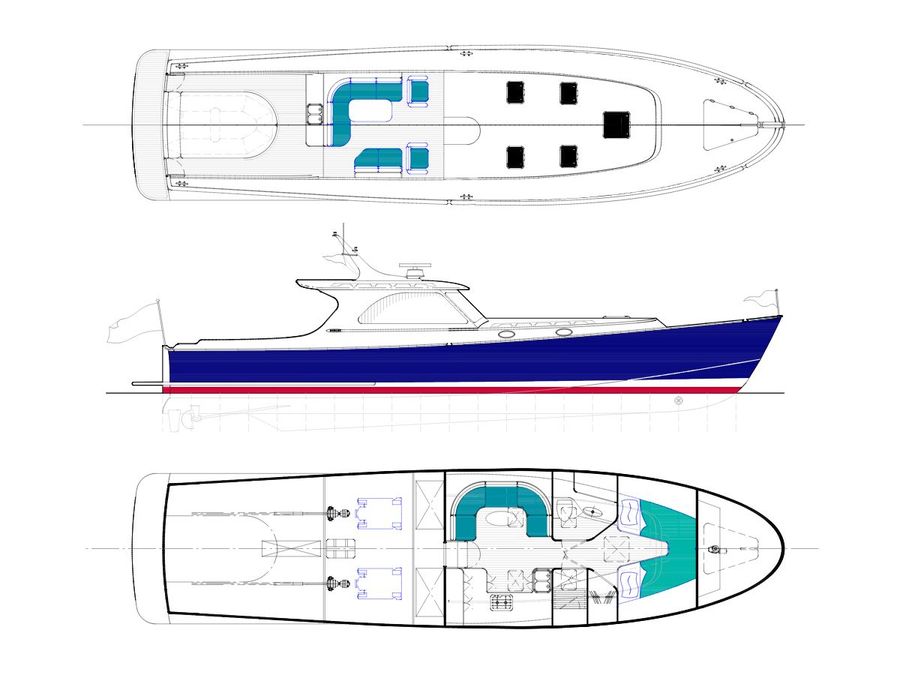
The original brief favoured a single-cabin layout, with two-cabin options and jet drive propulsion also on the table. In the end the 52 never progressed beyond the design stage. The clients chose a larger hull instead, a path that led to the Dibley-modified Salthouse-built Havana. Even so, the 52 design survives as a clear illustration of how far the Picnic Boat idea can be scaled without losing its essential character.
Custom design, Kiwi ethos
One of the things that separates the Dibley Picnic Boats from their American counterparts is how precisely each one is shaped around its owner's needs.
“All our designs are custom or at least semi-custom. We can customise pretty much everything from build material, layouts, propulsion — jet, outboard, inboard, electric — and everything in between.” — Kevin Dibley
The approach is also rooted in the way New Zealanders use their boats. In the United States, the enclosed cabin is almost a requirement, a refuge from cold and rain. In New Zealand, the calculus is different.
“In NZ we spend more time in the cockpit, so that had to be a consideration. We style with a nod to the past but give them a Kiwi twist, smoothing the cockpit–interior flow.” — Kevin Dibley
The designer's philosophy
For Dibley, the Picnic Boat is as much about a way of living as it is about naval architecture.
“The Picnic Boat brings back the simplicity of bygone days — gunkholing up small creeks, meandering from bay to bay, spending nights in coves. The idea is for our owners to leave work on a Friday and be tucked up in a bay just a couple of hours later. Turnkey simplicity.” — Kevin Dibley
He is candid about the influence of Hinckley and the lobster-boat tradition, but equally clear that the Kiwi interpretation has developed its own character over time. The connection to Hinckley goes back further than many might expect. In the 1990s, the American company actually wrote to Dibley asserting rights over the style. His response to that episode is characteristically understated. "I felt the letter was a compliment in some ways," he says with a smile.
A niche with real appeal
For now, the Picnic Boat occupies a narrow corner of the New Zealand market. The pool of home builders willing to take on a project of this nature is modest, and professional builds carry costs that put them out of reach for most. Dibley is open about the current situation: beyond Lynch-Blosse's 28 Weekender, there are no new Picnic commissions on the books. Economic conditions have seen to that.
Yet scarcity may be precisely what gives these boats their appeal. Each one is personal, shaped by its owner's intentions, finished with care, and destined for evenings at anchor with the hills fading into dusk and little pressing need to be anywhere else.
From the P25 that launched the range in Christchurch to the 28 Weekender taking shape in a Tauranga workshop, from the capable 35 to the unrealised ambition of the 52, the Dibley Picnic Boats trace a consistent line. A global idea absorbed and reinterpreted through a local lens, producing boats that reward simplicity, celebrate beauty, and make a quiet case for spending more time afloat.
A Dibley on the Waitematā or nosing into a Bay of Islands anchorage is more than a day boat. It carries the same spirit that animates a Hinckley in Maine: the conviction that time on the water, kept simple and done well, is among the finer things available to those lucky enough to pursue it.
“The Picnic Boat captures the spirit of simpler times — gunkholing quietly up creeks and into hidden bays, meandering from place to place and spending the night in a sheltered cove. It’s about keeping boating effortless, just as Tim described. The idea is that you can leave work on a Friday and, a couple of hours later, be anchored in a favourite bay, everything ready to go — true turnkey simplicity.” — Kevin Dibley