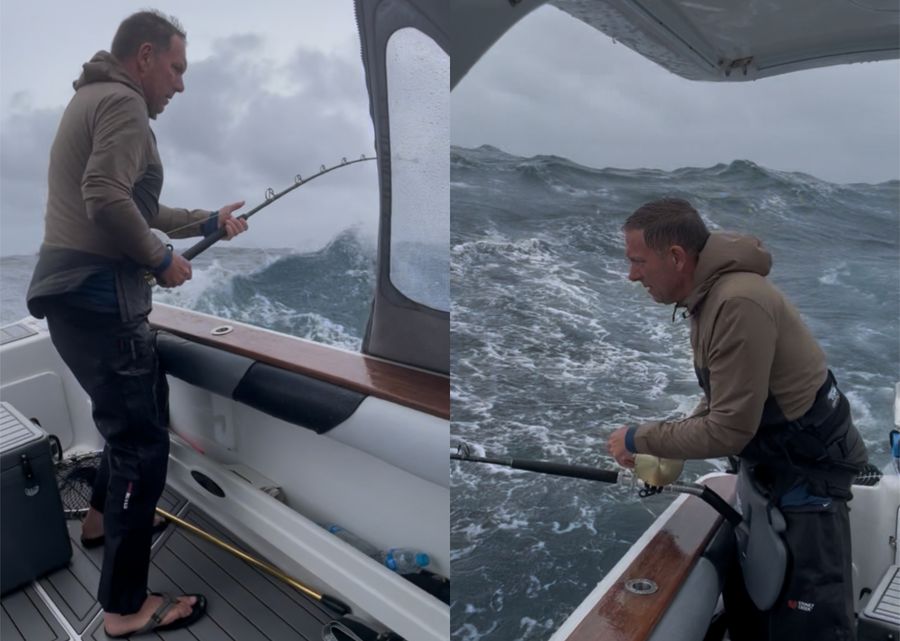
Sorting your tackle before you head out can save you from becoming the next hard-luck story at the boat ramp.
January is, for many anglers, the most maddening month on the water, and the reasons behind it are less obvious than you might expect.
Contrary to popular belief, snapper do not release all their spawn in a single event. When conditions are favourable, they release a portion and then hold the remainder, depositing it later. This staged approach is nature's insurance policy for the species. A sudden storm or a sharp drop in water temperature can wipe out a spawn release, since the eggs drift at the surface for roughly fifty-four days before juvenile snapper descend to the seafloor.
Once snapper have spawned, they feed aggressively as they rebuild condition, but those still holding spawn can be stubbornly reluctant to bite. One boat comes home with a limit while another, anchored just a few miles away, can barely buy a strike. Fresh bait is always the starting point, and getting the kids involved with flasher rigs, either from the boat or off a nearby wharf, turns a slow session into time well spent with the family. When fish are clearly showing on the sounder but nothing is taking, a steady stream of burley and ground bait will often coax them into feeding at some point during the tide. Start with small offerings. Snapper will readily pick at tiny pieces of ground bait but tend to ignore large baits entirely. Small recurve hooks, with a bait floated down slowly through the water column, will tempt bigger fish rising off the bottom for a snack before drifting away, only to find themselves hooked in the process. It also pays to toss a larger bait well astern, something like a butterflied jack macks. Small fish will work away at the flesh, and their activity has a way of drawing something considerably larger in to take it from them.
When rough weather keeps the boat on the trailer, that is the perfect moment to ask yourself honestly: when did you last go through all your gear and confirm it was genuinely ready to use?
Most fishing tackle spends the bulk of its life sitting untouched in a boat or a garage. It rarely gets a second thought until the moment you are out on the water, connected to the fish of a lifetime, and the line parts because something failed that you knew you should have checked. Even when anglers know perfectly well the fault lies with their own neglect, most will still mutter something about the manufacturer rather than admit the gear simply was not looked after, offering explanations along the lines of "I only used it a couple of times last year."
The marine environment is ruthless on equipment. A single grain of salt left on a reel will quietly do damage over time. Saltwater is carried back onto the spool with every retrieve, and as the line dries it crystallises, turning abrasive and steadily degrading the line's strength. The well-known phenomenon of "smoking reels" during a game-fishing run is a good illustration of this: as line is stripped from the spool at speed, crystallised salt embedded in it is released, creating the impression that the reel itself is on fire.
It took the school of hard knocks to change old habits. Years of bust-offs caused by sticky drags and deteriorated nylon eventually produced a simple routine followed after every trip on the water.
The process starts with a light spray over all the rods to loosen any baked-on bait or scales. Working down from the rod tip with a wet soapy cloth, each rod blank and every guide gets a thorough wipe. The guides deserve as much attention as the reel does, and doing them properly adds only a few minutes. Salt accumulates around the base of each guide and works its way under the binding, setting up hidden corrosion that eventually causes the guide to fail under load or after a knock.
Rod grips collect a layer of slime that hardens when dry, and the build-up makes them dangerously slippery in wet conditions. Heavy accumulation can be reduced with a light sanding, but the better approach is a proper scrub after every outing. Even during holidays when the rods are in use every day, a cleaning session each evening at rum o'clock keeps things in order.
The single most overlooked step when putting gear away after a wash is backing off the drags on every reel. Drag washers compress and harden when left under pressure, and the result is a drag that runs unevenly, with line jerking and sticking rather than flowing smoothly, which leads directly to bust-offs. One useful technique before setting the drag is to turn the reel handle a few times while holding the spool stationary, working out any stiff spots and warming up the drag system before the line is put under load.
Once everything is dry, a light application of Tackle Guard over both the guides and the reels will protect them going forward, applied carefully to avoid getting it on the nylon.
The only thing standing between an angler and the fish is the line itself, and it is the cheapest part of the whole day on the water. Lines develop small kinks over time. Nylon is damaged in ways that go unnoticed, whether from dragging across rocks or kelp, from sinkers sliding along it, or from a running fish using its tail to abrade the line as it thrashes and pulls. Kingfish are particularly effective at this.
Before every session, strip off at least a metre of line and run the next few metres through your fingers to check for damage. After breaking off on the bottom, where pulling the line to breaking point thins and weakens it for at least a metre back from the break by fifty per cent, this step becomes non-negotiable. Tying a hook directly at the break without first cutting back that weakened section is an invitation to lose the next good fish.
Over a lifetime of fishing, being spooled has happened only twice, yet watching it happen to others has been a regular occurrence, and in ninety per cent of those cases the cause was simply insufficient line on the spool. The last hundred metres of line is almost never used in practice, so a full re-spool is rarely necessary. A "top shot" does the job: leave that final hundred metres in place and tie on another two hundred and fifty metres of fresh line on top. When a large fish is taking line and the join between old and new nylon approaches the rod tip, ease off and play the fish patiently until the knot is safely back on the spool.
Keeping the spool genuinely full, particularly on fixed-spool or eggbeater reels, provides more line to work with and delivers a practical bonus: a full spool allows casts to travel thirty per cent further, with noticeably better accuracy in placing the bait exactly where it needs to land.
A little time spent on maintenance and honest self-assessment means you get to fish, rather than stand at the ramp explaining what went wrong.