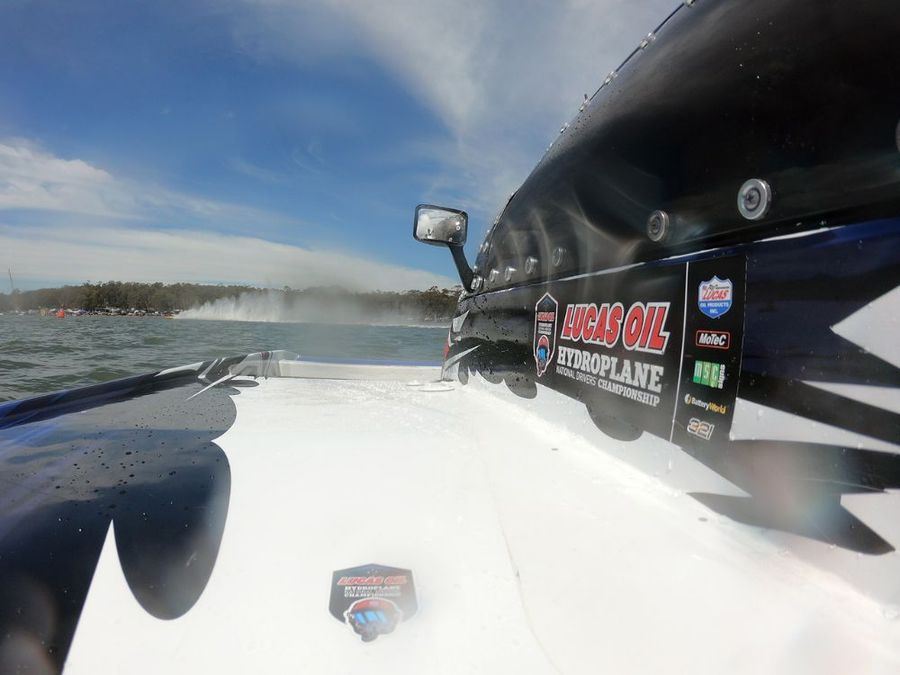
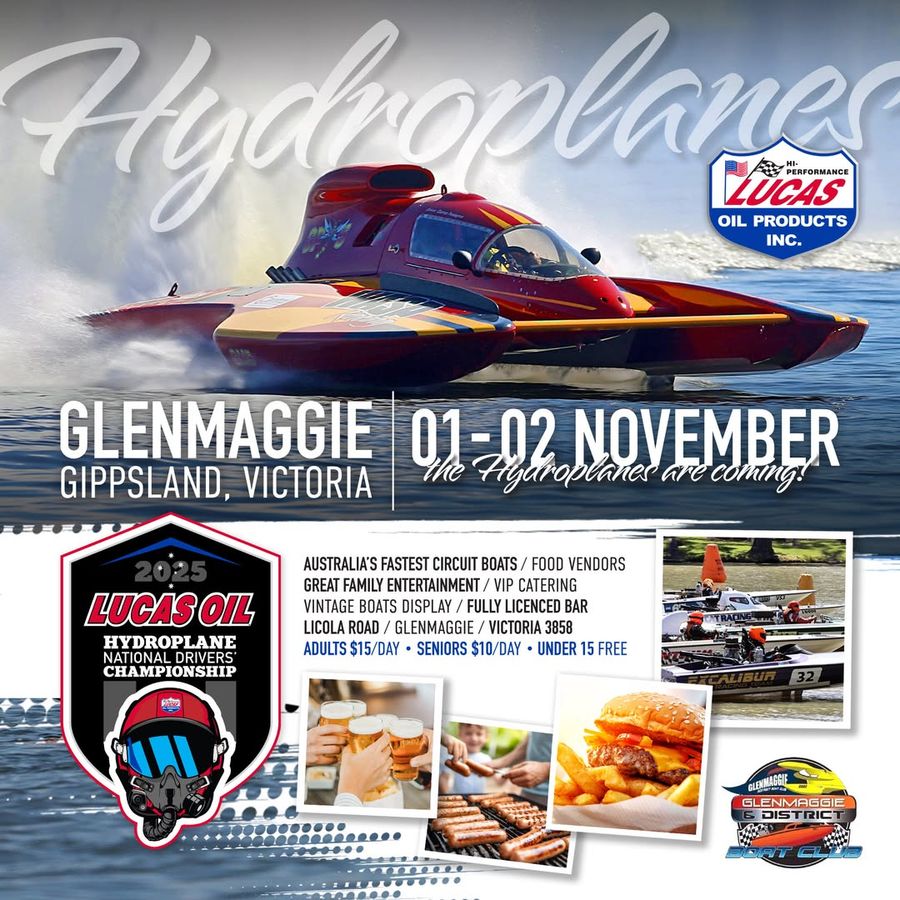
Australian hydroplane racing is about to enter a new era, and Gippsland's Lake Glenmaggie is where it starts. The Lucas Oil Australia Hydroplane National Drivers Championship makes its competition debut at the Glenmaggie & District Boat Club this weekend, bringing two days of GP Hydroplane racing at speeds well above 250 kph alongside a strong support card of 5/6-litre and 1.6-litre OzLite hydros.
The timing creates an accidental trans-Tasman parallel. While New Zealand's Hydro Thunder event fires up at Mangakino, the inaugural Hydroplane NDC round gets underway 200 kilometres east of Melbourne on the very same weekend. Same noise, same rooster tails, different hemisphere.
The Glenmaggie Cup carries significance well beyond any single race result. It represents the revival of national-level hydroplane competition in Australia, a category with a century of heritage behind events like the E.C. Griffith Cup but one that has lacked a cohesive season-long framework to give it sustained presence. The National Drivers Championship format already has a proven record in other Australian powerboat categories. Applied here, it introduces a points-based structure across multiple rounds, designed to build momentum, lift crowd engagement, and give the sport a continuous identity between trophy events rather than leaving it defined by isolated, sporadic showdowns.
NDC director Rob Psaila made the ambition plain earlier this year. "We've got world-class boats sitting in sheds. The goal is to get them back on the water, in front of the crowds that love them." With Lucas Oil as naming sponsor and Glenmaggie's open-water layout providing a genuine high-speed venue, this first round is both a homecoming for the machinery and a reset for the discipline.
The Grand Prix entry list reads like a roll call of Australian hydroplane royalty. GP1, driven by Grant Harrison, arrives as the form favourite. Harrison is a nine-time E.C. Griffith Cup winner and a former UIM GP World Champion, and his boat is expected to set the early pace benchmark. Dan Krusic's Krusader and Darren Pennington's Wasp both carry the speed to trade blows with Harrison throughout the weekend, while Ben Clark's GP101 comes in fresh after a significant rebuild and with something to prove.
The Glenmaggie Cup field broadens the competition further, adding Rival (John Bakker), Mad Dog (Les Smith), Fury (Hayden Chesser), Stampede (Paul Jones), AMS (Brendan Anderson), Always Pumping (Dennis Psalia), and Gator (Melissa and Kelvin Macansh) to the mix alongside the GP contingent. Glenmaggie's long, sweeping turns favour boats that maintain top speed through the arcs rather than relying on short-burst acceleration, a characteristic that has historically suited GP1 and Krusader.
Several individual storylines add texture to the competition. The return of GP101 is perhaps the most compelling. At the St George Speedboat Spectacular in July, Ben Clark's Tamworth-based team recorded a high-speed spin that data later confirmed occurred at approximately 150 mph, with lateral loads of 8 g and vertical loads of 3.6 g. The team rebuilt the boat and made it to Glenmaggie. That determination alone makes Clark a compelling figure to follow across the weekend.
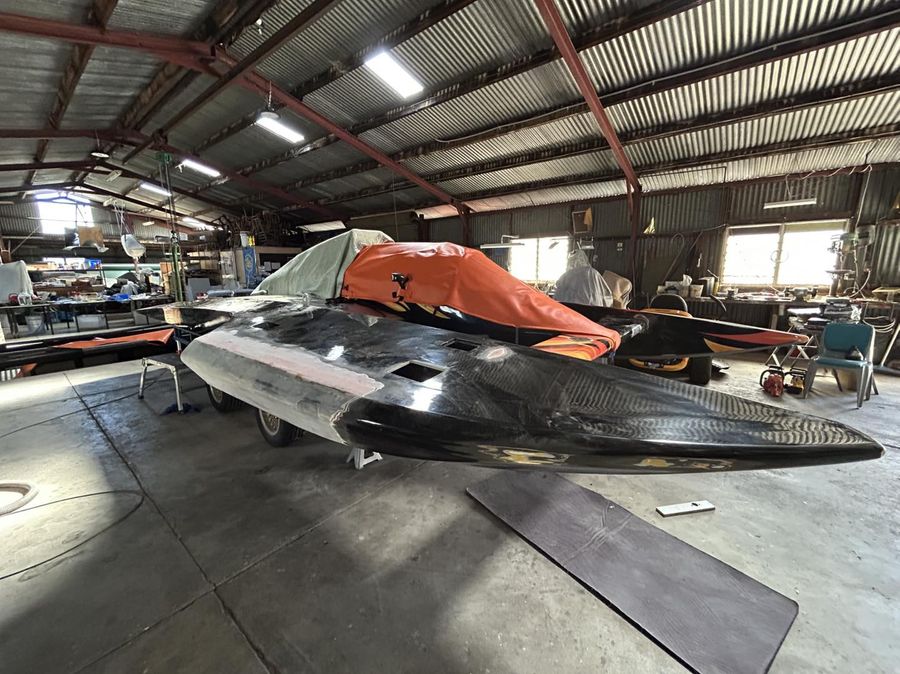
Darren Pennington brings Wasp back to competition after an extended absence. The boat has been fired up, cleaned, and prepared for the event, but how its set-up translates to race pace remains an open question. Glenmaggie's long right-hander will be the real test of whether Wasp carries speed where the lap time is actually made. Brendan Anderson's AMS, a 5-litre hydro in the support category, has been flagged by organisers as both immaculate in preparation and genuinely quick, the kind of entry that can catch a crowd off guard and put itself in podium contention.
On the question of speed, organisers have not undersold it. "2000-horsepower monsters at over 250 kph side-by-side" is the stated expectation for GP hydros at Glenmaggie, consistent with known GP benchmarks and with the NDC's own pre-event previews. If conditions hold, the back straight should produce closing speeds that make even experienced spectators reach for ear protection.
The event format follows the NDC template familiar to Australian powerboat crowds: hot-lap qualifying, two rounds of heats, and then class finals, with the Glenmaggie Cup as the Sunday centrepiece. Live streaming will be available through GP Hydro Livestream for those watching from a distance. The weather outlook is favourable, with a possible shower on Friday giving way to a mix of sun and overcast conditions across the racing days, good conditions for big power and clear sightlines.
The Hydroplane NDC is not designed to displace Australia's established trophies. Events like the E.C. Griffith Cup and the Max Kirwan Trophy retain their place in the calendar. The NDC sits alongside them as an additional layer, a mechanism to put GP hydros on the water more regularly, at venues capable of handling their performance envelope, under a structure that accumulates meaning across a full season. Following a disrupted lead-up in 2025, this Glenmaggie round serves as the reset point. The 2026 series opener is already confirmed for Lake Eppalock, scheduled for 10 to 11 January.
The boats to watch in summary: GP1 brings proven outright pace and the race craft that comes with multiple national titles. GP101 carries a high performance ceiling if the post-St George repairs hold under race loads. Krusader is a consistent top-three threat that tends to thrive in clean water. Wasp is the big unknown, a returning package with real upside if Pennington gets early laps to dial in the set-up. In the support classes, AMS, Gator, and Rival are crowd-pleasers backed by genuine pace.
From qualifying through to the final, Glenmaggie's maiden Hydroplane NDC round is set to deliver loud, fast, and consequential racing. When the GP finalists get a clear run down the back straight, the advice from anyone who has seen these boats before is simple enough. Don't blink.