Twenty-one solo sailors will leave Opua bound for Southport, Australia, when the 2026 Solo Trans-Tasman Yacht Challenge gets underway on the last Saturday of May next year. The passage covers roughly 1,300 nautical miles across one of the world's most demanding stretches of ocean, and every entrant knows it. Steep seas off the Northland coast, fast-moving Southern Ocean lows, and the final slog against the East Australian Current are all part of the picture. Each skipper has acknowledged the Tasman's reputation in their race entry, and that shared respect may be the one thing this otherwise varied group holds in common.
The 2026 fleet is the largest the event has ever assembled, surpassing the previous record of seventeen starters set in 1986. Every sailor entered brings genuine offshore mileage, ranging from sustained coastal campaigns through to full circumnavigations, and some have more than 100,000 miles behind them. All are over forty, though that detail tells only a fraction of the story. The more interesting question is why people who have already accomplished so much keep coming back to a body of water that has rolled, dismasted, and claimed boats on this very route.
The Tasman, known to those who sail it as "the Ditch", sits under the persistent influence of the Roaring Forties and is exposed to Southern Ocean weather systems, unpredictable sea states, and rapidly developing local conditions. Sailors have lost their lives here. In 2022, writing in his online journal Mv Astra, Iain Macneill described a crewed Tasman crossing in these terms: "Our five day crossing of the Tasman Sea presented sleeping problems for all with the pounding and pitching and sleep was generally in snatched blocks of 40 minutes for the middle two days." A crewed passage at least allows a watch system. In 2026, every one of these twenty-one sailors will face those same conditions alone, handling every sail change, every repair, and every navigational decision without another person on board.
The picture is no more comforting when viewed through other experienced accounts. The cruising blog buffalounickelblog, written after three separate Tasman crossings, put it this way: "We've crossed it three times in two different boats, and each time it has demonstrated why it is among the top five notoriously difficult and dangerous seas in the world… Our recent crossing in March 2019 was supposed to be our easiest, but we ended up seeing the largest waves we have seen in over 36,000 miles of cruising in the past ten years. And it humbled us." Those were crewed passages with shared watches and shared decisions. The 2026 soloists will be entirely on their own.
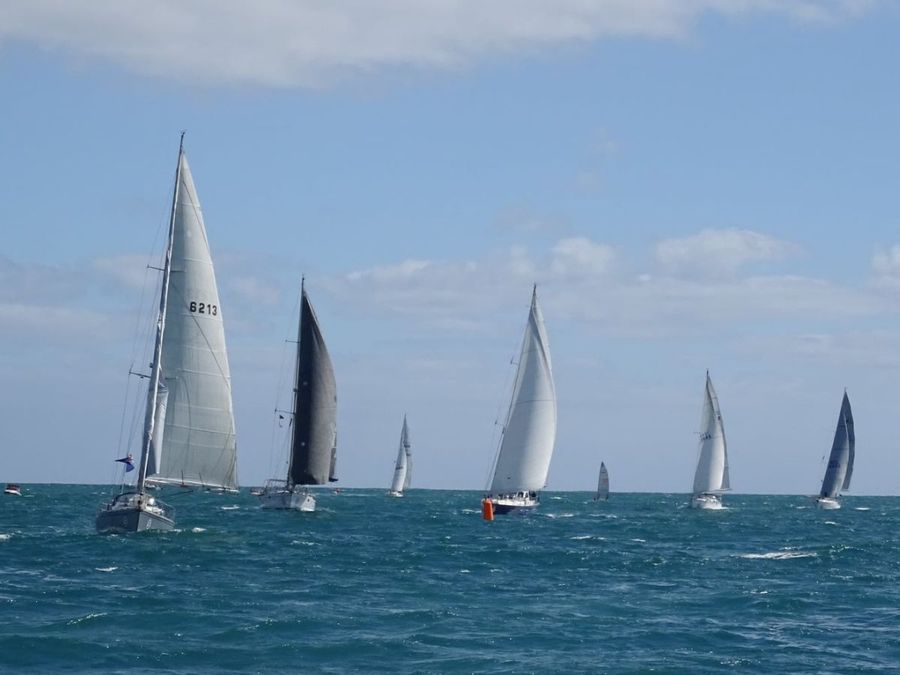
No one in the 2026 fleet embodies that reality more completely than Malcolm Dickson. At 79, Dickson is both the oldest entrant and the most experienced Tasman crosser in the fleet. He will race his 16.82-metre Sarau, a Dickson 55 that he designed and built himself before selling his business and moving to a full-time cruising life. Sarau is not simply his race boat; he drew her lines and oversaw her construction.
Dickson's connection to this race stretches back to 1978, when he lined up for the Solo Trans-Tasman aboard Spindrift. That year attracted sixteen starters, the largest fleet the race had seen at the time, and it proved brutal. One skipper, Bill Belcher, struck Middleton Reef and spent 28 days adrift before being rescued from his life raft. Dickson returned to the race in 2018, this time with Sarau, finishing second behind his son.
Before the 2023 edition, Dickson undertook a serious refit aimed squarely at performance. He stripped roughly three tonnes of live-aboard weight from Sarau: the dinghy, outboard, diesel heater, washing machine, extra chain and even the carpet all came out. The work reduced her displacement from around 18 tonnes to 15, transforming a well-appointed cruising yacht into a substantially leaner racing machine.
The 2023 results justified every hour of that refit. Dickson won outright, taking line honours and first monohull while setting a new monohull course record to Southport with a time just over 10 days, 1 hour, 53 minutes, 50 seconds. The crossing was far from clean. He lost his working jib on day two, and by the midway point his satellite phone had failed, leaving him without reliable weather routing or fleet tracking for the majority of the passage. He later admitted he was "just sort of guessing" where to go, and only learned he was leading when he closed to within 12 nautical miles of Southport.
That account is not included here for dramatic effect. It illustrates plainly what solo ocean racing involves: you manage whatever breaks, you keep the boat moving, and you absorb whatever the Tasman decides to send your way. Dickson's own summary of the sea he races is typically direct: "The Tasman can and does throw up anything."
His broader sailing history runs even further back. He learned to helm before he started school and grew up designing, building and sailing boats, describing sailing as "in his DNA." In 2000 he completed an eastabout circumnavigation south of the great Capes, a route that demands both seamanship and patience. Looking ahead to the 2026 race, he frames the challenge with characteristic simplicity: "This race will be my eleventh sail across the Tasman, and my sixth time solo. Feel very fortunate to still be able to participate in this great event."
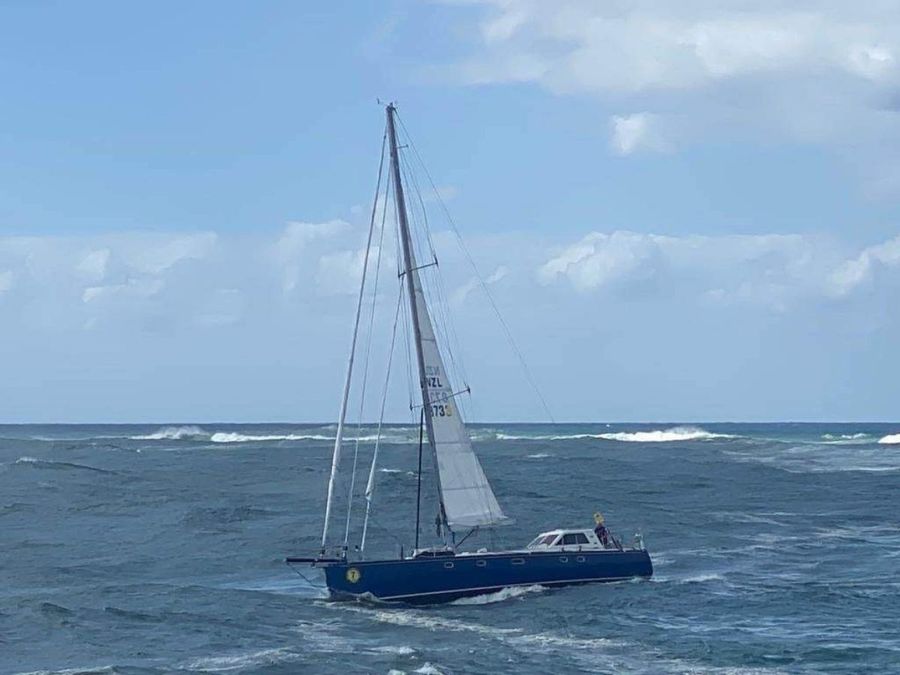
Dickson's career spans nearly fifty years of designing, building, cruising and racing, bridging the earliest years of the Solo Trans-Tasman and its record-breaking 2026 resurgence. Sarau herself stands apart within the fleet: in a field where many boats sit in the 10 to 11 metre range, often older designs or coastal cruisers pressed into offshore duty, a 16.82-metre purpose-refined Dickson 55 is a different proposition altogether. The comfort the design naturally affords has been deliberately traded back for performance, the result of a methodical refit rather than any compromise.
Dickson is far from the only sailor in this fleet with serious credentials. Kevin Le Poidevin arrives fresh from a solo non-stop circumnavigation aboard Roaring Forty. Leslie Graney brings 125,000 nautical miles of blue-water experience. Sharon Ferris-Choat carries world records and round-the-world victories. Younger skippers such as Lucy Te Moananui, campaigning the tough little Contessa 32, and hard-driving racers including Glen Jeffery and James Foster bring strong Tasman and RNI records of their own. Yet Dickson contributes something none of the others can match: continuity. He was on the start line in the 1970s, came back decades later, stripped his boat down and won, and is preparing to go again.
When Sarau clears Opua in 2026, she will carry more than a stripped interior and race-focused modifications. She will carry a story that began in 1978 and shows no sign of ending. For everyone else on the start line, Malcolm Dickson is not a curiosity or simply the oldest entry in the fleet. He is evidence that the Tasman can be faced honestly and repeatedly, alone and on your own terms, provided you never lose your respect for it.