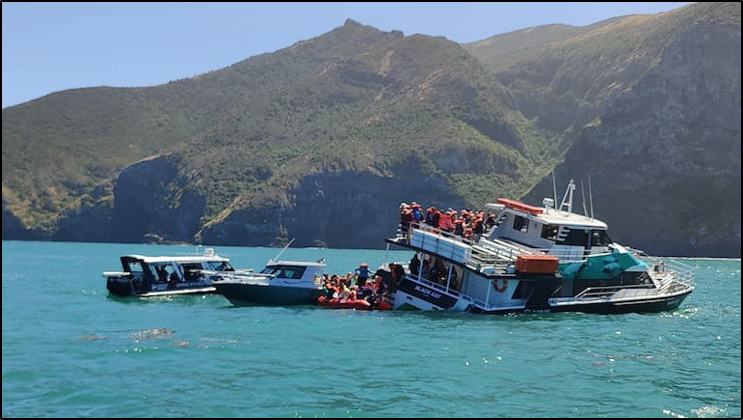
The Transport Accident Investigation Commission has released its Final Interim Report into the grounding of the passenger catamaran Black Cat at the entrance to Akaroa Harbour on 31 January 2026. It's the first detailed account of what went wrong that day, from the moment the hull struck a submerged rock near Archway Rock to the final loss of the vessel off Nikau Palm Gully, including the detail that the crew's engine-driven bilge pump was never actually engaged.
The Commission notes this was "a serious accident, where 41 people were at risk of significant harm, drawing heightened public interest," and says the interim report has been prepared "to provide timely information on the accident to the maritime industry and to the public." A final report, with analysis, findings and any recommendations, is still to come.
Out to Archway Rock
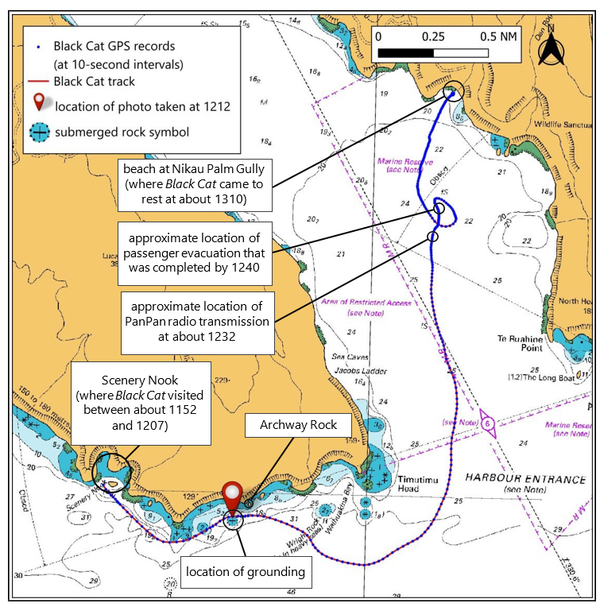
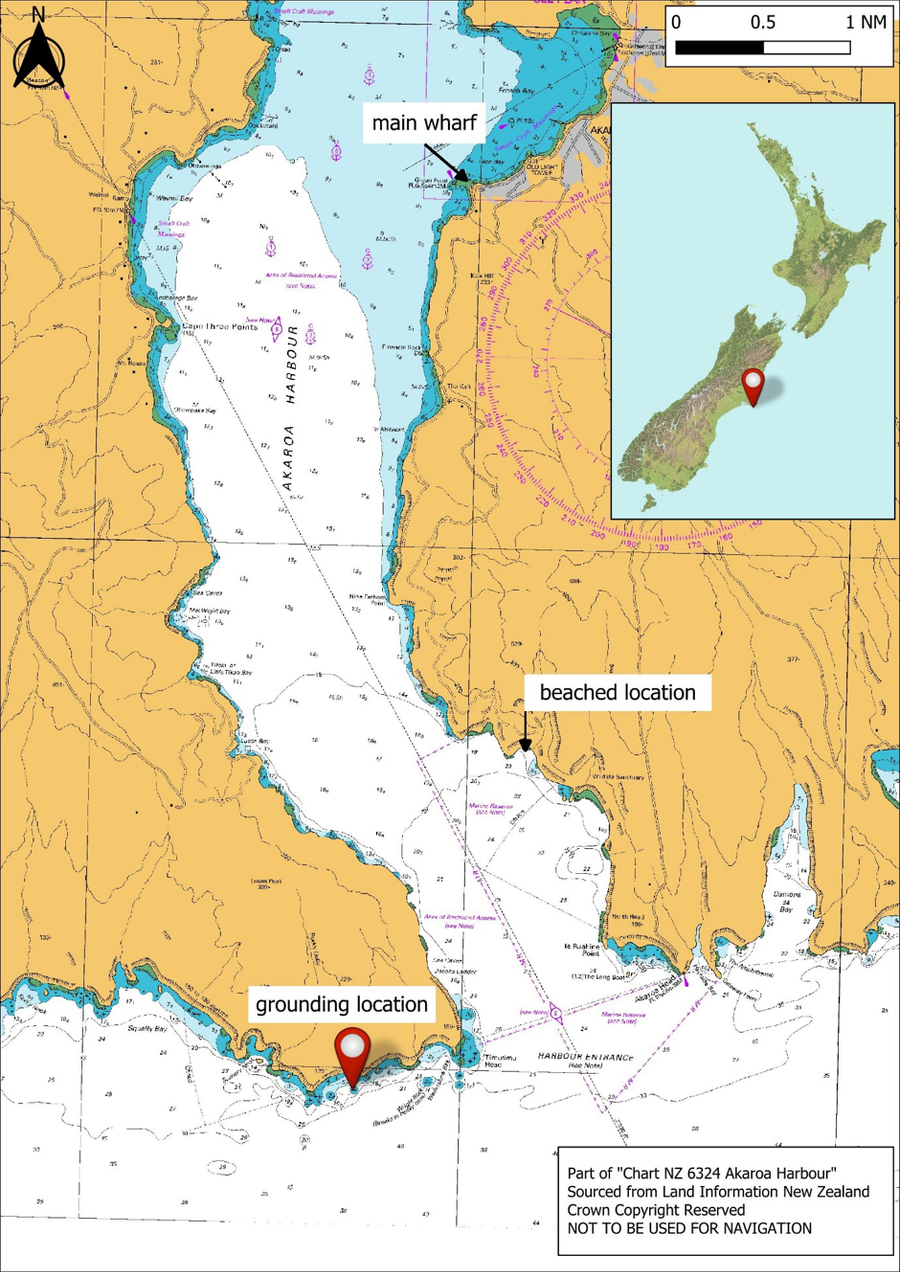
Black Cat departed Akaroa main wharf at about 1045 with 38 passengers and 3 crew aboard, on what the report describes as "a regular two-hour cruise during which the Black Cat crew embarked passengers at Akaroa main wharf and the vessel visited various locations to view wildlife and scenery." The master worked the vessel south along the eastern coast of the harbour, stopping at Spotted Shag Rookery and Cathedral Cave for commentary, before deciding, with the weather calm, to head outside the harbour heads to Scenery Nook on the south coast.
From Scenery Nook the master chose to detour to Archway Rock, a geological feature, on the way back in. Black Cat left at 1207. Five minutes later, she hit something.
The strike
As Black Cat approached Archway Rock, crew member C1 noticed something wasn't right. "While looking out the window, C1 noticed that the vessel was approaching Archway Rock from an unusual direction," the report states. C1 headed for the bridge to flag it to the master. At about 1212, "a bump was felt and there was a scraping sound."
The vessel's position at the moment of impact, established independently through geo-location data from crew member C2's phone and the boat's own GPS tracker, "aligned with a charted submerged rock of an unknown depth," a hazard marked on Admiralty charts as dangerous to surface navigation despite its depth being unrecorded. The master initially suspected a crayfish pot float, but could see nothing in the water. About a minute later, the bilge alarm went off.
The pump that wasn't operated
This is the part of the report that matters most. The master handed C1 the helm and went below to check the bilges personally, finding the starboard engine room flooded, "the water level was around the top of the engine." Returning to the bridge, the master ordered the crew to the aft compartment to start the engine-driven bilge pump, one of four independent pumping systems fitted to the vessel.
It didn't happen. "C1 and C2 went to the bilge-pump control station in the aft compartment but were not confident in how to operate the bilge-pump system," the report states plainly. The pump was never engaged.
Systems failing, smoke in the cabin
With the starboard hull taking on water, things went wrong fast. Smoke or steam began entering the main cabin from the engine room as the vessel passed the harbour entrance, and passengers realised something was wrong. On the bridge, steering, CCTV and the PA system all stopped working. The starboard engine and propulsion system failed. The emergency steering, also housed in the starboard hull, wouldn't respond.
The master radioed two nearby company vessels and began working toward the beach at Nikau Palm Gully, the only suitable option nearby, intending to anchor or beach the boat. Meanwhile C1 and C2 abandoned the failed pump effort and turned to getting passengers into lifejackets, a process the report says took "about 10 to 15 minutes."
At 1232, with the vessel listing heavily to starboard and smoke filling the cabin, the master broadcast a Pan-Pan urgency call over VHF radio: Black Cat, with 38 people on board, was taking on water just south of Dan Rogers bluff.
Passengers off, master and C1 stay aboard
Multiple vessels had already responded to the earlier radio calls and were standing by. Passengers were ferried from Black Cat's port stern onto larger boats, with the evacuation completed "without significant issue" by 1240.
The master and C1 stayed aboard, still trying to save the vessel. With only port-side propulsion working, Black Cat kept turning to starboard; the master countered it using bursts of astern power, working toward the beach at Nikau Palm Gully.
The local Coastguard vessel Ihenga Rescue, out training nearby with five volunteers and two recruits aboard, heard the Pan-Pan call and diverted into the harbour. Its crew brought a portable petrol-powered water pump aboard Black Cat and began pumping from the flooded aft deck, but it wasn't enough. As the starboard hull settled further and the list increased, seawater began flowing over the bulwark into the aft deck area, and the remaining crew, the Coastguard volunteer and the recruit evacuated to nearby boats.
At about 1247, still short of the beach, Black Cat grounded again. The master shut down the last working engine and stepped off onto a jet ski that had been standing by.
"All passengers and crew were safely transferred back to Akaroa with no reported injuries," the report confirms.
Total loss
Environment Canterbury declared a Tier 2 regional oil-spill response at 1345 that afternoon, though the Commission was told the environmental impact of the accident was ultimately minimal. A salvage operation, run by Black Cat Cruises and its protection and indemnity club, tried to refloat the vessel over the following days but failed; Black Cat broke up in heavy weather before it could be recovered. By 19 March 2026, all safe-to-collect fragments of the wreck had been retrieved.
The Commission's data summary records the outcome in three words: "Damage: Total loss of vessel."
The vessel and her crew
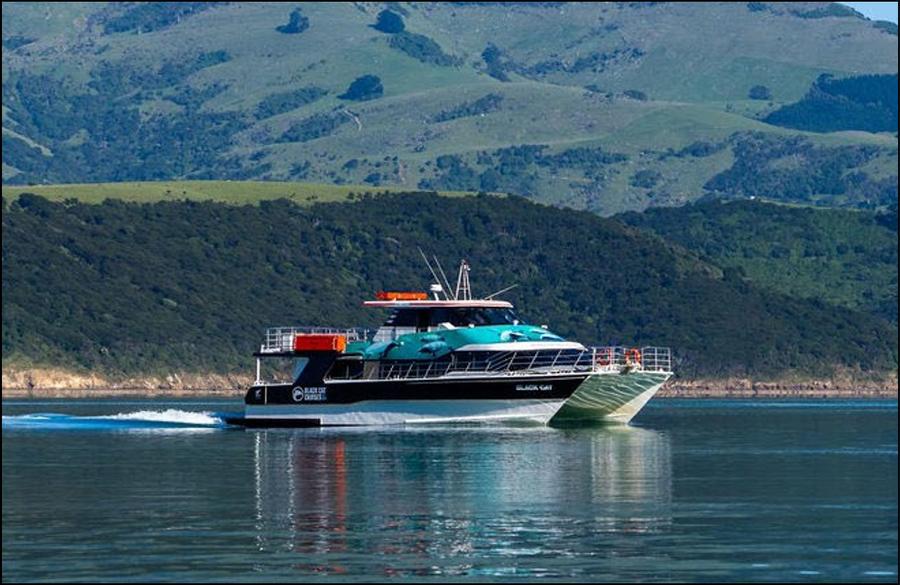
Black Cat was a 17.3-metre aluminium alloy catamaran built in 1994 for service in Queensland's Whitsunday Islands, before Black Cat Cruises brought her into service from Lyttelton and began operating out of Akaroa in 2004. She ran on twin Yanmar 6HY diesels, one per hull, each driving its own shaft and propeller, with steering provided separately by conventional rudders, one per hull, and carried four independent bilge-pumping systems: a 24V electric pump, a 230V electric pump, an engine-driven pump, and a manual backup.
The report also sets out the crew's experience. The master held an Australian Skipper 3 qualification dating to 1988 and a New Zealand Inshore Launch Master certificate from 2013, and had joined Black Cat Cruises in February 2025, taking command of Black Cat specifically on 1 December 2025, two months before the grounding. C1 had been with the company since 2012, after three years crewing in Doubtful Sound and on Lake Manapouri. C2 had worked in the company's office over the 2025 summer season before moving to crew duties that November.
What happens next
This is an interim factual report only. The Commission is explicit that it "presents facts that have been established so far" and does not assign cause or fault: "Our findings cannot be used to pursue criminal, civil, or regulatory action." Analysis, safety issues and any recommendations will come in the final report, still to be published.
The inquiry has been running since Maritime New Zealand notified the Commission on the day of the accident. A protection order was placed over Black Cat's wreckage, electronics, navigation equipment and logbooks, investigators spent three days in Akaroa gathering evidence in early February 2026, and a draft of this interim report went to four interested parties for comment and to four others specifically to check factual accuracy, in May before the Commission approved it for publication on 31 July 2026.
Go Boating NZ has followed this story from the initial capsize through to the salvage attempt. Read our earlier coverage: Akaroa tourist vessel capsize follows grounding and Salvage operation begins to recover wrecked Black Cat tourist boat from Akaroa Harbour.