Nearly five decades of active sailing life leaves its mark differently depending on the boat. On a fibreglass hull that came out of what was once the Southern Hemisphere's largest production boatbuilding operation, those years tend to accumulate as character rather than concern.
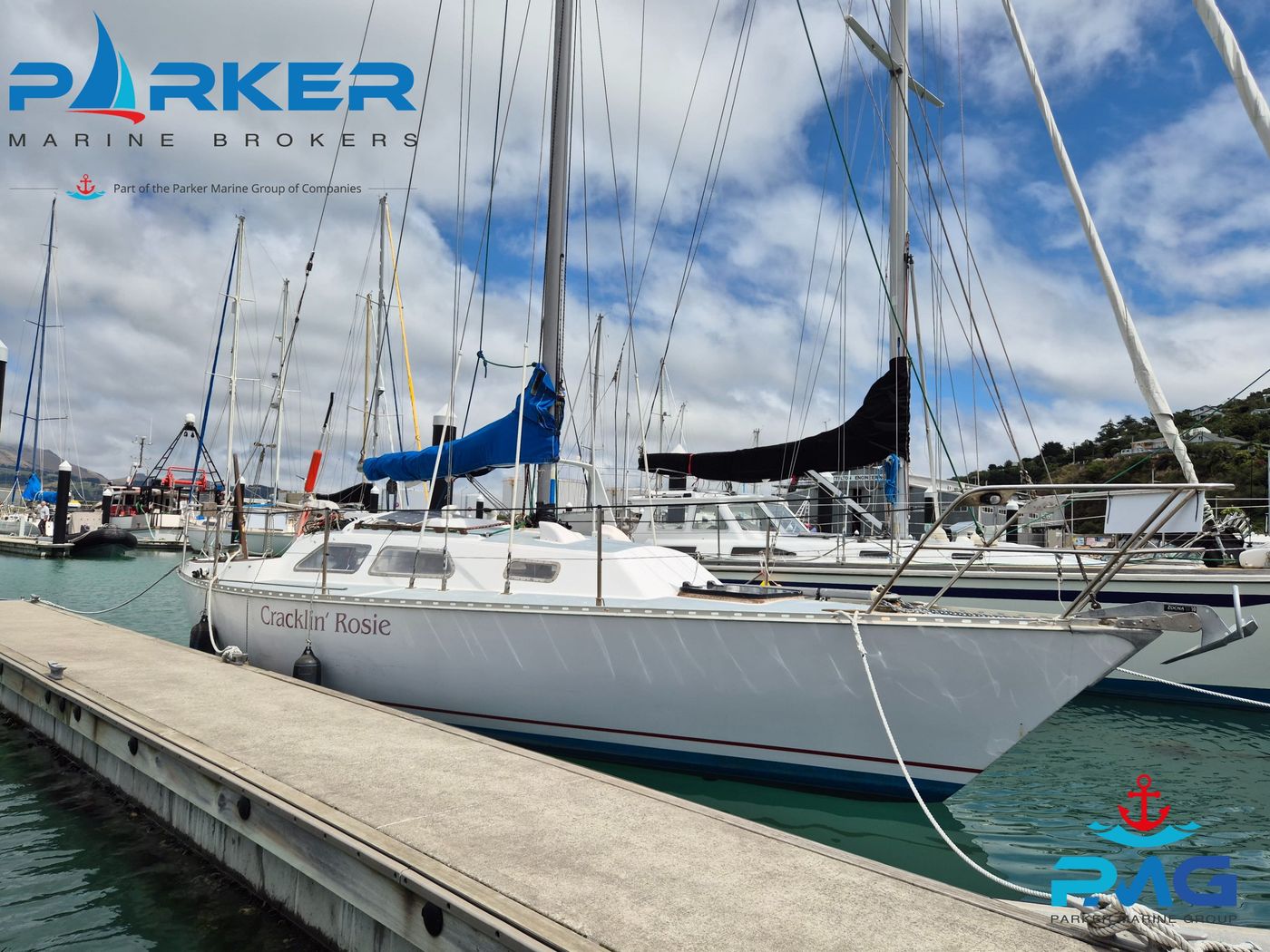
Cracklin Rosie is a 1977 Cavalier 30 lying in Lyttelton, offered through Parker Marine Brokers at $18,000. White topsides, light blue deck trim, blue canvas, tiller steering. The wear she carries is honest and visible, the kind that belongs to a boat that has been sailed rather than kept under wraps between boat shows. A lick of paint, the listing notes, is all it would take.
The company behind her is worth understanding. Cavalier Yachts was founded by Peter K. Smith and John Salthouse, and by the middle of the 1970s the operation was running eleven designs in simultaneous production, with licensed manufacturing extending to both Australia and Japan. The Cavalier 30 was developed specifically for the Half Ton IOR class, a racing rule that generated some of the most keenly fought club and offshore competition of that decade. These were boats conceived to perform under real pressure and constructed to outlast it.
The designer was American Doug Petersen (1945–2017), whose influence on offshore racing during that period is difficult to overstate. His IOR designs dominated the mid-1970s race circuit, and the principles behind them, low wetted surface, fine entry, powerful sections aft, remain visible in the way boats like the Cavalier 30 still move under sail today.
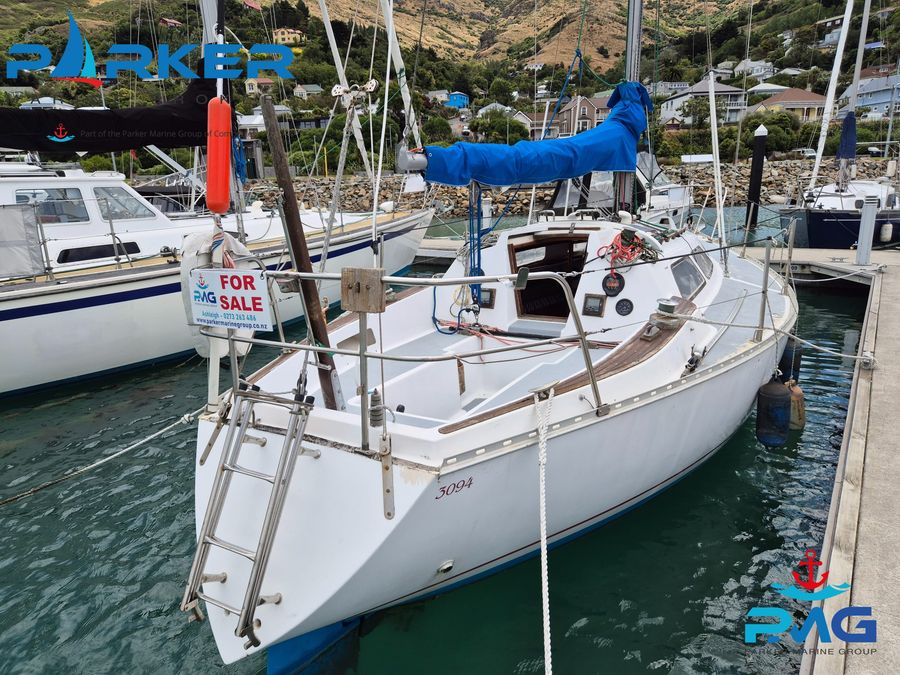
Cracklin Rosie comes with a full sail wardrobe already aboard, which is more significant than it might initially appear to anyone weighing up club racing. Getting a boat of this vintage to a start line is often a question of sails well before it becomes a question of hull condition, and not having to source a wardrobe from scratch removes a genuine barrier. The mainsheet traveller sits at the top of the companionway, a layout that will feel immediately familiar to anyone with IOR racing experience. The high-sided cruiser stern, fitted with a dive ladder, makes her equally comfortable swinging on an anchor as she is running before a decent breeze.
Power comes from a 13hp Sole diesel, a marinised Mitsubishi unit with a solid reputation for reliability. Fuel capacity is 70 litres, adequate for coastal passages, and she has been recently antifouled. The broker's summary is to the point: step aboard and sail away.
The history of Cavalier Yachts itself ends sharply. In 1979, Prime Minister Rob Muldoon imposed a sudden 20 percent sales tax surcharge on the New Zealand boatbuilding industry. The impact was immediate, pricing Cavalier out of its international markets overnight and bringing the company down. A receiver was appointed and managed to trade the business through to the point where all debts were repaid, but the momentum that had built over the previous decade did not survive. Cracklin Rosie came out of that factory during its most productive years, part of a manufacturing run that few yards anywhere in this part of the world have matched before or since.
At $18,000, she represents an accessible way into vintage class racing or unhurried coastal cruising from one of New Zealand's finest natural harbours. She will not be the fastest boat on any start line, and she will not turn heads for her presentation. Among boats at this price, though, she will be among the most rewarding to actually sail.
Contact Ashleigh Macdonald at Parker Marine Brokers on 027 326 3486 or ashleigh@parkermarinegroup.co.nz.
Specs at a glance: Year: 1977 | Designer: Doug Petersen | Builder: Cavalier Yachts | LOA: 30ft | Beam: 3m | Draft: 1.6m | Construction: Fibreglass | Engine: Sole 13hp (marinized Mitsubishi) | Fuel: 70L | Steering: Tiller | Location: Lyttelton | Price: $18,000 NZD