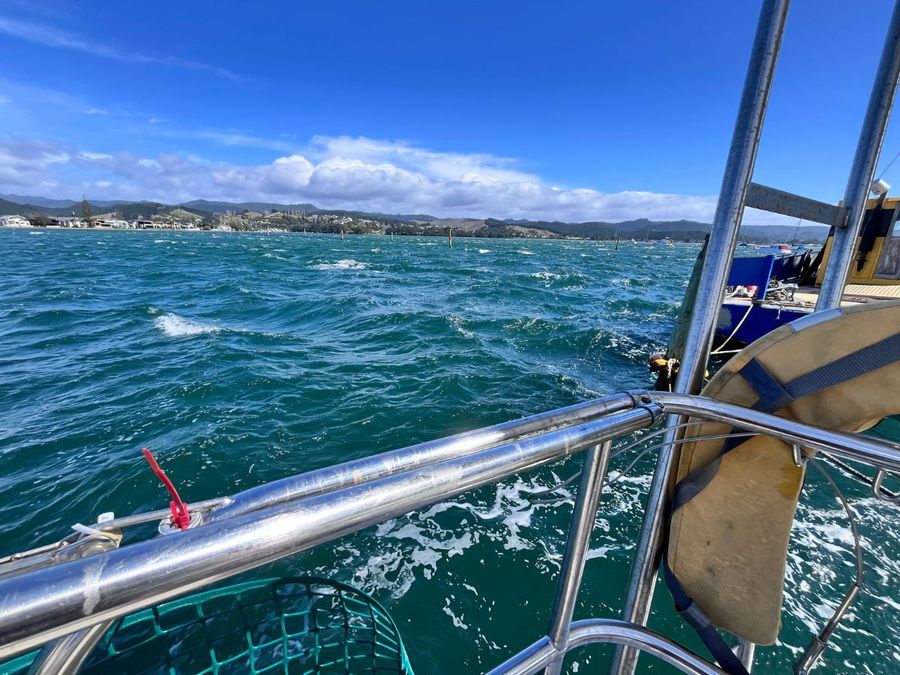
The Coromandel Peninsula took a battering overnight as a significant weather system swept through with devastating force. Winds and violent gusts tore across the region from end to end, punishing towns, harbours, and anchorages without discrimination.
Whangamatā Harbour was no exception. Our family lives aboard our vessel there, and the night turned into one we will not forget quickly. The harbour is usually forgiving, but our berth sits in an exposed position just off the marina channel, and when the storm arrived it funnelled directly into us with full force.
Saturday morning had felt manageable enough, with winds sitting around 25-30 km/h. It was the gusts that gave me pause. My husband was away caring for a sick relative, so rather than make the trip ashore to find somewhere to sleep, I decided to stay aboard. I knew what the forecast said. I did not fully appreciate its ferocity.
Through the afternoon conditions deteriorated steadily, and by 10pm the storm had arrived in full. The Whangamatā Coastguard later confirmed gusts had reached around 100 km/h, though sitting afloat through it, it felt if anything stronger than that.
Our Sun Kiss, a 50-foot Jeanneau with a deep keel, is a solid and heavy yacht built to handle serious conditions. Even so, moored side-on between two poles, we had no option but to absorb the full force broadside. She rolled between 10 and 30 degrees through most of the night, lurching to around 40 degrees when the worst gusts hit.
The noise was relentless. The wind turbine screamed, the rigging howled, ropes strained under load, and the hull slammed repeatedly with every wave. Below decks, water shaken loose from the bilge found its way into the aft head, something I only discovered during the night when I stepped in barefoot and got an unexpected footbath. I spent most of the night braced in my bunk, getting up repeatedly to investigate sounds from the galley. Sleep was impossible.
What unsettled me most was not the hull, which I trusted, but the gear outside. During the fiercest gusts, one of our large solar panels tore free. I had just stepped into the aft head, which has a window opening onto the cockpit, when a deafening crack split the air, followed by a rush and a violent bang right outside. I stepped out of the head very quickly, unsure what had come down with such force. With the thought of that near miss fresh in my mind, I used the forward head for the rest of the night. In the early hours I found the panel lying smashed in the cockpit, glass scattered everywhere.
The wind turbine also succumbed. It had been tied off earlier to hold it steady, and it was designed to cope with strong winds, but the gusts shook it loose. It spun up to full speed before shedding its blades. In the back of my mind I can't help but think keeping clear of the cockpit area that night had been a good idea.
Our recently replaced Bimini came through without a scratch. A neighbouring boat was not so fortunate, their canvas was shredded completely.
The mooring arrangement brought its own anxious moments. As waves lifted us, the mooring lines dragged the orange guide discs up to the tops of their poles, where they jammed under the strain. During the night, one pole gave way. It was the pole between us and a heavy trawler. Fortunately the ropes and discs held the pole in place, keeping it floating rather than lost, and holding us in relation to our neighbour. The forward pole, unshared and critical to our position, held firm. Had that one failed, the night would have taken a very different and far more dangerous turn.
Elsewhere around Whangamatā the storm left its mark. Solar arches broke, canvas was shredded on other vessels, and in the Wentworth River a couple of boats broke free from their moorings altogether. The local Coastguard spent Sunday working through the harbour, retying vessels before they could drift into danger. That community response, neighbours looking out for each other, was as memorable in its own way as the storm itself.
By Sunday morning winds across the Peninsula were still running hard, though nothing like the terror of the night before. The solar panel and the turbine are replaceable. The broken mooring pole will need attention. For now, the Coastguard has advised us to stay put until conditions ease.
The Sun Kiss proved her strength through everything the storm threw at her. But it was the Coastguard's work through the day, the community pulling together, and the simple relief of daylight after a night of roaring gusts that made the difference.