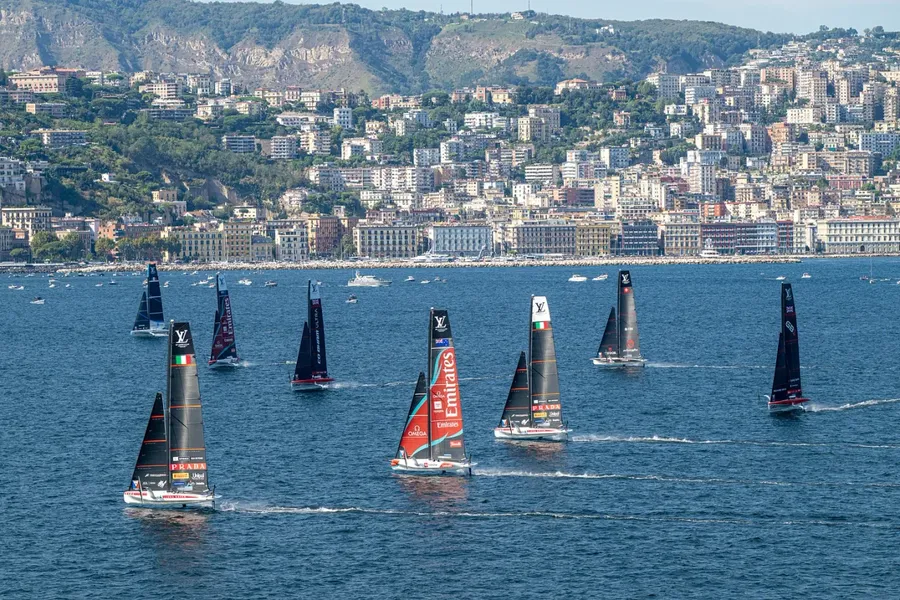
Ben Cornish doesn't sugarcoat it. The GB1 port-side helmsman has had a few weeks to sit with the fact that his team finished eighth of nine boats at the Naples regatta, and he's not interested in pretending it was anything other than a rough weekend.
It followed an equally underwhelming showing at Cagliari, where technical gremlins restricted the British AC40 to just three races. In those, at least, the team posted a 2,1,3.
"In that first prelim event we were riddled with issues with the boat," Cornish said. "But, in the racing we managed to take part in, we showed really good promise. We were competing at the front of the fleet, and I guess that naturally set a bit of an expectation as to where we felt we were."
Then came a decision that would shape everything that followed in Naples.
After Sardinia, GB1 chose to pull resources away from AC40 campaigning and pour them into getting the team's AC75 ready to relaunch. It meant the British sailors spent much of the Naples build-up watching rivals train from the shore.
"The priority was getting the race boat ready," Cornish said. "We are not a million miles away from the America's Cup itself, so focussing on the big boat was something that we as sailors and the whole team bought into. But it meant we had a difficult run-in to the PR2 event, having done far less hours than everyone we ended up lining up against."
Unfamiliarity with the Naples racecourse compounded things. Cagliari, by contrast, had been home turf of sorts, with GB1 having spent weeks there sparring against their Cobham-Ultra GB2 Women and Youth teammates.
"Naples is a very different venue to where we raced in Sardinia," Cornish said. "We had spent a lot of time there and had a good handle on the shift phases across a variety of wind directions, and where the breeze would trend throughout the day, and which side of the racecourse generally won.
"Whereas, I'd almost say we had the opposite understanding of Naples, where we were straight into the deep end, and we would experience a new wind direction for the first time when we had to race in it."
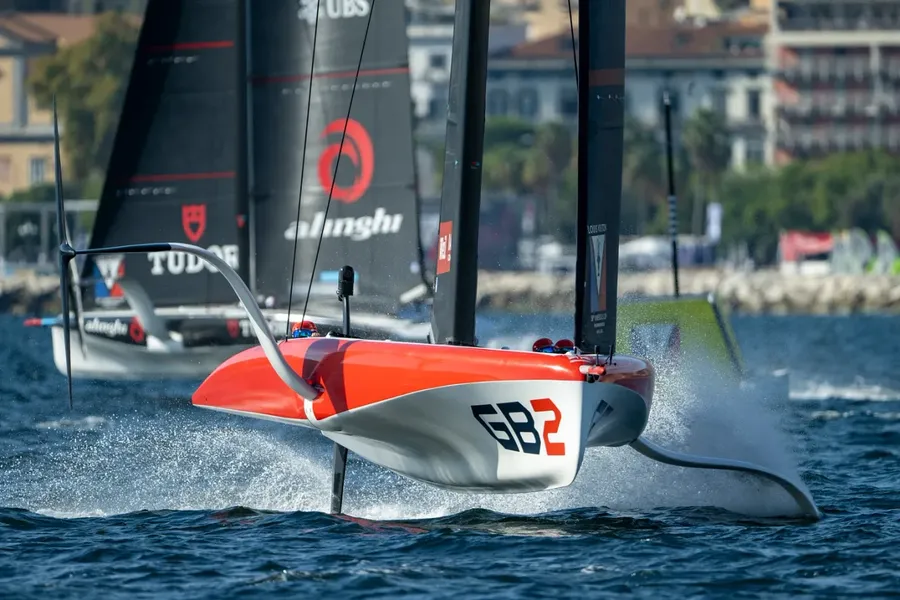
Boat-handling rust didn't help either. "When you combine everything together, it forms the perfect picture for how you wouldn't expect to perform very well at a regatta."
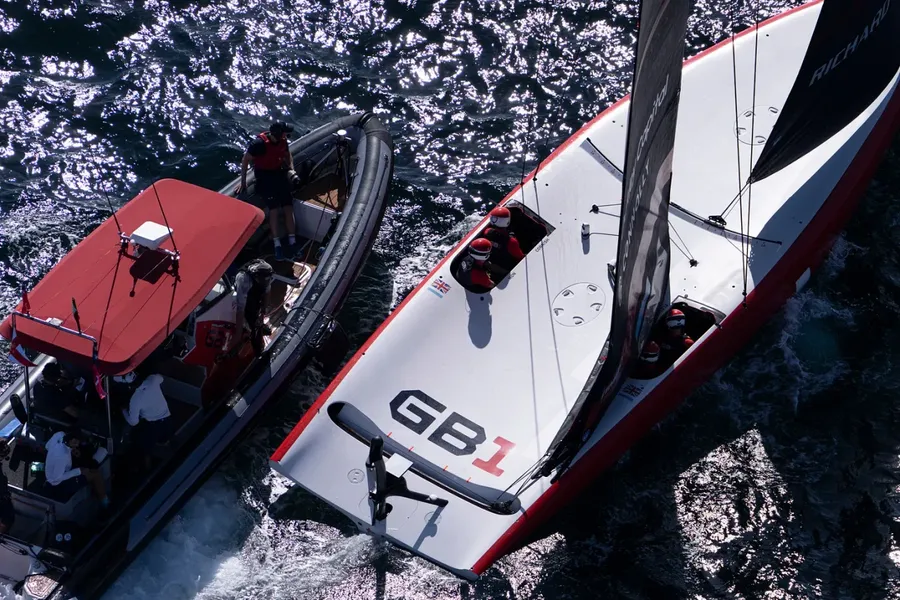
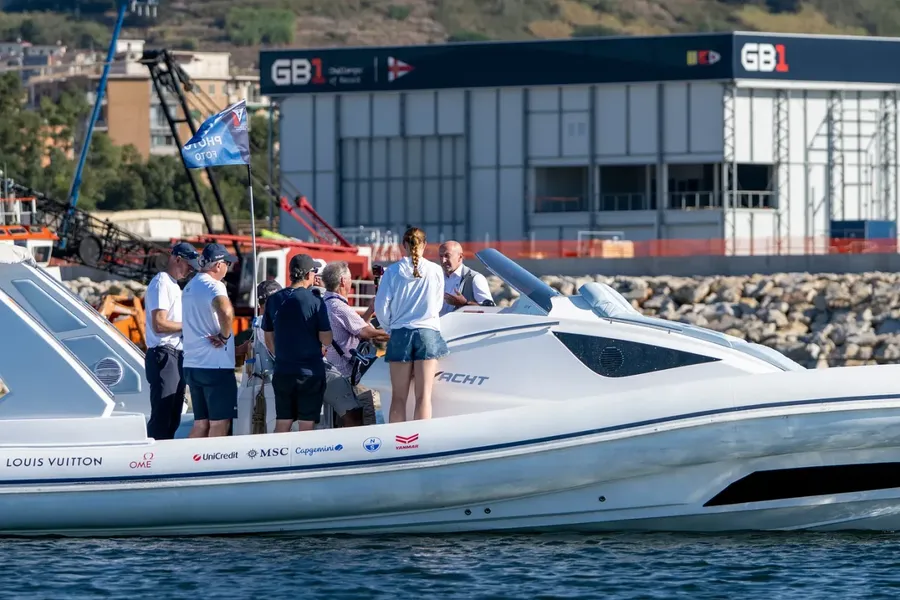
Then there was the collision. A practice-day knock with the Tudor Team Alinghi chase boat left the British shore crew working round the clock to fit a replacement foil arm, borrowed from the Swiss team, before racing began.
"Yes, we started racing properly on the back foot," Cornish summed up.
There has been plenty of chatter questioning the reliability of the British AC40, nicknamed "Crispy" after a battery fire during Barcelona training ahead of AC37. Cornish was having none of it.
"We have to give credit to the shore team," he said. "They had a hard run of it in Sardinia and I really felt for them. Other than an issue with a cover plate coming off one of the foils, from a hydraulic point of view and in terms of the boat's reliability, we didn't have a problem during this last event. The shore crew fixed all of the gremlins which haunted us in Sardinia."
That cover plate failure, on the opening day of racing in Naples, wrecked the flow over the foil and cost the team dearly on the scoreboard.
None of it counts for points in the bigger America's Cup picture. But try telling that to elite athletes used to winning.
"It's easy to say that it doesn't matter that much, but when you are on the start line everyone wants it as much as everyone else," Cornish said. "You certainly don't turn up there with the attitude that it doesn't matter. Every time you get in the boat on a race day you are out to win races and to try to put the best series you can together, and this one was no different for us."
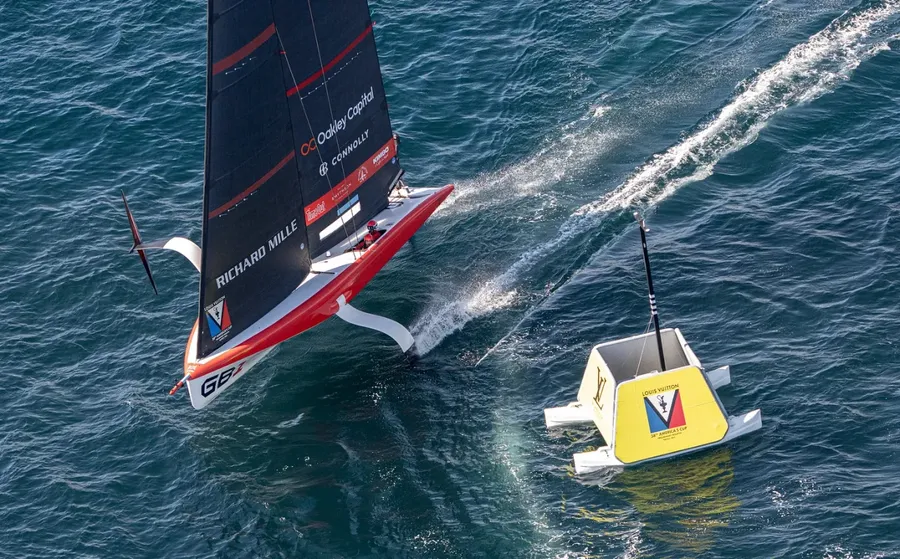
A 4,4,4 scoreline in the final three races offered some comfort. Even so, GB1 has run a full debrief.
"We have certainly done our due diligence on what we would say was a bad weekend in the office," Cornish said. "There has been a lot of work gone into identifying why Luna Rossa are getting around the racecourse faster than everyone else. What is special about their technique? What can we learn from boats that are doing a better job than we are? Then, there is so much to learn about the venue. I know we were racing at a different time of year to when the Cup will be held, but there are still geographic features that we need to get a handle on.
"So we are certainly not coming away from that event and thinking: 'Oh, glad that's done with, let's forget about it.' There is so much value in everyone picking themselves up and being able to think, big picture-wise, where can we improve and what do we need to learn going into next year? That is certainly the attitude of the sailing team and the wider team."
AC40 duty isn't entirely finished for the wider squad. The Women's and Youth sailors remain in Naples this week, continuing their own programme through to next year.
"We will keep our AC40 as an option if we want to sail two boats," Cornish said. "Like if we wanted to do some on-the-water match race prestart practice, maybe, it's great to have that platform available. Right now, it's, hopefully, not going to be coming out of the shed any time soon, but it is certainly going to be an option for next year."
Attention now turns squarely to the AC75.
There's a long-running dispute between the British team and former sponsor INEOS over ownership of the race boat, a subject Cornish wasn't drawn on. But news on that front may not be far off, and excitement is clearly building ahead of the boat's expected relaunch in November.
"It's really exciting," he said. "It feels like it has been a long time in the pipeline. It's not far away now, but it is also not long until the America's Cup. We are in quite a unique situation in this cycle, in that the package is going to come together quite late in the piece. But, for sure, once the boat launches we are going to be straight into the thick of it in terms of developing everything on board. We will be using every day we can, because we don't have many days between now and the first race day."
From the outside, the relaunched AC75s are expected to look much as they did in Barcelona. Below deck is another story entirely.
"Visually you won't see a huge amount of difference in the boats until people put their race foils on," Cornish said. "There will be some subtle visual changes, the cyclors have gone and the cockpits will obviously look different.
"It's hard to give you much of an answer without telling you what's going on. But inside the brains of the boat it will certainly be quite different. Much of that will be impossible to see from the outside. Even for us, looking with a trained eye at the recon footage, it's hard to be sure. You think you know what people are up to but it's very hard to be sure what's driving different things."
Closer racing may be coming.
"From a race point of view and in terms of the closeness of the competitors, I think things will step forward and start to arrowhead towards a really exciting and a less predictable summer," Cornish said.
He expects foil designs to converge further, too. Three generations into the AC75 class, the gaps are closing.
"I think naturally it has to," he said. "As the iterations move on, peoples' tools have been working for however many years now and things are getting more and more defined. You learn from your mistakes in previous campaigns. And you learn from what other teams did, because people move between campaigns and you start to gain that knowledge, I think a lot of that has gone on during this campaign.
"All of which means that, with us now being in generation three of the AC75, there's not going to be a lot in it. I hope so anyway."
Batteries have replaced human power generation this cycle, and Cornish expects that to open up new prestart tricks.
"What we are seeing from the other teams that are sailing AC75s already, so Emirates Team New Zealand, Luna Rossa, and La Roche-Posay Racing Team, is the ability to throw the boat around a bit," he said. "We have seen Team New Zealand doing a lot of circles in their practice pre-starts, and I think we will see that all the boats will be more capable in the prestart."
Back at base, something has shifted too. GB1's relaunch preparations have brought the whole operation together at its AC38 base in Bagnoli, ending a split between the design team in Portsmouth and the sailing squad training in Cagliari.
"It's really exciting to have everyone under one roof for the first time," Cornish said. "Up to now, you could go a few weeks without seeing certain people in the team. There's much more of a team feeling once we all are together in the same place."
GB1 is set to become the fourth team to relaunch its AC75, and only the second, after the French, to have sailed an AC40 in Naples. Catching up to the Kiwis and Italians, who have banked far more training time, will rely heavily on the simulator.
"So much of sailing these boats is repetition, and I think something that we did a good job of in the last campaign was having preplanned responses to certain moves in the prestart and having really strong set plays," Cornish said. "That's something we need to maintain.
"It's also a difficult one to practice out on the water, because even when you do have the big boat out you are so restricted under the rules, in that you can't rack up against another boat. So you need to have the system in place to be able to figure out all your timings and your routines: if A does this, B does that etc."
As for the Naples venue itself, Cornish's early verdict is cautiously positive.
"It's a very cool natural amphitheatre, that was my first impression the first day we got round there," he said. "I think when we get the typical sea breeze direction, it will be a really good racecourse. It was pretty challenging when we had the offshore breeze, there was quite a lot going on. But, if we get the more typical sea breeze, then it's going to be a really good spot for racing."
Ferry traffic between the islands adds another layer of complexity, along with chase boats and the spectator fleet, all of it circulating around the harbour and affecting the sea state.