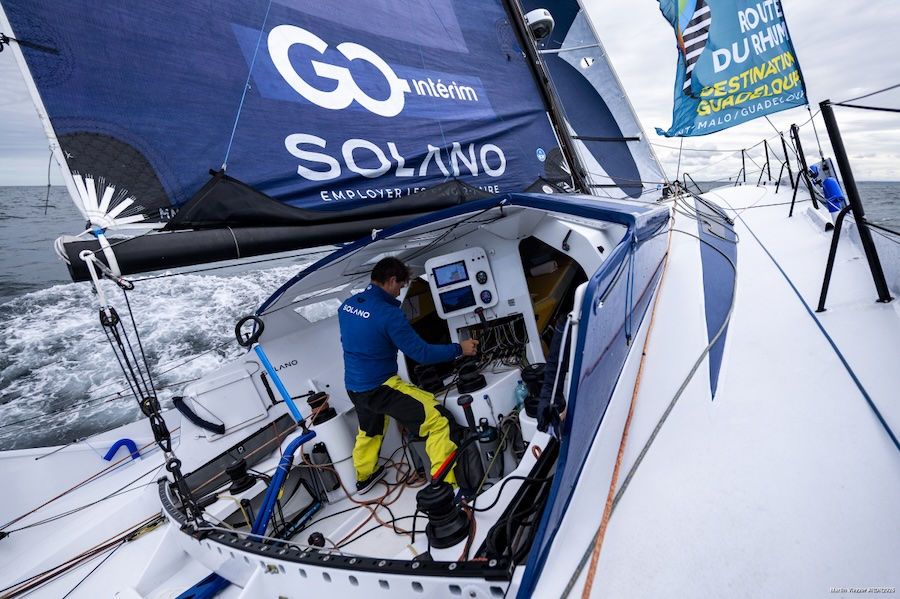
The Class40 fleet in the Route du Rhum has split into two camps over how to handle an approaching depression, due to hit within two days. Ian Lipinski on Crédit Mutuel leads the believers in a northern route, while Robin Follin on Solano, currently the class leader, has pushed further south. Most of the fleet sits somewhere between the two.
It is an unusual sight for a Route du Rhum. Like every other competitor in this edition, the Class40 skippers have all taken a route north of the great circle course, the direct line to Guadeloupe. Belgian amateur Gaëtan Thomas, sailing Barco Brésil in his first solo Class40 race, put it simply: "We have to go round one depression to the north, then another, maybe a third. It feels like we're heading to New York!"
The immediate conditions are tough enough, with sustained winds of 20 to 25 knots. Lipinski expects to face an average of 40 knots and a confused sea with seven-metre waves. "The centre of the depression is moving a lot and the wind direction is very unstable, which complicates things," he said. Follin was blunter still: "In the centre, you could potentially get 50 to 60 knots of wind, and we all know our boats aren't built for that."
Strategies differ sharply. The fleet is spread laterally across 220 miles, with Lipinski and Luca Rosetti on Maccaferri Futura backing the northern option, and Follin committed to a more southerly path.
Lipinski explained his thinking: "We knew from the start that this northern option was the one being recommended. Ideally I'd like to pass just below the depression, come in close-hauled on port, tack as I cross the front, then set off fast upwind again." He believes this approach should mean fewer stops and less suffering through the depression's centre than his rivals.

Follin, sitting slightly south of the great circle route and pointing his bow towards the Azores, has taken the opposite approach. "Since the start of the race I've been trying to conserve energy, look after the boat, and be careful," he said. "That's why I ruled out the furthest-north route early on." He admits it means plenty of upwind sailing, but insists it remains "manageable" and "suited to our boats." For now, it has him leading the class. "We'll see in two days whether it was the most effective strategy."
Guillaume Pirouelle on Sogestran-Seafrigo, locked in a close battle with Pierre Leboucher on Institut Imagine, has split the difference, sailing 85 miles south of Lipinski and 130 miles north of Follin. "Those heading north, I find that bold," he said. "On paper the routing software backs them. But it assumes we're capable of things that aren't necessarily realistic in heavy conditions. Personally, running downwind solo in a huge sea with 40 knots or more, I didn't fancy it."
Lipinski, meanwhile, is readying himself to punch through the depression. "It's obviously easier with two people on board," he admitted. "I try to remind myself of what I went through in the Southern Ocean, to reassure myself. I tell myself I've done it before and it'll be fine." There is no turning back now, he added: "We're in it now. We're not going to turn around!"
Thomas, who has already dealt with some technical issues aboard his boat, simply hopes not to go too deep into the system. "With the state of the sea and the waves expected, it's going to get dangerous." Still, like the rest, he is holding firm. "We're not going to stop here. We're going to grit our teeth. And we're still managing to enjoy it."