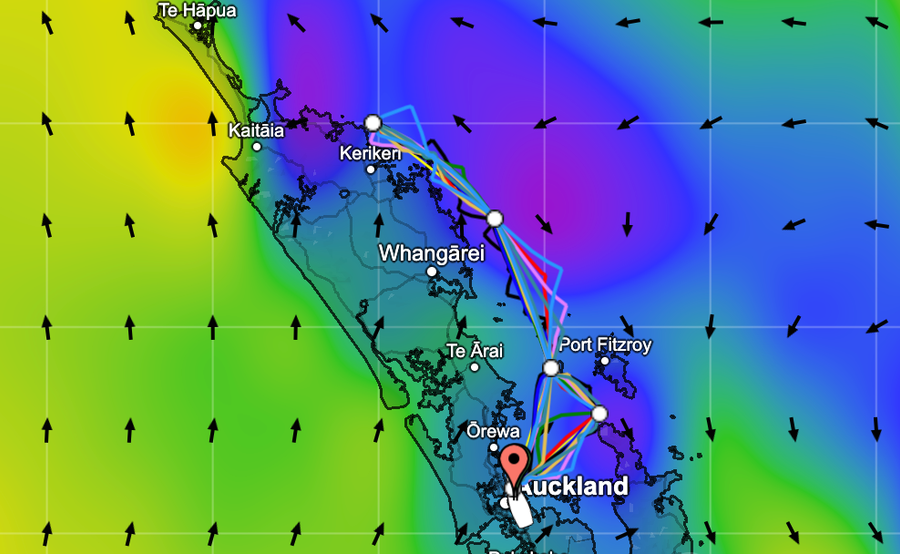
The start of the 2026 Doyle Sails Cavalli Islands Race is still three days away, and November weather in New Zealand has a habit of tearing up Tuesday's forecast long before the gun. The navigators will already be poking at the numbers, though, and so have we. The early PredictWind routing has the fleet running north in a south-westerly on Friday night, then grinding to a near halt off Northland on Saturday evening.
The first warning signal sounds at 6.25pm on Friday 20 November, with the fleet starting at 6.30pm from outside the Royal Akarana Yacht Club. No two boats in it share the same size, weight or polars, so we routed a pair of quite differently sized boats, a Young 88 and a Sun Fast 3300, through all eight models PredictWind offers: ECMWF, PWG, PWE, GFS, AIFS, UKMO, ICON and PWAi.
Downhill to the Cavallis
The start should be a downhill affair. Every model has a south-westerly at the gun, mostly 8 to 13 knots, and the routing sends boats north with the breeze well aft, gybing up through the Gulf at true wind angles of 130 to 170 degrees. PWG is the optimist of the bunch. It builds the breeze to 18 or 19 knots by about 8pm, which would give the fleet a quick first night.
By Saturday morning the wind is backing round through south and southeast until it settles in the east at about midday. It loses strength on the way round, dropping to 6 to 9 knots in most models.
The Young 88 reaches the Cavallis between about 11.15am in PWG and 4pm in ICON, with most models putting it there between 2pm and 3pm. The turn for home puts the boats on the wind in a light easterly to north-easterly direction.
Parked off Northland
In the models, Saturday evening is where it gets ugly. A transition zone settles over the fleet, and the wind goes right round the compass, from north-east through north and west to south-west. Several models take it close to calm. PWG has the Young 88 sitting in 1.6 knots at about 6.50pm and making half a knot. PWE drops to 2.5 knots and UKMO to 2.7 at around the same time, while ICON bottoms out at 2.5 knots after 9pm.
In the routing, how long a boat sits in that hole accounts for most of the gap between the quickest and slowest finishes.
The long way home
A new southerly to south-easterly fills in overnight, usually 7 to 10 knots, and Sunday morning becomes a beat back down the Northland coast. PWE is kinder than the rest, with 13 to 14 knots in the early hours.
Most models then swing the breeze into the north-east during Sunday, freeing the boats for a run towards the Gulf. PWE and UKMO give them 14 to 15 knots for it and have them tied up by mid-afternoon. In the slower models the north-easter turns up later and with less in it.
ECMWF and ICON save the worst for last. Both bring in a northeasterly of around 10 knots on Sunday evening, then let it die to about 3 knots with the finish almost in sight. In those runs the last few miles become a drift that drags on into the early hours of Monday.
Eight models, eight finish times
Ask eight models when the boats will finish, and you get eight answers. The Young 88 is home in anywhere from 43 hours to just under 54, depending on the model. The Sun Fast 3300 takes between 43 hours 41 minutes and almost 57 hours.
On the clock, the quickest runs (PWE, PWG and UKMO) have boats crossing the line early to mid Sunday afternoon. ECMWF and ICON don't get them in until after midnight.
| Model | Young 88 elapsed | Young 88 finish | Sun Fast 3300 elapsed | Sun Fast 3300 finish | Young 88 distance |
|---|---|---|---|---|---|
| PWE | 1d 19h 00m | Sun 1.30pm | 1d 19h 41m | Sun 2.11pm | 290 nm |
| PWG | 1d 20h 18m | Sun 2.48pm | 1d 22h 32m | Sun 5.02pm | 289 nm |
| UKMO | 1d 21h 24m | Sun 3.54pm | 1d 22h 11m | Sun 4.41pm | 292 nm |
| GFS | 1d 23h 02m | Sun 5.32pm | 2d 1h 39m | Sun 8.09pm | 295 nm |
| AIFS | 2d 1h 44m | Sun 8.14pm | 2d 4h 13m | Sun 10.43pm | 302 nm |
| PWAi | 2d 2h 03m | Sun 8.33pm | 2d 3h 36m | Sun 10.06pm | 311 nm |
| ICON | 2d 4h 34m | Sun 11.04pm | 2d 8h 34m | Mon 3.04am | 297 nm |
| ECMWF | 2d 5h 55m | Mon 12.25am | 2d 8h 53m | Mon 3.23am | 321 nm |
Elapsed times are cut to the whole minute so they line up with PredictWind's finish times. The distance column shows where the time goes. On a course of about 275 nautical miles, the quicker models keep the Young 88 to around 290 miles sailed. ECMWF sends it more than 320 miles chasing pressure.
Where the hours go
PredictWind's data breakdown fills in the detail. In each pair of figures below, the first is the Young 88 and the second the Sun Fast 3300, with the models listed from fastest to slowest.
| Model | Avg wind (kts) | Max wind (kts) | Time under 8 kts | Upwind / reach / downwind, Young 88 | Upwind / reach / downwind, Sun Fast 3300 |
|---|---|---|---|---|---|
| PWE | 9.8 / 9.8 | 15.5 / 15.4 | 25% / 27% | 26% / 47% / 27% | 31% / 43% / 26% |
| PWG | 9.0 / 9.0 | 18.9 / 18.9 | 49% / 55% | 7% / 53% / 41% | 5% / 45% / 50% |
| UKMO | 9.7 / 9.8 | 14.2 / 14.6 | 24% / 22% | 34% / 15% / 51% | 41% / 7% / 52% |
| GFS | 7.7 / 7.4 | 10.9 / 10.9 | 54% / 58% | 18% / 33% / 49% | 21% / 29% / 49% |
| AIFS | 7.9 / 7.7 | 10.7 / 10.7 | 51% / 54% | 46% / 21% / 33% | 46% / 21% / 33% |
| PWAi | 8.0 / 7.9 | 10.6 / 10.7 | 62% / 62% | 46% / 4% / 50% | 44% / 7% / 49% |
| ICON | 6.9 / 6.9 | 10.0 / 10.0 | 64% / 65% | 26% / 23% / 51% | 32% / 18% / 49% |
| ECMWF | 7.9 / 7.7 | 11.0 / 11.0 | 49% / 52% | 47% / 4% / 48% | 49% / 4% / 47% |
Light air is what separates the quick runs from the slow ones. PWE and UKMO keep both boats under 8 knots for 22 to 27 per cent of the race and average close to 10 knots. In the slower models the boats spend half to two-thirds of the race under 8 knots, and ICON is the worst at 64 to 65 per cent, averaging 6.9 knots. PWG bucks the trend. It has around half the race under 8 knots, yet still finishes early on the back of that 19-knot ride north on Friday night.
How much windward work the fleet faces depends heavily on the model. PWG has barely any, 5 to 7 per cent, while ECMWF has the boats on the wind for close to half the race. It all comes down to how far the breeze swings on Saturday and how long the Sunday beat lasts.
None of the eight models shows sustained winds above 20 knots along either simulated course. The routing also keeps seas under 2 metres, forecasts no rain and shows little thunderstorm energy, with CAPE peaking below 34 J/kg. It points to a mostly light-air race, but crews will still be watching the gusts, the sea state and every forecast update before they settle on sail choices.
The weather calls the shots
The Young 88 and Sun Fast 3300 are in this exercise to give a feel for the fleet, not to tip a winner. In every model they see near-identical conditions. Where their numbers part company, the Sun Fast 3300 tends to log a little more time under 8 knots, largely because it is still at sea when the breeze goes soft.
The gap between the two boats is small beside the gap between models. In PWE and UKMO they finish within about 45 minutes of each other, and elsewhere the margin grows to two to four hours as the light patches stretch out any difference in pace. Set that against the spread between models: almost 11 hours for the Young 88 and more than 13 hours for the Sun Fast 3300. At this stage the weather matters far more than the boat, and while every crew will run its own polars and get its own numbers, they'll all be sailing into the same holes.
Early days
This is a broad-brush look from three days out. Both routings use PredictWind's stock polars for the Young 88 and Sun Fast 3300 at 100 per cent, with Mercator currents and no motoring. The crews on the start line will have proper polars and a far better feel for how their boats go in the light.
The weather will have its say before Friday too. November in New Zealand rarely sticks to a script, and the models should start to come together as the week goes on. We'll keep running the numbers right up to the 6.30pm start.
Open the live tracker full screen
Then we'll see how close the models got. Our new trackers will be on every boat in the fleet, and we'll be running live coverage from Friday evening, so you can follow the race all the way to the Cavallis and back and watch who finds a way through the Saturday night hole.