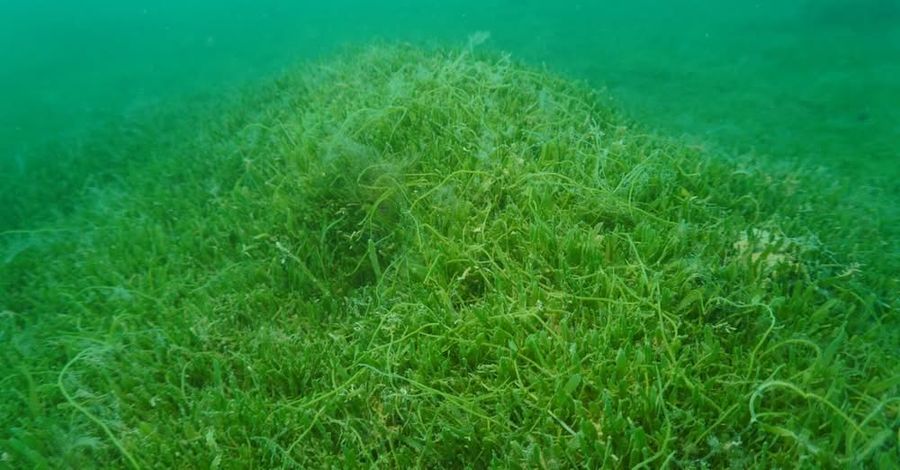
Caulerpa is a fast-spreading seaweed that carpets the seafloor, smothering kelp, shellfish, and virtually everything else in its path. Its spread through New Zealand waters has drawn a response involving new technology, iwi leadership, and growing pressure on government to act more urgently.
Nicola MacDonald, chief executive of the Ngati Manuhiri Settlement Trust, knows what is at stake. Her iwi's territory covers Kawau Island and Little Barrier Island, both among the 11 areas where the pest seaweed has established a presence. She points to Great Barrier Island as a cautionary tale of what happens when the response falls short.
"When caulerpa first got here, government really struggled with how to address caulerpa and take real proactive action, and we saw what happened at Great Barrier Island. It went from 60 hectares to now it's well and truly over 2000 hectares. So that's an absolute indication of how we take it seriously. And government isn't taking it as seriously as they need to."
Ngati Manuhiri recently produced a short film bringing together voices of iwi from the Hauraki Gulf and Coromandel through to the Bay of Islands. The shared threat of caulerpa has become a unifying force across those communities.
"We certainly don't want to leave the Hauraki Gulf in a much worse state for our mokopuna, our grandchildren and our children that inherit from us. So for all of those iwi that have been battling the invasive species such as caulerpa, that has been the single uniting moment."
A national caulerpa strategy has been drawn up and sent to Biosecurity Minister Andrew Hoggard. MacDonald is watching closely to see what follows.
"My understanding is that he was taking it through to Cabinet and there may be further budget, well there will have to be, further budget in order to deliver on those milestones that the strategy recommends."
On the government side, MPI director of readiness and response John Walsh noted that $25 million had been spent prior to this year on efforts to contain the alga.
"I think we're actually in quite a good place through some good planning and some good management and also some good luck."
That luck has taken the form of caulerpa dieback at several sites monitored by NIWA, among them Great Barrier Island and Omakiwi Cove in the Bay of Islands. Walsh acknowledged that the reasons behind the retreating growth remain elusive. "It's a bit of a mystery, we'll still be continuing to examine it this year." There is no guarantee the dieback will continue.
"This summer will be very telling," Walsh said. "The waters are starting to warm up already. Warm waters mean more growth, unfortunately."
Two New Zealand companies are developing technologies aimed at tackling caulerpa on the seafloor.
Brook McRae runs Commercial Dive Specialists and brings a biosecurity background to the problem. His team built on an earlier technique that used chlorine-treated mats to kill caulerpa, then took the concept further. They dispensed with the mats entirely and developed a submersible enclosure, known as a rehabitat chamber, capable of moving across the seabed. Chlorine is pumped in, the caulerpa is treated, and the chlorine is then extracted before the chamber moves on, with none escaping into the surrounding water.
"They're actually just like an inflatable bouncy castle. But they're inflated with water, and that allows them to contour to the shape of the seabed," McRae said.
The chambers have proven effective at killing caulerpa, though regulatory sign-off is still required before higher chlorine concentrations can be deployed within the rehabitat enclosure.
A different approach is being pursued by Craig Thorburn of Advanced Aquarium Technologies, whose team is using UV-C light against the weed. The idea came from an unexpected source.
"I ended up talking to a chap in the USA, John Pelluccio, in Lake Tahoe. He was using UVC light to manage freshwater plants in Lake Tahoe. So that kind of set us on that journey of looking at is there an application here? No one had tried it in salt water. No one had tried it with a plant like caulerpa."
Testing carried out with the University of Auckland confirmed that UV-C light can kill caulerpa. The greater challenge has been engineering a vehicle capable of deploying that technology on the seafloor. Thorburn describes the current state of the equipment plainly.
"We like to think of it, it's still a bit of a Model T Ford. The frame of it and its workings are still off our original prototypes. We're building another unit in China at the moment that is another step towards something that would be a production model."
Both McRae and Thorburn's projects have received government funding.
Ngati Manuhiri is also looking beyond New Zealand's shores for answers. After bringing Californian experts to New Zealand in 2023, MacDonald attended Aqua Nor in Norway and came away convinced that overseas technology holds further promise.
"Having recently attended Aqua Nor in Norway, I saw a lot of technology that I think could be applied in New Zealand."
"Those are some of the conversations that I've had with Biosecurity New Zealand, that there's some tech overseas that I think we need to bring here and we really need to get on the job of getting rid of this stuff."
Whether full eradication is ever achievable remains an open question. Thorburn sees grounds for optimism in specific contexts.
"I think the chances of managing it, particularly in our anchorages and our open sandy shellfish habitats are quite high."
"I think there's a range of tools now that are available and they're not well practised by any means, but they exist and the knowledge exists to say yes, that could be tackled in response and we didn't have any of those possibilities, three or four years ago. We really would love to acknowledge that incredible leadership shown by iwi and local communities in tackling exotic caulerpa and from my experience, right from the very, very start, iwi have been right at the heart of this response."
With summer arriving and sea temperatures rising, MPI's advice to boaties in the top of the North Island is straightforward.
"If you're in the top of the North Island, if you pull up seaweed on your gear, on your anchor, on your fishing gear, no matter what it is, no matter where you are, it's really good practice to get into the habit of storing it safely on your boat, in a bag, in a bin, in a bucket, taking it ashore and disposing of it safely," Walsh said.