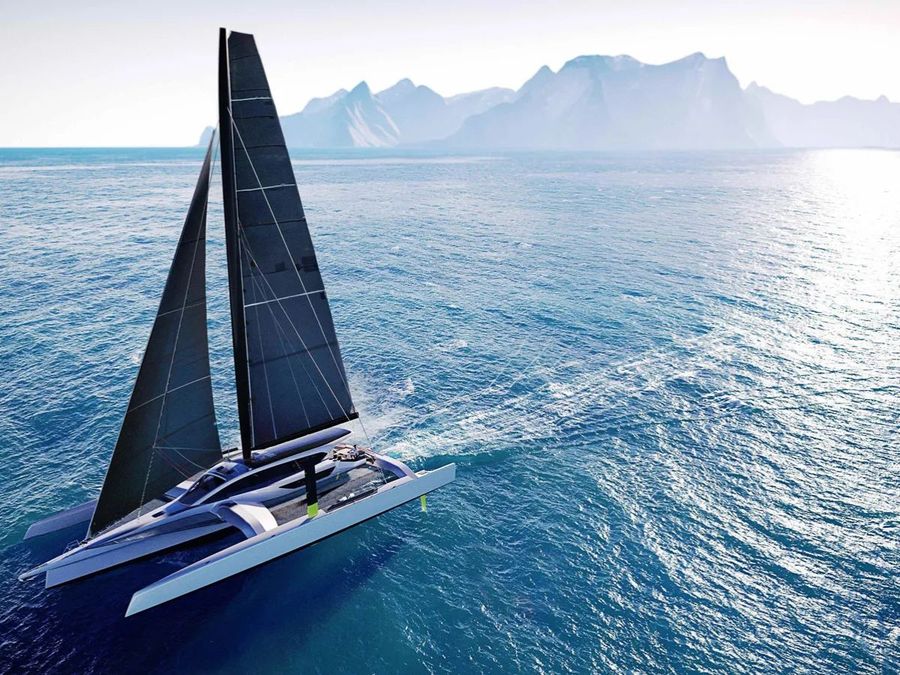
The world's largest cruising trimaran is being built from the same materials that lift Cup boats past 50 knots. What does that mean for tomorrow's cruising multihulls?
Carbon composite has been shaping high-performance boatbuilding for decades. It is not a new material, yet its influence keeps expanding. Advances in production methods now allow builders to work with it at levels of precision that were difficult to achieve even a generation ago. Prepreg fibres, carefully managed resin ratios, controlled layup environments and large-format oven cures give designers the consistency they need to produce ultra-light structures at superyacht scale.
Fibreglass still dominates the broader production market, but at the performance end of the spectrum, carbon has become the expected standard rather than the exception. It sits at the heart of the world's fastest sailing platforms, and it defines Anahita, a 30.5 metre cruising trimaran built entirely from prepreg carbon. Her construction does not introduce an unfamiliar material to boatbuilding. What it does show is how far that material can travel when a builder applies grand prix knowledge to a luxury cruising brief.
Cast an eye across today's elite racing fleets and a consistent picture emerges. Carbon composite is no longer an exotic or specialist choice. It is the baseline for any platform that demands high speed, low weight and reliable structural margins under extreme load. The SailGP F50s, the America's Cup AC75s and AC40s, the IMOCA 60s campaigned in the Vendée Globe, and the TP52, RC44 and International Moth classes all depend on carbon construction in almost every part of the boat. Hulls, decks, masts, foils and internal structural frames are built from advanced prepreg laminates cured at controlled temperatures. These structures carry loads that would destroy traditional materials, and without them, boats of this type could not foil, fly or sustain the repeated shock loads of hard offshore sailing.
That thinking has gradually moved into the top tier of performance cruising. Builders including HH Catamarans, Rapido, YYachts, Shogun and O Yachts now use extensive carbon construction to produce light, stiff platforms capable of high cruising speeds with modest crew requirements. Anahita belongs to this evolution. She follows the structural reasoning seen in racing fleets, but the application is a 100-foot trimaran designed for fast, comfortable offshore passages rather than podium finishes.
Global Yacht Technology is building Anahita using moulds developed by CDK Technologies for an ocean-racing prototype, a lineage that places her in the same design family as the Ultim multihulls. VPLP retained the long central hull and the wide 18.4 metre beam that define high-performance trimarans at this level, while Jean-Jacques Coste's interior work points toward long-range cruising comfort. The result is a vessel that carries a clear racing inheritance yet arrives fitted for life aboard rather than competition.
The full prepreg carbon structure, combined with a Nomex core throughout, holds displacement to around 28 tonnes. For a yacht of 30.5 metres, that figure is striking. It is that lightness, working alongside a carbon rotating wing mast and well-resolved hull lines, that underpins an expected cruising speed in the mid-20 knot range, with the capacity to push into the 30s when conditions allow. Anahita was not a racing platform softened with cruising fittings after the fact. She was engineered from the outset as a performance yacht capable of carrying a superyacht-quality interior without surrendering pace.
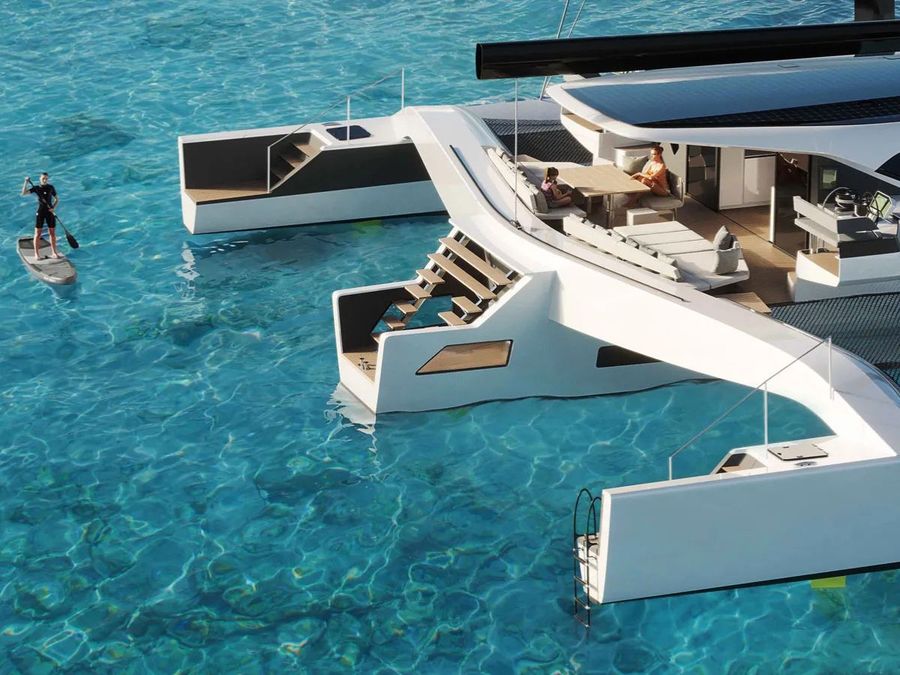
The hull form itself tells the story. At 30.5 metres, Anahita carries a long waterline, fine bow entries and the wide stance of the trimaran configuration, all inherited from her racing antecedents. With the boards raised, she draws only 1.8 metres, opening up shallow anchorages that would be closed to a comparable monohull. Drop the boards to 5.4 metres and she has the lateral grip required for serious offshore work.
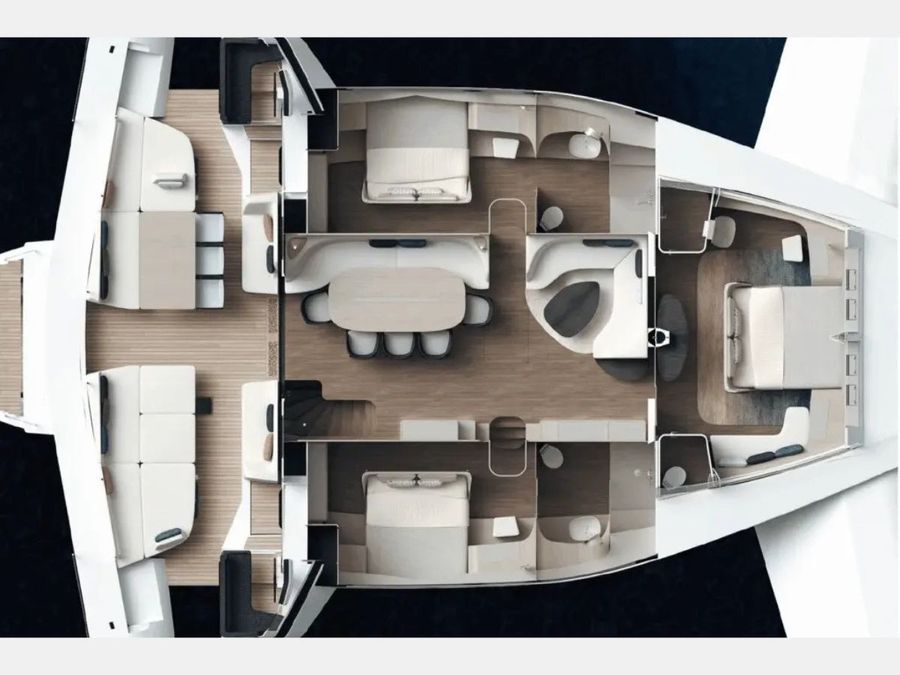
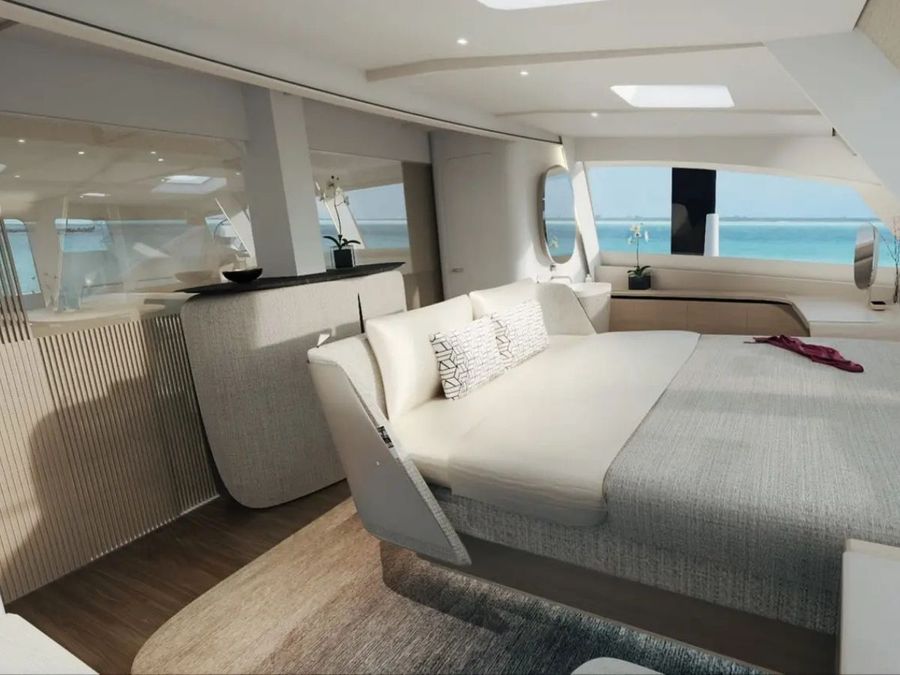
Step inside and the atmosphere shifts. The forward master suite spans the full beam of the central hull, with private access and generous glazing combining to create a quiet, light-filled space. Lightweight composite construction throughout helps damp noise and vibration while keeping the yacht within its strict weight targets.
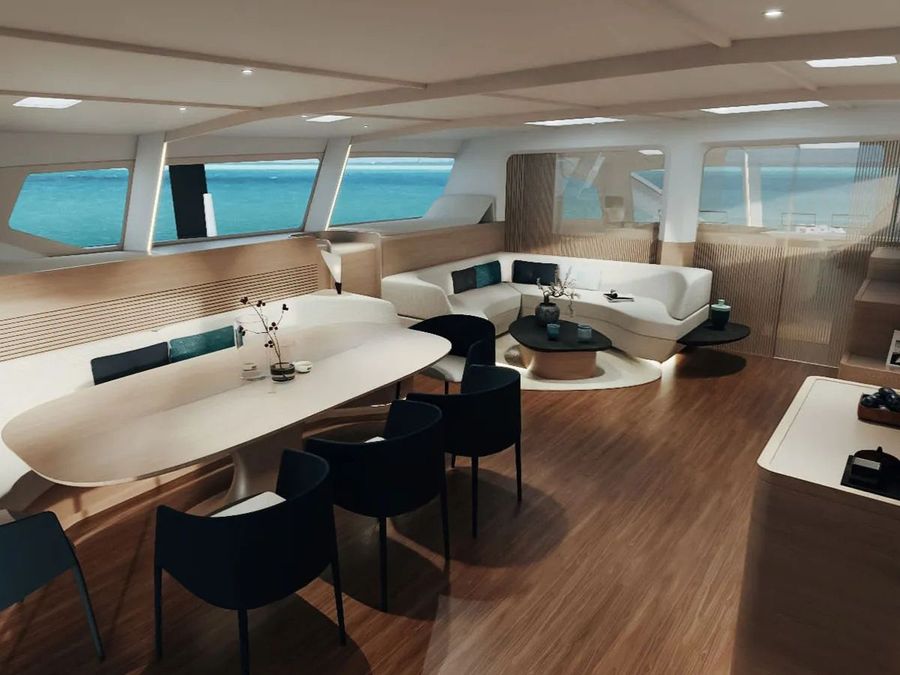
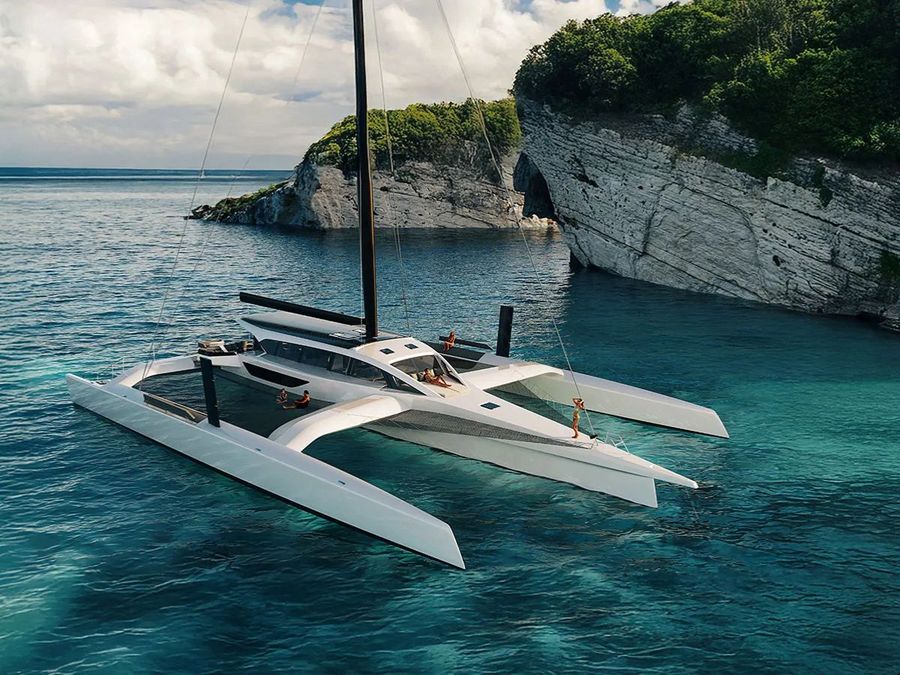
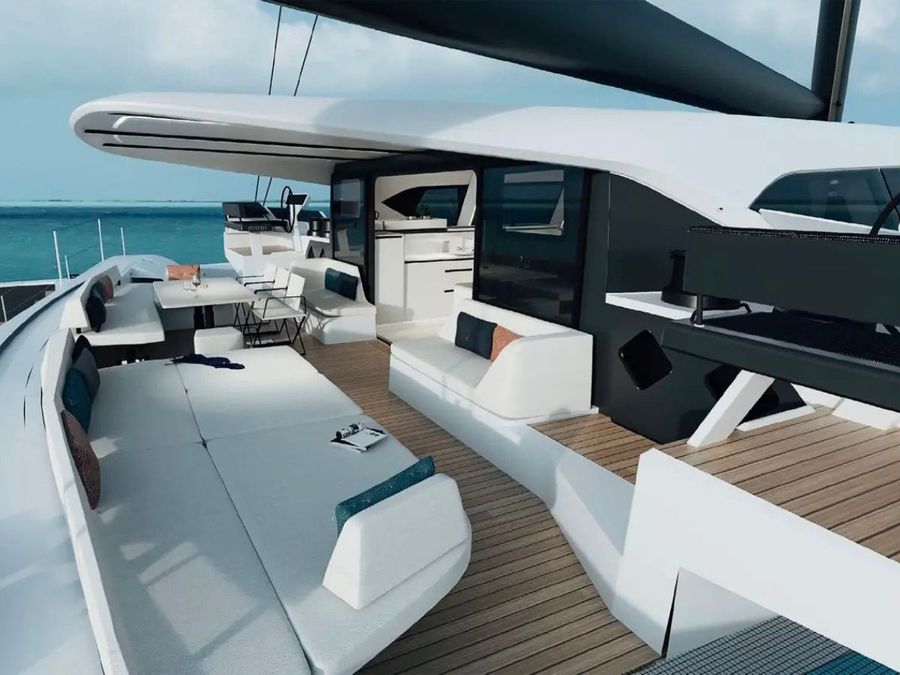
Accommodation for six to eight guests is arranged aft and amidships, designed with extended voyaging in mind. Crew quarters are positioned separately, suited to the demands of long offshore passages. The main saloon runs across the central hull beneath a low-profile coachroof fitted with wide glazing, delivering broad, unobstructed views without adding windage aloft. The protected cockpit aft serves as an outdoor living space, with seating and dining positioned close to the yacht's centre of gravity to minimise pitching on passage. The outboard floats house storage and technical systems, positioned low and wide to benefit stability and trim.
VPLP's ambition throughout has been to preserve the hydrodynamic purity of a race trimaran while meeting the expectations of privacy and comfort that a modern 100-foot yacht demands of its owner.
The project has already passed a significant milestone, with the complete main hull now finished. Global Yacht Technology is scheduled to move into full assembly in February as the amas, crossbeams and interior modules are brought together. Anahita is not conceived as a volume production model. The builder plans only two to four sisterships after the lead boat, a deliberately small run that will allow a close relationship with each owner and a more personalised level of support throughout ownership and voyage planning. It also confirms the yacht's identity as something genuinely rare rather than a series product.
Understanding why carbon composite delivers such a structural advantage at this scale helps explain why the approach matters. In a carbon composite panel, the fibres carry the structural loads and the resin holds everything in position. Add a lightweight Nomex or foam core and the result is a panel that is simultaneously lighter, stiffer and stronger than a metal equivalent. Prepreg carbon pushes that further, controlling resin ratios with precision and ensuring uniform consolidation across every part of the structure.
For large multihulls, these properties translate into meaningful performance gains. Lower weight means higher speed and improved motion at sea. Greater stiffness improves the efficiency of foils and reduces hull flex under load. Higher structural margins allow designers to pursue wider beams, taller rigs and more ambitious hull geometries. Better weight distribution lowers pitching tendency and improves overall balance. These are the reasons why performance trimarans and catamarans, from the ORMA 60s and Ultims through to the AC75s, AC40s and F50s, rely on carbon composite as a matter of course.
New Zealand boatyards are not strangers to this thinking. The country has a well-developed tradition with composite materials across a range of builders and scales. From carbon raceboats and foiling platforms through to custom carbon superyachts, advanced composite refits and even smaller recreational trimarans using carbon and glass sandwich construction for stiffness and responsiveness, the technical foundation is deeply established here. The knowledge that underpins Anahita is well understood in New Zealand yards. What differs is the scale of application, not the underlying philosophy.
Anahita draws together three worlds that have historically kept their distance from one another: racing multihulls, offshore cruising yachts and luxury superyachts. Her existence shows that high performance and genuine comfort are not competing values when designers apply carbon composite construction with discipline and purpose.
As the principles behind this approach continue moving into mainstream cruising, bringing lighter structures, stiffer beams and more considered weight placement with them, owners will find faster passages and better motion without sacrificing the comfort that makes long voyaging worthwhile. Anahita may well be the vessel we look back on as a turning point in how large cruising multihulls are conceived, built and sailed.