
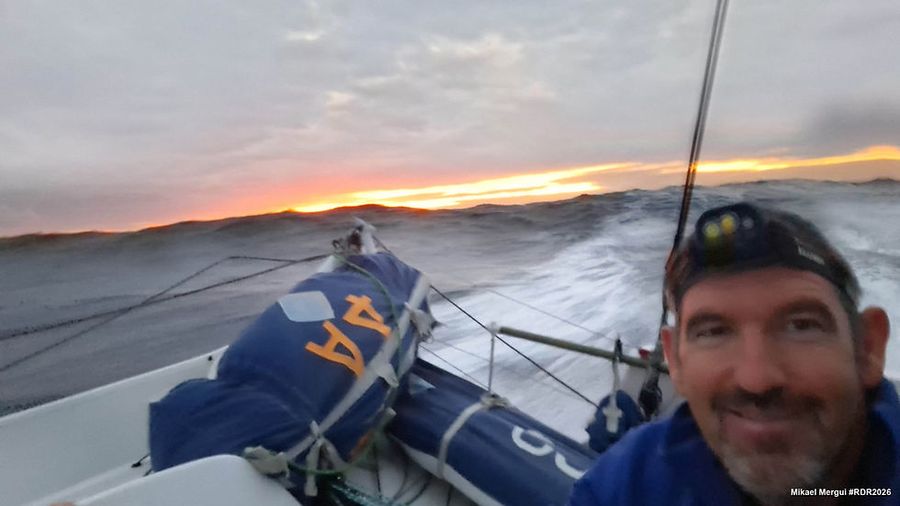
Two capsizes rattled the Route du Rhum fleet overnight, but the real story out front is Corentin Horeau, who continues to pull away on MACSF with the kind of controlled, aggressive sailing that has turned the IMOCA fleet into a procession behind him.
The race began like a downhill ski run, wide arcs and maximum speed. Around the Azores the slope steepens. Boats now need to carve the shortest line through a seriously rough patch of ocean, and Horeau is doing it close to perfectly, digging ever deeper into his lead. Basile Bourgnon on Edenred is managing the same trick in Ocean Fifty. The Class40s, meanwhile, are using a brief lull to brace for a depression due to hit the fleet from tonight.
The day's real news, though, is the double capsize. Ocean Fifty Elvest and the Ultim Maxi Banque Populaire XI both went over, sending a chill through the fleet. Mathieu Perraut and Armel Le Cléac'h are both fine, thankfully, but these incidents, coming on top of Francis Joyon's capsize earlier on Océans (Vintage Multi), are a blunt reminder that multihulls, big or small, remain high-risk machines.
"We're not at 150 percent, more like 90 percent downwind in decent conditions. If Armel was alongside, we'd be doing 45 knots," said a visibly shaken Tom Laperche (SVR Lazartigue), describing how he experienced his closest rival's accident almost as a neighbour. "Coming off the ridge, we headed toward the front, got knocked back by heavy rain, and by the time I'd tacked I had 30 knots. Just as I got the boat moving again, I got the message that Banque Populaire XI's EPIRB had triggered. It was a cold shower."
Race direction asked Laperche to divert toward the capsized trimaran's position. He reduced sail and was preparing to head upwind again when word came through that Le Cléac'h was unhurt, sheltering inside his boat, and Laperche was released from the assistance mission. His message afterwards is worth watching, a raw, genuine account of just how violently wind can shift on a multihull, and likely to stand as one of the most powerful testimonies of this race.
Erwan Stef, sporting director of Team Banque Populaire, has confirmed a tanker is now making its way to the capsized Maxi Banque Populaire XI. Actual Ultim 4 has also retired, leaving six Ultims still racing if you count Gitana 18, which is now sailing back to Lorient after damaging its port foil.
For now, Laperche can afford to ease off slightly, though the course ahead isn't clear either, with a tropical depression to negotiate Thursday and Friday approaching the Antilles. Louis Burton (Armand Thiery), racing his first Ultim campaign, showed no hesitation crossing the same front but sits more than 250 miles behind. Thomas Coville, second on Sodebo Ultim 3, chose a route closer to the direct line instead.
The top two are now effectively racing on parallel tracks, with noticeably better conditions for the leader. Coville used the light wind to serve his 45-minute penalty for a broken seal on his propeller shaft, and sits 170 miles off the lead. Worn down but no stranger to hardship, he admitted at the radio check-in that this Route du Rhum is "exhausting, because there's no pattern we know, that we have under control. It's not the postcard version, everything is wild."
Wild is also the word for what the Class40 fleet, and most boats still north of the Azores, are about to sail into. The large depression system activating tonight and over the following two days will affect roughly 90 percent of the 109 competitors still racing, following Alexis Loison's retirement after his Class40 Réel hit an unidentified floating object and turned back to the Azores. Conditions will vary considerably depending on how far west or south each skipper sits.
The leading Ocean Fifty boats, still headed by Bourgnon on Edenred, should break clear to the south fairly quickly. Second-placed Pierre Quiroga (Wewise), who admitted he's "not far from the fatigue limit," said he and his routers were looking for "a way through without getting smashed too badly." The strongest wind and roughest seas, for a tricky downwind passage, will be on the western side of the system. The four Ocean Fifty stragglers should find a passage between the islands of Flores and Faial, inside the Azores archipelago, now navigable in the race since the Cetacean Vigilance Zone restriction was lifted.
Most Class40s will cross ahead of the depression and face it tomorrow, with southeasterly winds of 25 to 30 knots and gusts to 40 as the front passes. The fleet is well spread out, still led south by Guillaume Pirouelle (Sogestran Seafrigo), who's found an excellent pacemaker in Pierre Leboucher (Institut Imagine). Robin Follin (Solano) sits 140 miles to the south, Ian Lipinski (Crédit Mutuel) 100 miles north.
Reached at check-in, Lipinski is enjoying pleasant sailing for now but braced for "40 knots on the forecast and waves up to 7 metres" in his sector. "I'm trying to remember the Southern Ocean to reassure myself, telling myself it's easier downwind and I've done it before," said the Crédit Mutuel skipper. Pirouelle wasn't willing to take the same risk: "I think that's bold. The routing backs him up, but you've got to be able to hold it."
In IMOCA, there's still a long way to go, and the 60-footers are better equipped to handle these conditions than the smaller boats. The question of the day is really about getting back to double-digit average speeds, and getting over the frustration of watching Horeau run away alone at the front, now 231 miles clear of second-placed Boris Herrmann (Malizia 4).
"It's cruel!" said Ambrogio Beccaria (Allagrande Mapei), flatly, now down in eighth more than 300 miles back after gambling on chasing the front north. It's turned into a real ordeal for Sébastien Simon (Groupe Dubreuil - Air Caraïbes), who has slipped to 17th and still hasn't found his rhythm. On his new Verdier design, he covered just 118 miles over the past 24 hours while MACSF banked 415.
Veterans of the IMOCA class struggle to recall such a gap opening up in a fleet that usually sails tightly grouped, with racing at every level of the board. Only Doldrums crossings have ever produced anything close, and even then, rarely like this.
This evening, though, Horeau, who pulled off a beautifully clean sequence of gybes down his lane, has eased slightly, and the pressure is building again behind him. Third-placed Francesca Clapcich (11th Hour Racing) is doing 11 knots, and Herrmann on Malizia 4 is over 15. With still 2,000 miles to Pointe-à-Pitre, hope remains for everyone back there. Just a little more for Horeau than the rest.