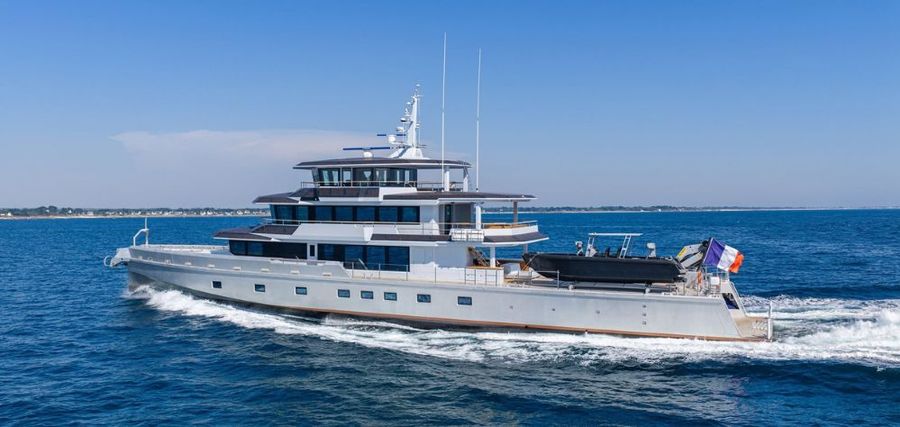
JFA Yachts has delivered CANOA, a 50 metre Explorer motor yacht that stands as the largest vessel the French shipyard has ever built, and the first Explorer of this size to combine an aluminium hull with a composite superstructure. Launched in January 2026 and handed over to her owner mid-year, she measures 49.95 metres overall with a 9.1 metre beam and a shallow 2 metre draft that belies her scale.
The construction choice is the real story here. The composite sections above the waterline cut weight aloft and lower her centre of gravity, which improves stability, fuel efficiency and comfort both underway and at anchor. It's a technique the yard built its name on through its Long Island catamaran range, now scaled up to something several times their length, and JFA points to that lineage directly as the foundation the project was built on.
Humphreys Yacht Design handled the naval architecture and exterior styling, and drew on its own Fast Displacement hull form, developed through extensive hydrodynamic studies, to deliver efficient long-range cruising without giving up the ability to push harder when conditions allow. Fin stabilisers and a gyroscopic stabilisation system keep motion down both at sea and at anchor, and the whole package is built around one number: a 5,000 nautical mile range at 12 knots, enough for genuine ocean crossings and extended stays somewhere with no marina in sight.
Propulsion follows the same logic. Two MTU diesel engines run in parallel with electric motors, letting the crew switch to electric-only power for harbour manoeuvres, low-speed cruising or sitting at anchor, cutting noise, vibration and local emissions. A battery bank and solar panels help carry that load, and a Dynamic Positioning System lets CANOA hold station automatically without dropping anchor, sparing the seabed beneath her in sensitive areas. The diesels take over for the long ocean legs, where range and reliability matter more than silence.
She carries two substantial tenders on a purpose-built aft deck. Boat International's coverage of her January 2026 launch adds that CANOA runs three cranes to handle her toy and tender inventory, including a dedicated davit for a 9.25 metre tender and a concealed foredeck crane for a rescue boat. Inside, the accommodation runs across four decks, designed by Milan-based m2 atelier, with extensive glazing pulling natural light through the living spaces. Boat International's fleet data separately lists capacity for 10 guests across five staterooms, with a crew of nine to ten and a gross tonnage of 498.
Sea trials are complete, and by JFA's account they matched the design predictions closely enough that Tom Humphreys, Managing Director of Humphreys Yacht Design, called the result "particularly rewarding." Frédéric Jaouen, President of JFA Yachts, put it more simply: "We are extremely proud of the result and delighted to see CANOA begin her life at sea." Fair enough, for a yard whose biggest previous project just got dwarfed by its own newest one.
It's worth noting how the two headline systems here are framed. The Dynamic Positioning System is pitched around protecting the seabed rather than just holding position, and the hybrid propulsion is sold on noise and emissions rather than top speed. Explorer yachts have always traded on range and remoteness. What's shifting, at least in how JFA is telling this particular story, is how much of that pitch now runs through measurable efficiency rather than adjectives. CANOA isn't the first hybrid Explorer to make that case, but her scale, and the fact she was built by a yard best known for lightweight aluminium catamarans, makes her one of the more credible ones.
| Yacht name | CANOA |
| Builder | JFA Yachts, Concarneau, France |
| Yard number | 32C |
| Type | Explorer motor yacht |
| Length overall | 49.95 m |
| Beam | 9.1 m |
| Draft | 2 m |
| Construction | Aluminium hull, composite superstructure |
| Naval architect | Humphreys Yacht Design |
| Interior design | m2 atelier, Milan |
| Propulsion | Parallel hybrid, two MTU diesel engines with electric motors |
| Range | 5,000+ nautical miles at 12 knots |
| Decks | Four |
Guest, cabin and tonnage figures per Boat International's fleet data, not confirmed by JFA Yachts directly. Crew capacity is reported as either nine or ten depending on source.