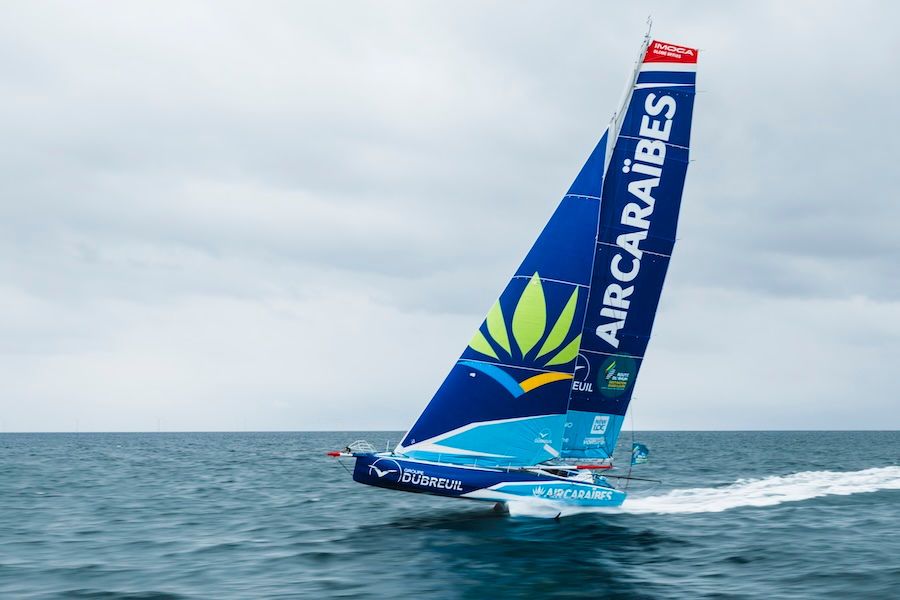
Sébastien Simon's new IMOCA looks nothing like the boat moored beside it on the pontoon.
Launched in July, Groupe Dubreuil - Air Caraïbes is the latest Guillaume Verdier design, and where neighbouring boats favour slim, beam-efficient hulls, this one is enormous by comparison. It has a higher freeboard, significantly more width, and bow sections pushing right to the edge of scow territory. Dockside wags have likened it to a wide-body jet parked next to a fighter plane, and it's not hard to see why.
Underneath, though, there is something unusual: a "bustle", a secondary, much narrower hull hidden beneath the main one, similar to the shaping seen on America's Cup boats and the upcoming Ferrari Hypersail. Martin Derville, the project's technical lead, explains the thinking. "The first benefit is to reduce drag when the boat is airborne, but it also produces a much softer behaviour in the sea. We're not trying to fly high like some others, but rather to have a cushioned passage through the waves and therefore high average speeds."
Derville trained in naval architecture at Southampton, started out at Mer Forte alongside Michel Desjoyeaux, then spent time with Juan Kouyoumdjian in Valencia. He's been with Simon since the project began, right after the last Vendée Globe finished. He admits the first images of Malizia 4 were a shock. "I don't think there have ever been such marked architectural differences across previous generations of boats. It's going to be interesting."
A wider, heavier platform raises an obvious question, given weight remains such a decisive factor in IMOCA performance. Derville doesn't dodge it. "The platform is heavier, that's true, and we accept it. But we've saved mass on the bulb, because the boat needs less righting torque to pass the 180-degree stability test." The coachroof isn't just about headroom below. It effectively forms a third hull shape, and if the boat capsized, it would help right itself, unlike flat-decked boats that can suction to the water and need heavier bulbs to break the roll.
The coachroof also gives the boat its look, with rounded portholes and sliding hatch covers lending an aeronautical feel. Solar panelling is neatly integrated across the surface, responding to new rules limiting diesel allowance. Derville reckons "one sunny day is enough to be self-sufficient in batteries for 24 hours."
Below deck, it gets stranger still. Gone are the usual bunks, replaced by two heavily padded carbon aircraft seats mounted on a scissor structure, hydraulically damped, adjustable to heel angle, and foldable into a bunk. "The story started with a business-class flight Sébastien took with the sponsor. On the way back he told me, Martin, we're putting the same seats in the boat. Once we saw their weight, we realised we'd have to rebuild them in carbon, but the result is very satisfying."
Each seat faces forward with excellent visibility, and a joystick allows helming from either side. "We wanted a restful way of steering, the opposite of having your head outside taking waves over you, or holding a tiller that always has slightly asymmetric, exhausting movements. The joystick is very pleasant, the movements are precise, and it has force feedback so you get the same feel as steering the boat directly."
Winches and control lines are tightly grouped around the cockpit, a deliberate choice: if Simon falls, he won't go far. The design reflects his history. He suffered a concussion during the Transat Retour à la Base and was unconscious for several hours.
The cockpit may be the most watertight in the IMOCA fleet, fitted with small rubber bulbs to inflate hatch seals and keep things dry. Comfort has become the real weak point in recent IMOCA campaigns, and Simon has clearly bet heavily on it.
Built by Jason Carrington, a boutique British yard known for high-end composite work (they built Alex Thomson's last Hugo Boss), the finish is immaculate. "When I look at the fabric on the bulkheads, I feel like I'm looking at the architect's drawings," Derville says, pointing to the crossing weave of twill and unidirectional carbon, matte black, with no filler hiding any imperfections.
The boat has raced just once so far, at September's Défi Azimut. But Simon, who finished the last Vendée Globe on the podium despite a broken foil, has never lacked appetite for performance. The Route du Rhum will be this boat's real test, right in among the expected showdown between Macif Santé Prévoyance (Sam Goodchild), Charal (Jérémie Beyou) and Allagrande Mapei (Ambrogio Beccaria).