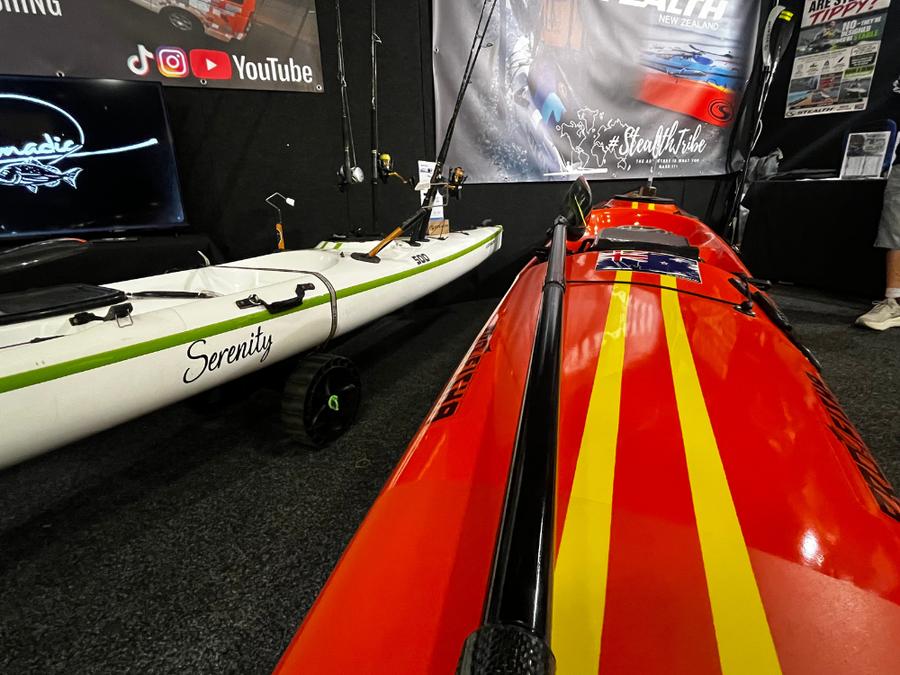
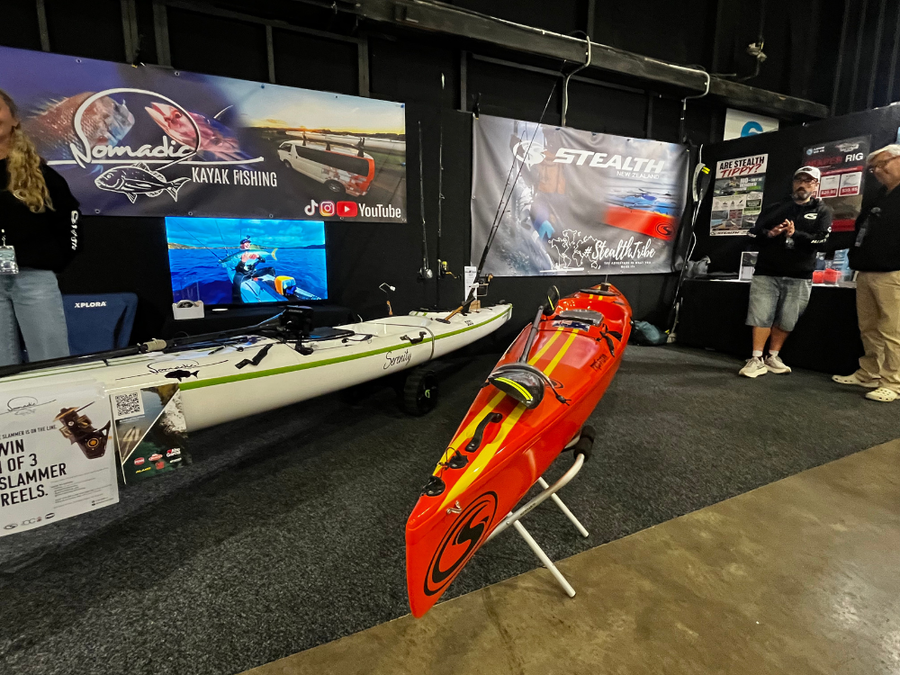
Two weeks have flown by since I met with Andrew from Stealth at the Boat, Fish, Dive Expo at the
Mystery Creek Events Centre. He was able to introduce me to Stealth, their kayaks, and a bit about the business he leads here in New Zealand.
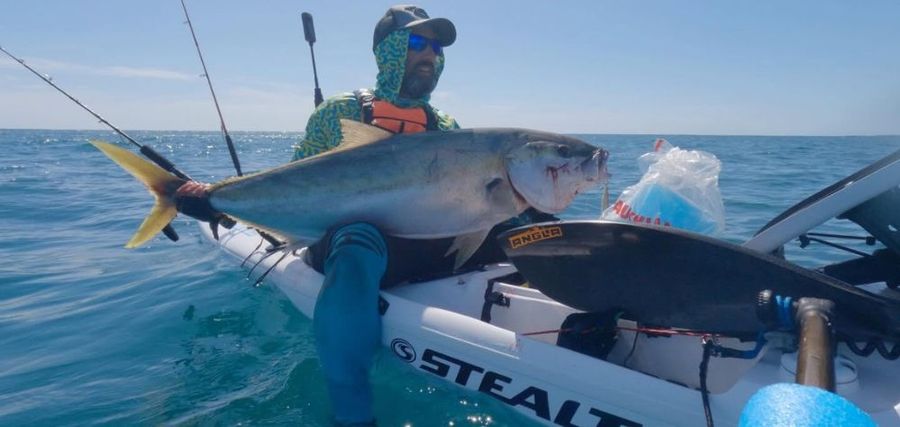
A 20 kilogram kingfish, sealed in the hatch, coming home through the surf at Murawai without a drop of spray reaching it. That's the sort of afternoon Stealth Kayaks New Zealand's Andy Hitchcock has come to expect from a design that started life on the other side of the world, built for racing rather than fishing.From surf ski to fishing machine
Stealth was founded in South Africa in 1998 by father and son Bruce and Brett Challenor, initially building high performance racing kayaks before the fishing side of the business took over. Bruce had been laying up fibreglass since he was 16, shaping his own surfboards long before he turned to kayaks, and later went back to study CAD so he could draw his own hull designs rather than hand them off to someone else. Brett came at it from the paddling side, racing for South Africa in surf lifesaving before the pair went into business together, and it was that background on the water that shaped the first Stealth hull.
The company now builds around 600 kayaks a year out of its factory in Tongaat, on the coast just north of Durban, and ships to 11 international distributors, with more talks underway. Every hull still carries the surf ski influence Brett brought to the original design: a fast, narrow shape adapted to carry rod holders, a live bait tank and enough sealed storage to keep the deck clear while punching through a break.
A local convert turned distributor
Hitchcock picked up the New Zealand distribution rights two years ago, but he'd been paddling Stealth kayaks for years before that. He started out on a secondhand Warehouse kayak that leaked, moved on to a Torpedo7 fishing model, and eventually had a South African friend point him toward Stealth. What sold him was watching Rodney Pacitti (aka RoKKiT KiT), an Australian kayak fishing YouTuber, taking Stealth kayaks through heavy surf on video after video.
He now fishes out through the surf at Murawai chasing kingfish and other pelagics, and paddles a hybrid 530, the narrowest hull in the range, laid up with a single carbon layer over a fibreglass core for extra stiffness through the water.
Construction and the range
The standard Stealth build is three layer fibreglass, a fibreglass core between two fibreglass skins and finished in gelcoat. From there, buyers can step up to a hybrid layup with one carbon layer, a full carbon hull, or carbon Kevlar for those chasing the lightest, stiffest kayak on the water.
Four series are currently sold in New Zealand. The Fisha range covers the 460, 500 and 555, and the Pro Fisha series, which gets carbon hatch lids and a carbon rudder as standard, runs the 475, 525 and 575, the last of those the longest and narrowest hull Stealth builds. Alongside them sit two rotomoulded plastic ranges, the Elite 530 and the entry level Fusion 350 and 480, both under two thousand dollars and still built to the same hull profile as the fibreglass boats.
Length is what sells speed. A longer waterline moves faster for the same paddling effort, which is why the range runs from the 4.6 metre models through to the 5.75 metre Pro Fisha 575, Stealth's biggest kayak.
Why the hull shape works
The bow carries a V to split waves and chop cleanly on the way through, but the hull flattens out underneath the paddler for stability. Lean into that edge and it locks, giving a firm, predictable point of stability that lets the kayak move with a wave rather than get knocked around by it, a different feel to the V hulled kayaks a lot of paddlers start out on, which tend to tip the moment you lean rather than settle.
The narrow, buoyant hull also makes getting back on after a capsize easier than it is on bulkier plastic kayaks. Paddlers can lean across the deck in the water, flip themselves upright and slide straight back into the seat, without the deck clutter that makes remounting some other kayaks a real struggle.
Pedal steering, explained
The foot pedals aren't primarily there to steer. Their main job is giving the paddler something solid to brace against, so the power in each stroke comes from the legs rather than the arms. Pressing a pedal does turn the rudder, letting paddlers hold one consistent stroke pattern without switching sides, but that only works while the rudder's in the water. Once a wave lifts it clear, steering goes back to the paddle, same as any other kayak.
Getting one
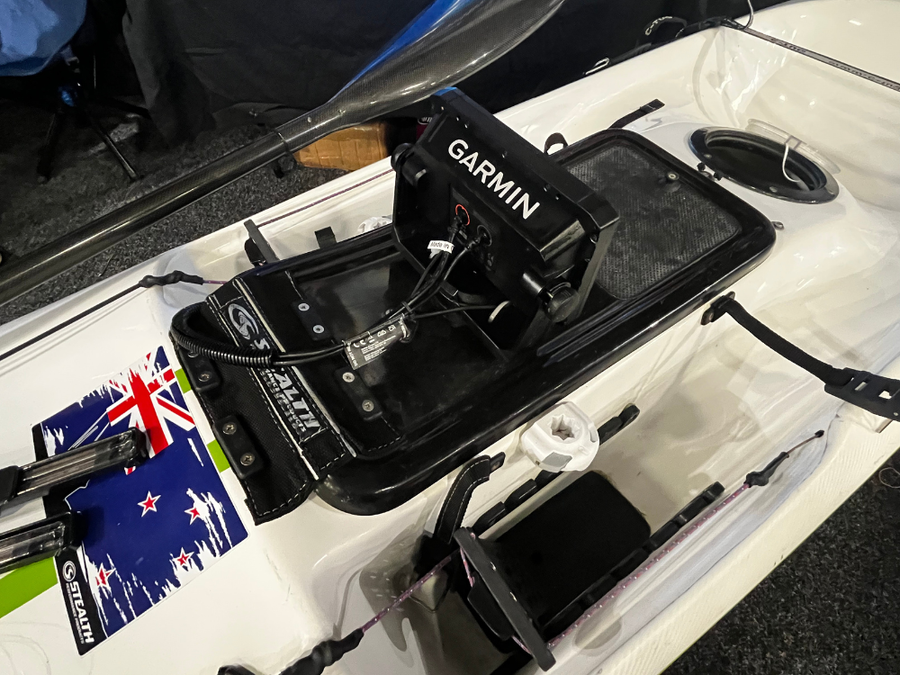
Buyers who want more than the standard colourways can go through Stealth's design your own kayak tool on the parent company's website, choosing hull graphics, base and tip colours and extras such as an additional rod holder, a fishfinder install or a folding rear hatch lid before the order goes in.