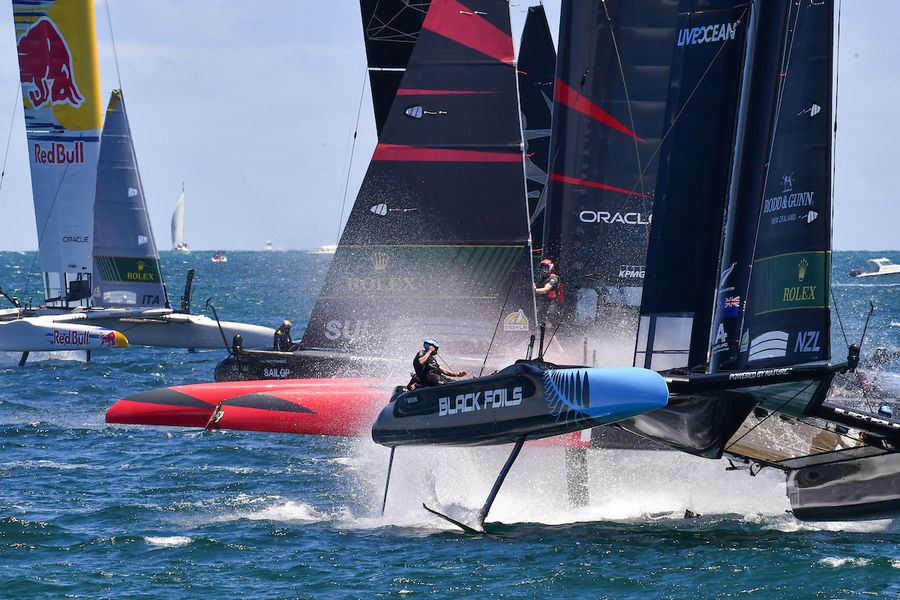
New Zealand's sailing fans received welcome news when the Black Foils were cleared to race at the ITM New Zealand Sail Grand Prix, following a major structural recovery effort that saw Amokura pieced back together against the clock.
The F50 had suffered serious port hull damage at the Perth season opener, an incident that ended the team's racing at the first event and triggered an immediate, complex rebuild operation. The forward hull section made the journey by ship from Australia, while SailGP Technologies in the UK fabricated a new stern section and flew it directly to Auckland. Once both components arrived, they were structurally bonded and blended before Amokura was returned to SailGP's technical base earlier in the week.
From that point, the technical crew worked through a full reinstallation programme. Steering systems, hydraulics, electronics, rudders and foils all had to be refitted, then subjected to precise alignment and calibration across thousands of onboard data channels. Every control surface and every data stream required individual verification before the boat could be signed off for sailing.
Co CEO and Driver Peter Burling made no attempt to hide his relief at getting back on the water. "We're stoked to be out there again," he said.
He was candid about the circumstances that led to the situation. The Perth collision not only ended their racing prematurely but also brought the first driver demerit points of the season. Burling acknowledged that Amokura had not turned quickly enough in what he described as a grey zone decision, and that when a collision can be avoided in situations like that, it should be. Both teams were involved in the incident, and it now forms part of the broader learning curve for the championship.
The Swiss team, who completed a rapid turnaround of their own in the aftermath of Perth, described their one-day rebuild effort as vital to team development. High-speed foiling carries inherent risk, incidents will occur, and teams must evolve through them.
For the Black Foils, the compressed timeline between Perth and Auckland was the defining challenge. Watching a completely new stern section be fabricated, flown to Auckland and fully integrated in time for on-water testing underlined the scale of the operation. There would still be items to refine, but confirming systems integrity and rebuilding confidence on the water were the immediate priorities.
{{MEDIA_1}}
Amokura was scheduled for final dockside checks before launching ahead of the racing programme, with the team expecting to get out on the water for testing. Conditions in Auckland were far from cooperative. A choppy sea state, strong breeze and steady moderate rain combined to make the session more about systems verification than performance assessment.
A more settled forecast for race day was expected to give the team a genuine opportunity to stretch Amokura's legs before competition began in earnest. After days of work balanced on a knife edge, the Black Foils were set to take their place on the start line in front of a home crowd.