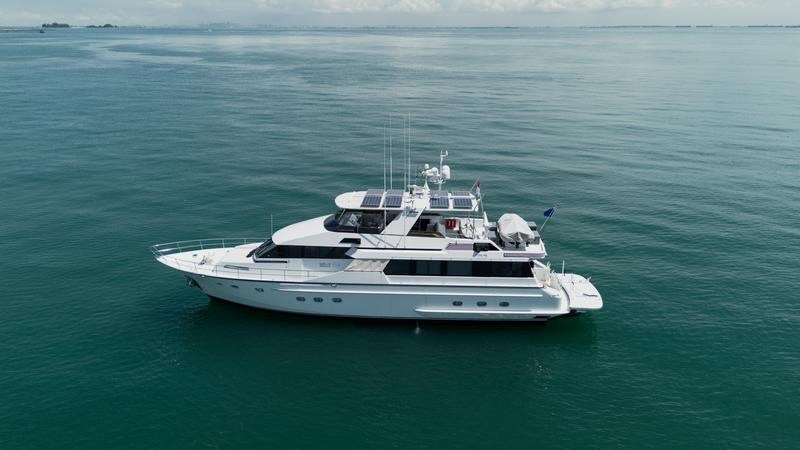
Braveheart 2 is a Lowland 80 motor yacht with genuine offshore credentials, built in Holland in 1987 by Neth Ships Lowland Yachts BV. Both the interior and exterior carry the work of designer Pieter Beeldsnijder, whose lines have held up well over the decades. The hull and superstructure are welded aluminium throughout, with a single hull and double bottom construction for structural strength. Twin screw propulsion and fin stabilisers deliver predictable tracking and a comfortable motion in lively conditions.
Measuring 25.75 metres overall with a beam just under six metres, Braveheart 2 sits in a useful size bracket for private offshore voyaging. A draft of 1.65 metres keeps a wide range of anchorages within reach. Fuel consumption across both engines and generators runs to around 57 litres per hour at a steady 10 knots, and range approaches 2,000 nautical miles. When conditions or schedules demand it, she can push to around 16 knots.
*Design and build pedigree*
The Beeldsnijder aesthetic gives this Lowland 80 a timeless appearance, with fair hull lines, a clean superstructure, and deck layouts that allow safe movement at sea. The design brief prioritised strength, ease of maintenance, and service access. Aluminium construction keeps displacement in check while resisting corrosion when properly maintained. The twin MAN D2842 LE diesels, each producing 769 hp, are mounted on solid foundations with adequate room for routine work. Shafts and running gear were renewed during the refit, leaving the drivetrain tight and well sorted.
*Range, efficiency, and systems on the Lowland 80 motor yacht*
Braveheart 2 is built for distance rather than sprint performance. At her natural passage speed of 10 knots, fuel burn is modest and the motion is easy, making extended offshore legs comfortable rather than merely survivable. Onboard tankage and generating capacity support independent cruising over weeks rather than days. The fin stabilisers earn their keep both at anchor and underway, reducing roll and easing fatigue on longer passages. The 2016 refit tackled the significant mechanical items directly: engine rebuilds, new shafts, new generators, tank replacement, and a full hull strip were all part of the programme, leaving a systems foundation with most of the costly work already completed.
*Interior layout and finish*
The accommodation carries a warm beech interior with contrasting dark timber trims throughout. The main saloon is carpeted and arranged for relaxed social use, with a bar, a generously sized C-shaped sofa, and a dining table that seats six. The open galley is fitted with granite countertops and contemporary appliances, keeping meal preparation straightforward whether the yacht is at a marina berth or several days offshore.
Sleeping arrangements are flexible and comfortable. The full-beam master stateroom has a queen berth and separate his and hers bathrooms. A VIP cabin sits forward, and two twin guest cabins each include Pullman berths, bringing total sleeping capacity to ten. The interior finishes read as warm and practical rather than showy or fragile, which suits a yacht intended for real voyaging.
{{gallery td_select_gallery_slide="slide" ids="153581,153580,153579,153584"}}
*Decks, handling, and watchkeeping*
From the wheelhouse, sightlines are clear and access to the side decks is direct, two qualities that matter when manoeuvring in confined marinas or managing ground tackle in an anchorage. The flybridge carries a central helm position, seating for guests, and storage for safety equipment, with a stainless Bimini frame providing shade overhead. Aft, the teak cockpit, large lazarette, and mezzanine seating area work together to create a space well suited to long evenings at anchor. Forward, a clean foredeck carries a sunpad and windlass, with enough room to work comfortably in a breeze. The deck layout points to a yacht designed for serious use rather than marina living.
{{gallery td_select_gallery_slide="slide" ids="153583,153577,153576"}}
*Where she has been and where she is now*
Braveheart 2 was originally built for the United States market before moving to New Zealand and subsequently to Australia, satisfying the safety requirements of each jurisdiction along the way. In 2016, she underwent a comprehensive refit at Boat Works in Coomera, Queensland, with a reported spend exceeding one million Australian dollars. She has cruised widely since then and currently lies at Nongsa Point Marina in Batam, close to Singapore, flying the New Zealand flag. That position makes her convenient for handover into South East Asian cruising grounds or for a straightforward passage toward the Indian Ocean.
*At a glance*
Year built 1987, refit 2016. Beam 5.86 metres. Draft 1.65 metres. Speed 10 to 16 knots. Gross tonnage 120. Power comes from two MAN D2842 LE diesels rated 769 hp, 573 kW each. Exterior and interior by Pieter Beeldsnijder. Construction by Lowland Yachts in Holland. Location Indonesia.
[embed]https://youtu.be/D9f_NXnotKQ[/embed]
Braveheart 2 combines proven Dutch construction, a substantial refit, and well-planned living spaces in one capable package. For buyers who want range, a comfortable motion, and a platform ready to go rather than ready for work, she is worth a close look.