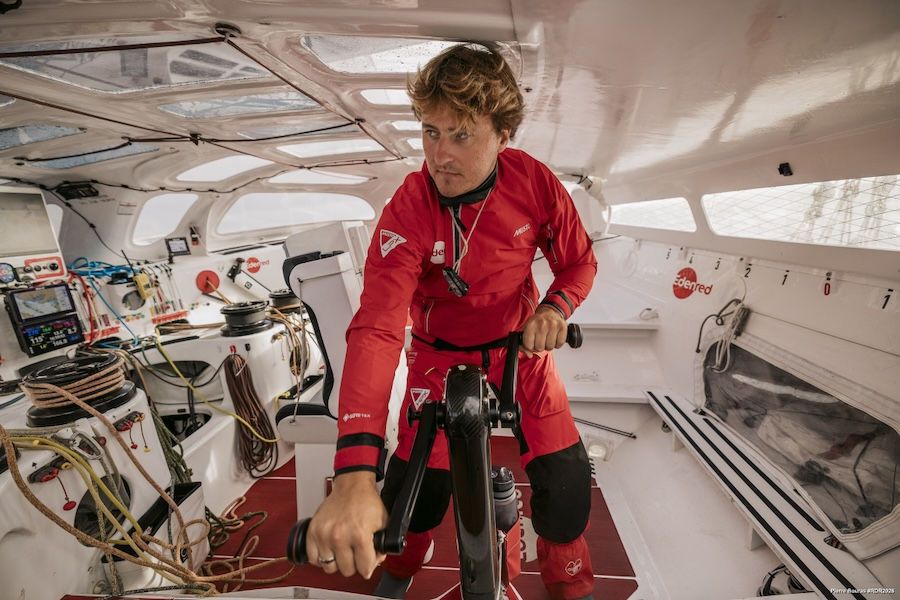
Basile Bourgnon carries one of sailing's most storied surnames into this year's Route du Rhum, and he is doing it without flinching. Nearly thirty years after his father Laurent Bourgnon claimed back-to-back victories in 1994 and 1998, Basile lines up as one of the favourites in the Ocean Fifty class aboard Edenred.
He sat down for an interview early in race week, newly arrived in Saint-Malo, before the media crush properly began.
Despite being tipped as a contender for outright victory, Bourgnon comes across as grounded. Asked whether there is room to enjoy the village atmosphere while also being in the hunt for a win, he does not hesitate.
"Yes, of course! We do this job to live out strong emotions, and that works just as well at sea as it does on land," he said. "It's a particular atmosphere, one I'd already experienced accompanying Emmanuel Le Roch (then skipper of Edenred) four years ago. When we went through the locks earlier this week, the team told me, 'right mate, this is it, there's no turning back now.'"
The Ocean Fifty class, he explains, demands total respect.
"It's a race that's anything but trivial. You can't go into it carelessly, without preparation. Our boats need a huge amount of energy, attention and precision. If you don't handle them well, they can be dangerous. But once you're up and running, they're extraordinary boats. They're light, fast, I'd even say they're alive! The power-to-weight ratio is insane."
That relationship with risk, he says, never lets up.
"There's a limit you can't cross. On these boats, we're always on a knife edge. Except if you don't get close to the limit, you're guaranteed not to win! In recent years the level in the class has gone up. Average speeds are higher and we've all pushed that limit further out. There's a lot more intensity now. Even the start of a race isn't a slow burn any more, it's electric from the off."
On being named favourite after a strong season, Bourgnon is matter-of-fact rather than boastful. He mentions tweaking the boat's interior layout himself, particularly to rest better during the race, something he believes could prove a real advantage over the Route du Rhum's distance.
Asked how anyone prepares for ten days of such intensity solo, he's refreshingly honest.
"I have no idea! The longest I've done solo on this boat was just under three days, at the 2026 Drheam-Cup, which he won. It was at a crazy pace, I only slept two hours... I know I couldn't keep that up for ten days! But adrenaline and the desire to win keep you awake. We're also lucky to have routers who push us and help us hold the rhythm. At some point it's like you turn into a robot to push the machine to its limits."
There's still room for pleasure out there, he insists, even if it isn't constant.
"It can be a bit stressful, a bit infuriating, especially when things aren't going your way. But I never forget to lift my head up from that because I want to enjoy myself. We live through fabulous moments. And the sunsets and sunrises, everything you see at sea, I remember them very clearly."
Inevitably, watching him race multihulls recalls his father. But the pull toward sailing, he says, wasn't forced on him.
"I started very young, at 11. I was too tall for the Optimist, and the only way to keep sailing was to switch to catamaran. We'd repaired a Hobie Cat that had washed up on the beach. My father bought it, and I've never stopped since. Even though I've sailed Mini and Figaro, I feel multihulls are where I express myself best."
"He never pushed me toward it. Never."
"We lived on a boat, so of course that draws you in a bit. But I also played plenty of other sports growing up. The only thing that mattered to him was that I saw things through to the end."
Seven years spent living aboard as a family left its mark, Bourgnon says, chiefly in the trust and independence it instilled.
"That's the kind of upbringing my father gave us. We always had a lot of freedom to express ourselves and be very independent. And alongside that, he was extremely demanding. I wasn't in school for long, but I was lucky enough to be self-taught, to learn from what I saw. The biggest quality my father passed on to me is the ability to adapt to any situation and any person."
At sea, he says, he feels entirely himself.
"When I'm at sea, I'm comfortable! Even knowing its dangers, I feel like I'm in my element, it's a bit like home to me... And I love the humility of the sea, the fact that you have to adapt to it, not the other way round."