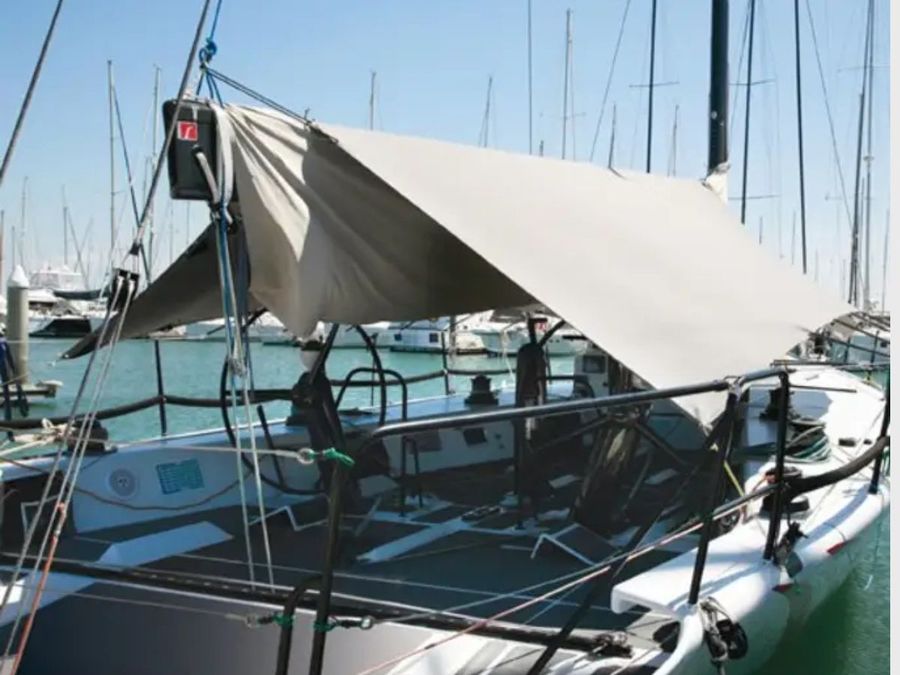
There is a moment at anchor when you realise the cockpit could be so much more than a place to sit and steer. Rigged over the boom and tied down to rails or the backstay, a boom tent awning transforms that open space into something closer to an outdoor room. Shade on sweltering afternoons, shelter when the drizzle rolls in, a dry place to sleep under the stars without waking up damp. For Kiwi sailors who spend real time aboard, it is one of the most quietly useful pieces of gear on the boat.
The difference becomes sharper when you live aboard full time. Our family of five calls a Jeanneau Sunkiss 49 home, and managing airflow is something we think about every single day. The roof hatch in the saloon is essential whenever we cook or boil the kettle. Leave it closed and steam builds quickly, condensation forms on every surface, and the interior feels oppressive within minutes. Products like the Kontrol Slimline Moisture Trap from Burnsco help manage residual moisture, but the better answer is stopping it from accumulating in the first place.
Rain over the past few days forced us to improvise. We stretched a blue tarpaulin above the open hatch, propped it at an angle and crossed our fingers. It kept most of the water out, most of the time. But the wind had other ideas. One decent gust and the whole arrangement shifts, sending us back outside to re-tension lines and fiddle with angles in the rain. It keeps the ventilation going just enough to be worth the trouble, but only just.
That recurring frustration is exactly what a well-fitted boom tent awning solves. The boom itself acts as a natural ridge pole, giving the awning structure, headroom and the kind of taut, rain-shedding profile that a loose tarp can never quite achieve. The flapping stops. The pooling stops. The airflow keeps moving. You stop going outside to fix things.
Why use them
New Zealand summers bring their own particular combination: intense UV, sudden passing showers and days when the air sits heavy and humid before the sky breaks open. A boom tent awning handles both sides of that equation. It blocks the heat radiating down into the cockpit, keeps rain off the open hatch while you cook in the galley below, and gives you somewhere to stretch out on deck without slowly cooking in direct sun.
Aboard a trailersailer on a weekend cruise, cockpit space has to work for everything at once, and a shade cover extends how long that space stays genuinely comfortable. During a wet week at anchor, it means ventilation through the boat without rain pouring in at every opening. The boom provides the shape; the awning does the rest.
Buying the easy way: the Burnsco boom tent awning
For most boaties, the straightforward path is a ready-made awning sized to fit a broad range of yachts. The Burnsco Boom Tent Awning is built to rig over the boom and tie down to rails, the mast or the backstay. The fabric is UV-resistant and waterproof, made with New Zealand conditions in mind. It comes in various sizes, with a rectangular shape that suits compact keelboats and older production cruisers alike.
It packs down small, deploys in minutes and adds minimal weight to the boat. For weekend cruisers, day-trippers and liveaboard families who would rather not wrestle a tarp into shape every evening, it is a practical and reliable solution.
When a custom or DIY option makes sense
Some owners want something that fits their exact boom height, follows the profile of their sail cover and lines up neatly with their lifeline positions. A canvas specialist can produce a tailored awning to those measurements, or you can make one yourself if sewing and pattern work appeal to you.
The DIY process follows these steps:
- Measure from the sail cover's spine down to the lifelines. - Cut two identical marine-grade fabric panels. - Hem all edges securely using UV-stable thread. - Install twist-lock fasteners along the boom-side edge. - Add spur grommets along the lower edge. - Sew the long centre seam that sits over the boom. - Tie the lower edge to the lifelines using a durable rope such as .
It is a satisfying project for anyone who enjoys working with their hands, though for most boaties the ready-made version covers every practical need.
Tips for setting up a boom tent awning
A handful of habits make the difference between an awning that performs well and one that causes frustration.
- Keep tension even across the fabric to stop water from pooling in low spots. - Use or shock cord to absorb load during gusts rather than letting the fabric take the strain. - Leave airflow open in hot weather rather than sealing the awning tight against the boat. - Check for chafe where the awning contacts the sail cover or topping lift. - Drop the awning before the breeze builds to a level that stresses the attachment points.
Once the routine is familiar, getting the awning up takes only a couple of minutes.
Cleaning and care
Salt and grime work into the fabric over a season, but a simple routine keeps an awning in good shape for years. Shake off any loose dirt, wet the fabric, then work over it with a mild cleaner such as 303 Multi Surface Cleaner applied with a soft sponge. Leave the cleaner to do its work for a few moments, rinse thoroughly and always dry the awning completely before folding it away.
A few habits extend the life of the fabric further:
- Avoid harsh chemicals and bleach entirely. - Check the stitching at the seams once or twice each season. - Rinse the awning after any salty passages. - Never stow it damp, as mildew sets in quickly in warm conditions.
Ready for summer
Before summer arrives, a boom tent awning is one of the simplest additions you can make to the boat. Whether a ready-made option from Burnsco suits your setup or you prefer to have one built to measure or tackle the project yourself, the result is more shade, better airflow and a cockpit that earns its keep from morning to evening. For families living aboard, it also removes that nightly negotiation with tarps and gusting wind, and that alone makes it worth the effort.