Few production cruising yachts from the 1980s carry their age with quite the same grace as the Beneteau Oceanis 430. Philippe Briand's design arrived in 1986 and immediately set a new course for the genre. While the dominant aesthetic of that era leaned toward traditional, enclosed interiors and dim saloons, Briand and Beneteau moved deliberately in another direction, placing interior volume, abundant natural light, and open-air deck living at the heart of the brief. Those choices, once considered bold, have since become the industry default. Production continued until 1993, yielding around 430 hulls, a substantial portion of which were delivered directly into Caribbean and Mediterranean charter fleets, where the yacht's ability to accommodate eight adults in genuine comfort made it a natural fit. This 1989 example, Titaua, listed from Marsden Cove in Northland, has much to offer the serious cruising sailor.
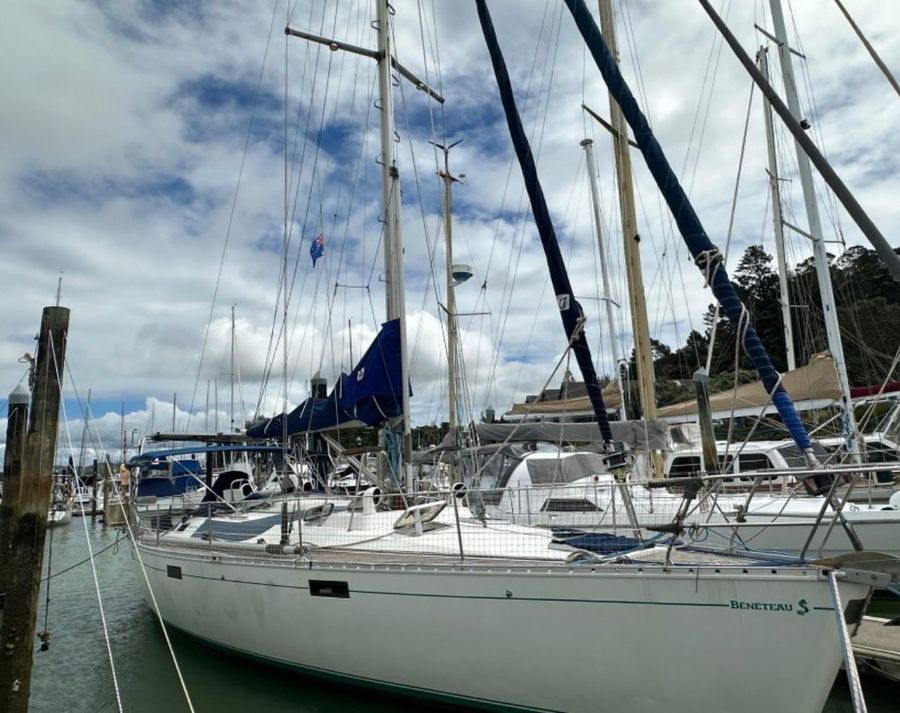
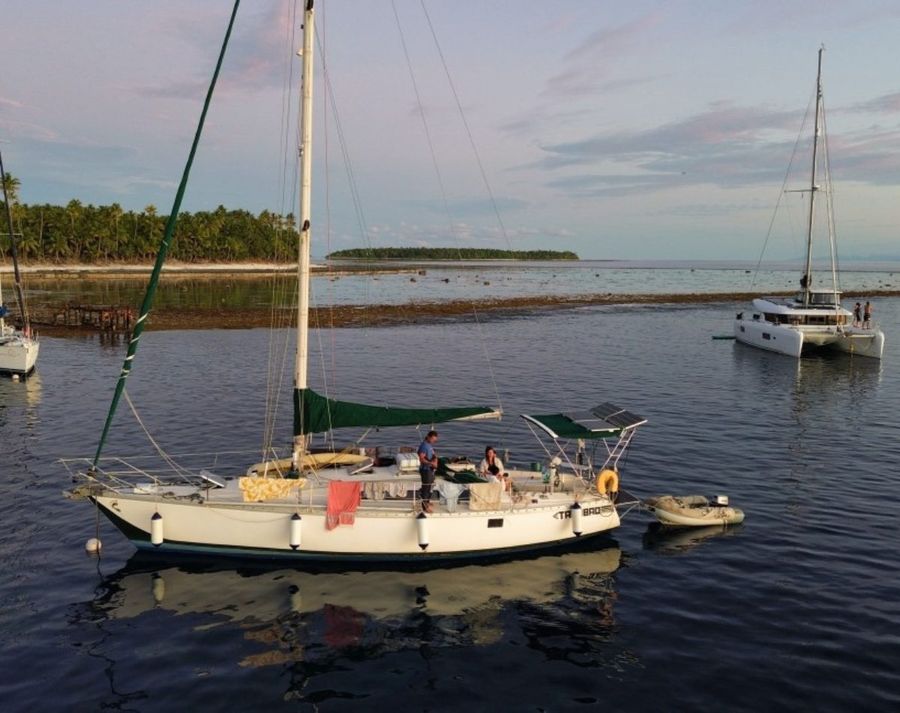
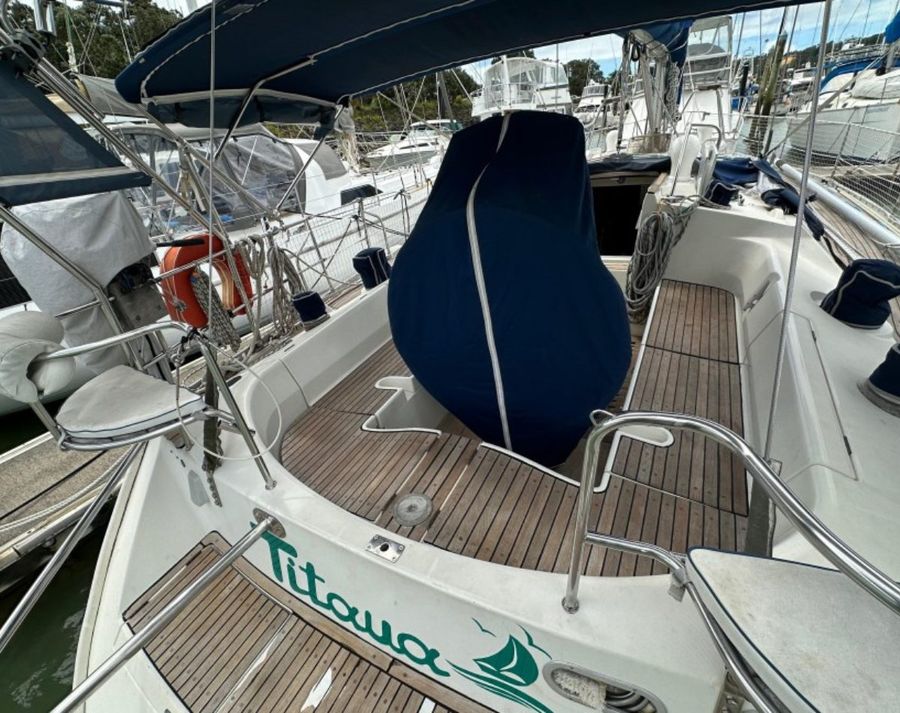
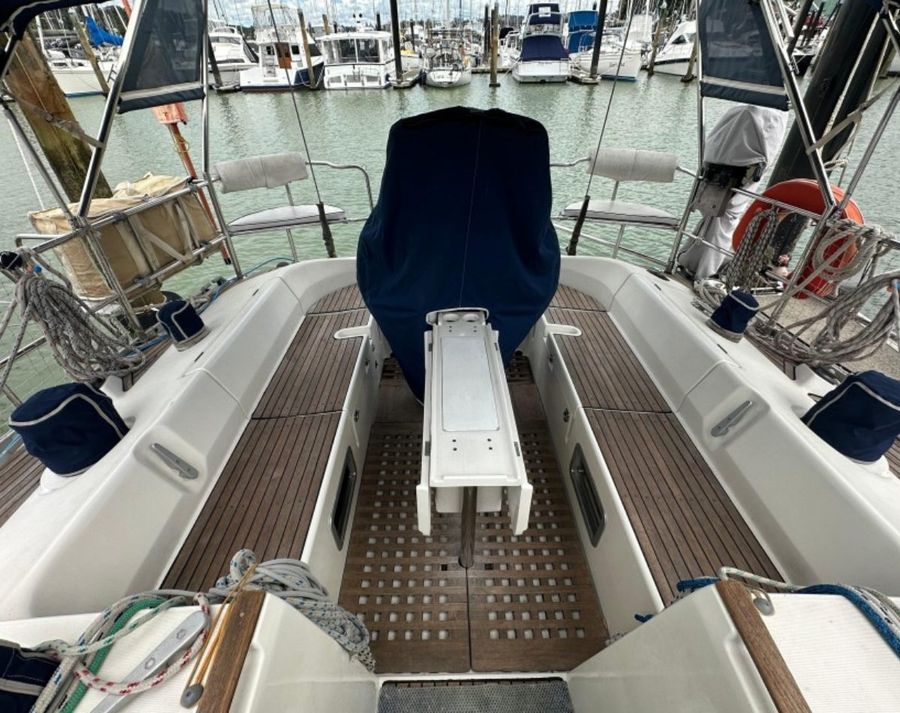
From the water, Titaua presents herself neatly. A dark blue waterline stripe runs the full length of the white hull, a colour echoed throughout the boat's dark blue canvas, and the mainsail carries matching dark blue trim on white. Underfoot, the deck combines teak and painted grip surfaces, and lifeline netting runs along each side for the full length of the yacht, a sensible arrangement for offshore passages or family sailing. The sail lines are tidy and well managed. Solar panels are mounted aft alongside a dedicated Starlink arm, taking care of both power generation and connectivity for extended time at sea. Getting aboard is straightforward via a swim platform and transom steps, and two raised navigator seats at the stern retain their teak in good condition. An outside collapsible table with cup holders completes a cockpit that suggests genuine passage-making intent rather than a vessel content to sit in a marina.
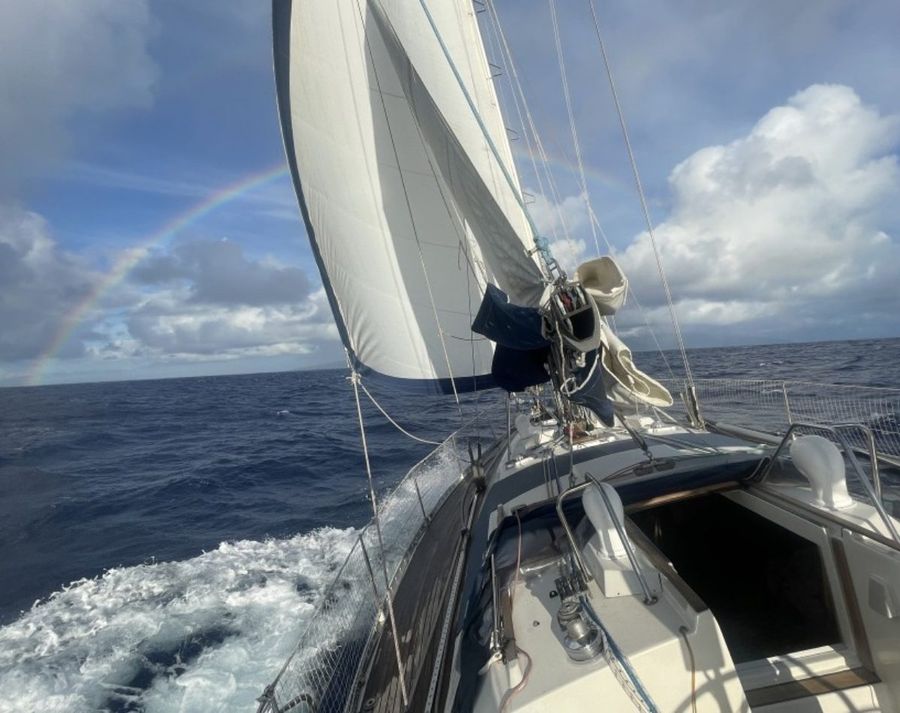
The 430's reputation at sea rests on a settled, confidence-inspiring character at the helm. Moderate displacement of around ten tonnes gives the hull enough momentum to push through a choppy head sea without the restless pitching that lighter modern designs can produce. A full-bodied midsection combined with a relatively flat underbody delivers strong initial stability, and those familiar with these yachts consistently describe a hull that feels stiff and secure as the breeze strengthens. The beam carries well aft, opening up a generous working cockpit, and the large-diameter wheel provides the leverage needed to manage the spade rudder with confidence. Experienced 430 sailors tend to recommend reefing early to keep the helm balanced as conditions develop. With a masthead rig that performs surprisingly well in light air, Titaua is a capable and versatile performer across a wide range of conditions.
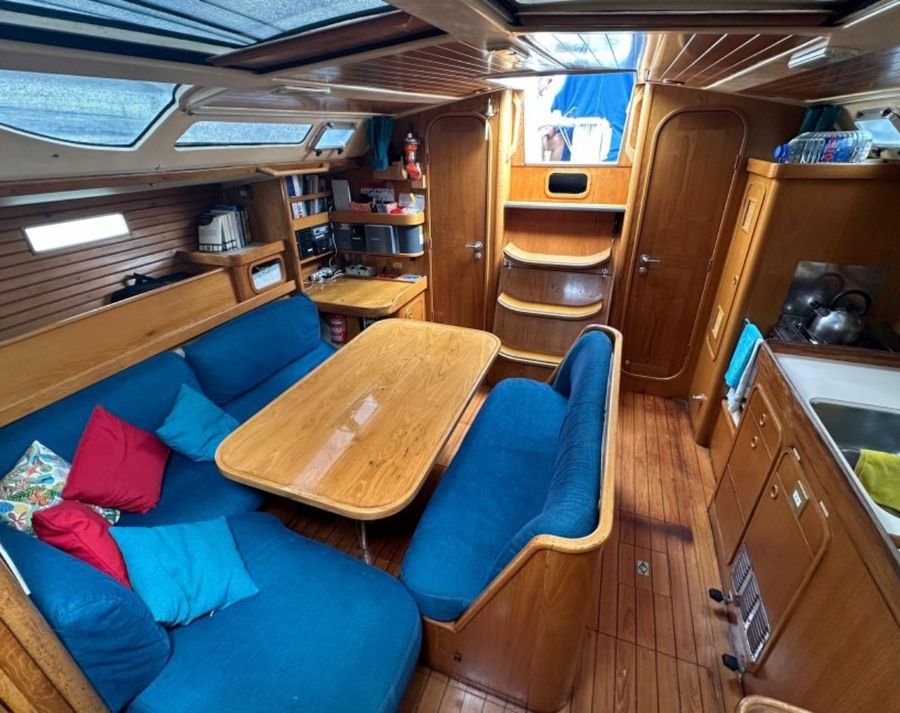
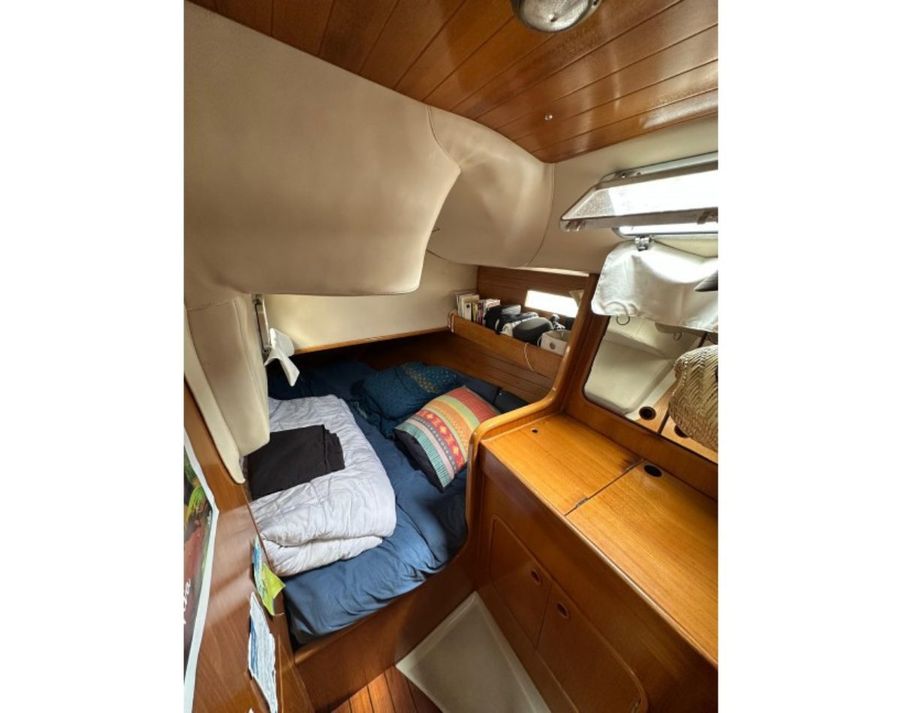
What made the 430 genuinely forward-thinking at the time it appeared is perhaps most evident below decks. Multiple deck hatches and longitudinal skylights draw natural light deep into the saloon, a deliberate departure from the cave-like interiors that had defined production yachts through much of the previous decade. Warm teak veneer joinery adds traditional richness without competing with that brightness. The four-cabin layout follows the charter configuration, with two symmetrical cabins forward and two aft, all of them spacious and well resolved. Directly below the companionway stairs sits a dedicated captain's desk providing a proper navigation station with good stowage close at hand. The row galley is well equipped throughout, fitted with two sinks, a two-burner gas stove, a gimballed oven, an ice box, and ample stowage. The L-shaped dining and lounging area is finished in blue covers, and two shower and head combos, each with sufficient storage, serve the cabin arrangement comfortably.
A comprehensive refit carried out across 2021 and 2022, with more than €50,000 committed to the work, brings Titaua firmly into the present. The Perkins Prima M50 50HP engine has been fully overhauled, the keel refurbished with epoxy protection, and critical equipment replaced throughout. The result is a yacht that holds on to its classic character while being genuinely ready for sea.
Briand himself brings considerable credentials to this design. Born in La Rochelle, he came to sailing through family, his father having competed at Olympic level in the Dragon Class. He began designing at 16, and an apprenticeship under Swedish designer Pelle Petterson gave him early grounding in America's Cup hydrodynamics and the practical demands of series-production engineering. His own practice opened in 1978, and significant results followed steadily, including victory in the 1983 Half-Ton Cup and the 1984 One Ton Cup, design commissions for both the French and Swiss America's Cup campaigns, and the later creation of the acclaimed superyacht Mari Cha III. The Oceanis range, developed for Beneteau through that same period, reflects his consistent intention to balance genuine performance with practical, real-world usability.
Berthed at Marsden Cove Marina, Titaua is well placed for coastal cruising or as a staging point for passages into the Pacific. At EUR €65,000, she offers an accessible entry into a proven bluewater design backed by decades of pedigree.