Below the waterline is where the Louis Vuitton 38th America's Cup will likely be decided, long before anyone sails into Naples.
With AC75 hulls carried over from the last cycle, teams have poured their development budgets into one area: the foils. It has become the defining technical battle of AC38.
Stand on the dock during a training session and you will notice the cameras. Dozens of them, trained on the foils from almost every angle, hunting for cavitation, for ventilation (air dragged down from the surface, often the bigger problem near the tips), for flow behaviour using tufts or paint, and for how the flap moves and the foil bends, vibrates and twists under load.
Look down from on board an AC75 and it is almost unsettling. Something so small is holding up several tonnes of boat. The foil wing has to lift the hull clear of the water, generate the sideways force needed to sail upwind, survive brutal hydrodynamic loads, and stay controllable from take-off right through to speeds beyond 55 knots. All with as little drag as possible.
Those compromises have shaped AC75 foil design since the class began. For AC38, though, the designers understand the problem far better than they did back in 2021. What has emerged is a convergence towards high-aspect, increasingly refined foil wings, alongside fresh thinking on weight, take-off, control and the foil's full operating range.
**High aspect is still king**
The broad trend is still towards long, narrow foil wings. The hydrodynamic logic is simple enough: more span and less chord means a higher aspect ratio, and that cuts induced drag. A long, efficient wing generates lift while wasting less energy in the vortices spinning off its tips.
But the AC75 Class Rule boxes the foil into a tightly defined design space. Teams can't just stretch the span. The real challenge is squeezing maximum useful span and efficiency out of what little room they have.
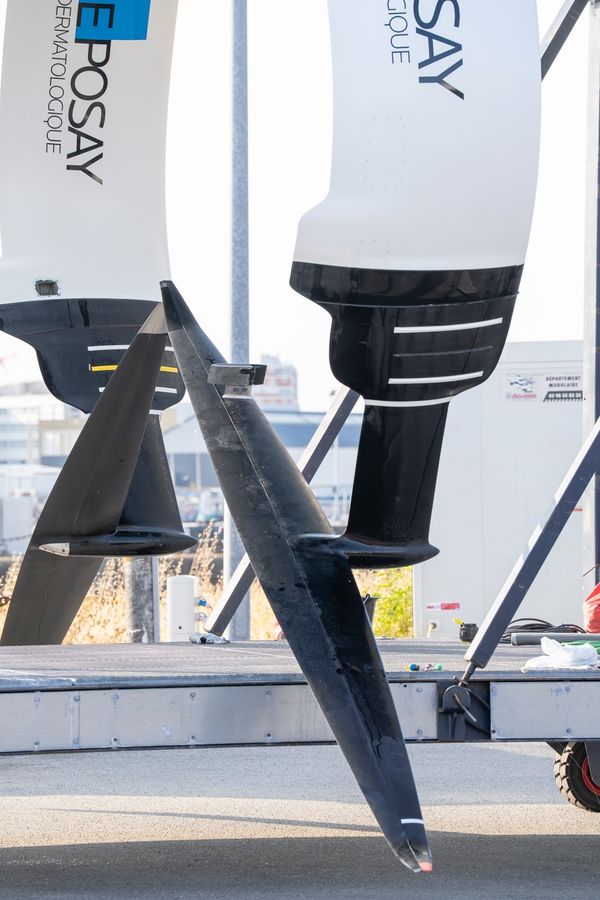
By Barcelona, the leading teams had already converged on highly refined high-aspect shapes, and that philosophy looks set to continue. But maximum aspect ratio isn't automatically maximum performance. A very narrow foil still has to generate enough lift to get the boat flying in light wind, and it still needs structure strong enough to survive huge loads, house the flap mechanism, and cope with an enormous speed range. Large enough to take off. Small enough to be fast. That is the central tension of AC75 design.
High aspect ratio cuts induced drag, which matters most at low speed: take-off, light air, coming out of manoeuvres. Take-off gets harder because of reduced area and chord, not the aspect ratio itself. At top speed, friction drag takes over, so less area and thinner sections are what count there.
**Naples changes the question**
The venue matters a great deal. The declared AC38 raceable wind range runs from 6.5 to 23 knots, which puts real weight on the lower end. Foil area that looks wasteful at 50 knots can be the difference between flying and floundering at six-and-a-half or seven knots.
So designers aren't just chasing the lowest drag at top speed. They're designing around an entire race, weighing up take-off speed, loss of inertia through tacks and gybes, re-acceleration, flying through lulls, and how the boat behaves at touchdown.
The fastest AC75 around the track may not be the one with the highest headline speed at all. It may simply be the one that spends more of the race flying efficiently.
Manoeuvres are where it gets unforgiving. Boat speed drops temporarily right when the yacht needs the most lift, exactly when flow over the foils is least stable. That's why designers now talk about the full "performance envelope" rather than chasing a single top number. The ideal Naples foil might give up a touch at 52 knots to gain more at 18, 25 or 35.
**The section is getting cleverer**
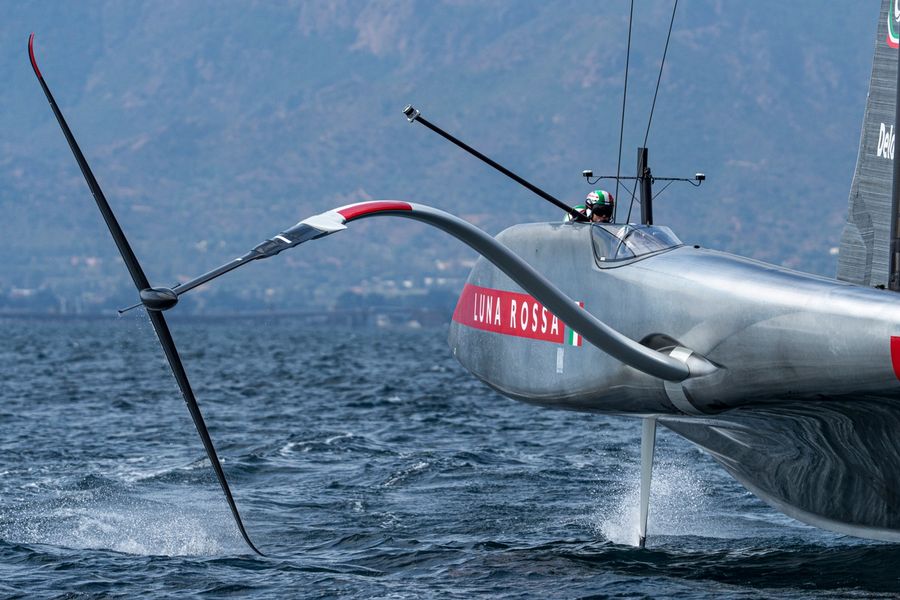
Span and area are the visible part of the story. The cross-section shape matters just as much. Thicker sections bring structural benefits and can handle high lift coefficients, but they cost drag. Thinner sections are fast but structurally harder to engineer and less forgiving across the range.
Then there's cavitation. The thicker the section, the sooner it arrives.
At extreme speed, pressure over parts of the foil can drop enough for water to vaporise locally, creating cavities that completely change how the foil behaves. Spotting it early is one of the main jobs of those dockside cameras.
So designers need sections that stay efficient at very high speed without sacrificing the low-speed traits needed for take-off. The same wing is effectively being asked to be two different things: a high-lift take-off foil and a low-drag speed machine.
**The flap changes everything**
The AC75's answer to that contradiction is its movable trailing-edge flap. Rather than changing the angle of the whole foil, the flap alters the effective camber of the section. More flap at lower speeds generates extra lift. As speed builds, flap demand drops and the foil effectively changes gear, which makes foil and flap design inseparable from one another.
A beautifully efficient wing paired with a poor flap will not make a fast AC75. Hinge location, flap chord, structural stiffness, sealing, and how smoothly the geometry transitions from fixed wing to movable surface all matter.
For this cycle, teams may build five new foil flaps and three new foil wings, with legacy components modifiable within set limits: three legacy wings, three legacy flaps, each allowed to be modified but required to retain 60% of their AC37 mass.
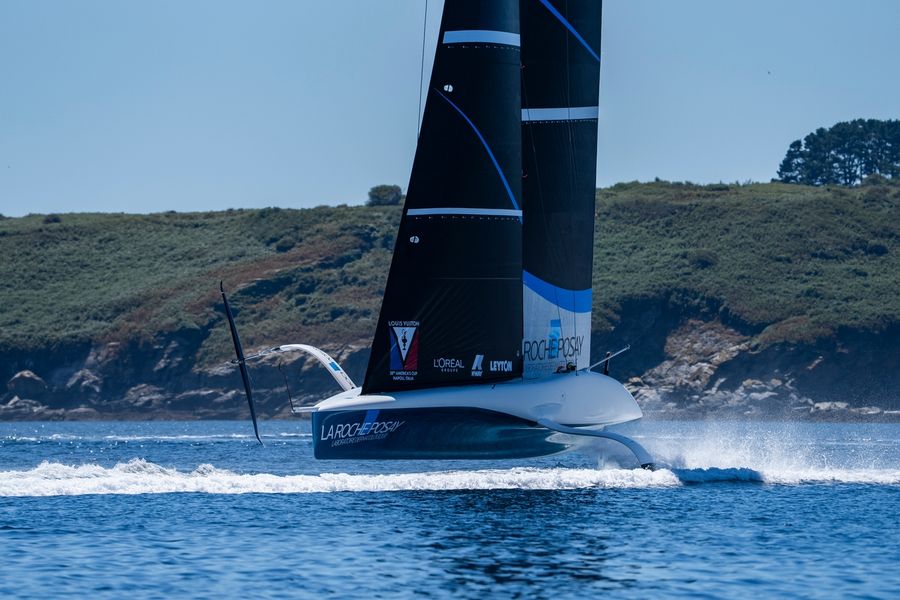
That allocation tells its own story. The flap isn't an accessory. It's a major development item in its own right.
**Control is now part of foil design**
Perhaps the biggest conceptual shift is that it no longer makes much sense to talk about an AC75 foil separately from its control system. A theoretically faster foil is worthless if nobody can fly it. The flap is constantly being adjusted to manage lift, and therefore ride height and heel, while pitch is mostly handled through the rudder elevator. The better the control architecture, the harder designers can push the foil itself.
A stable, forgiving foil might cope with relatively crude control inputs. A low-drag foil working near its limits demands precise flap positioning and flight control, and that's where software meets hydrodynamics. The real question designers are asking: how difficult a foil can our sailors and systems actually fly? That question may define the next generation of these boats.
**The gull-wing remains**
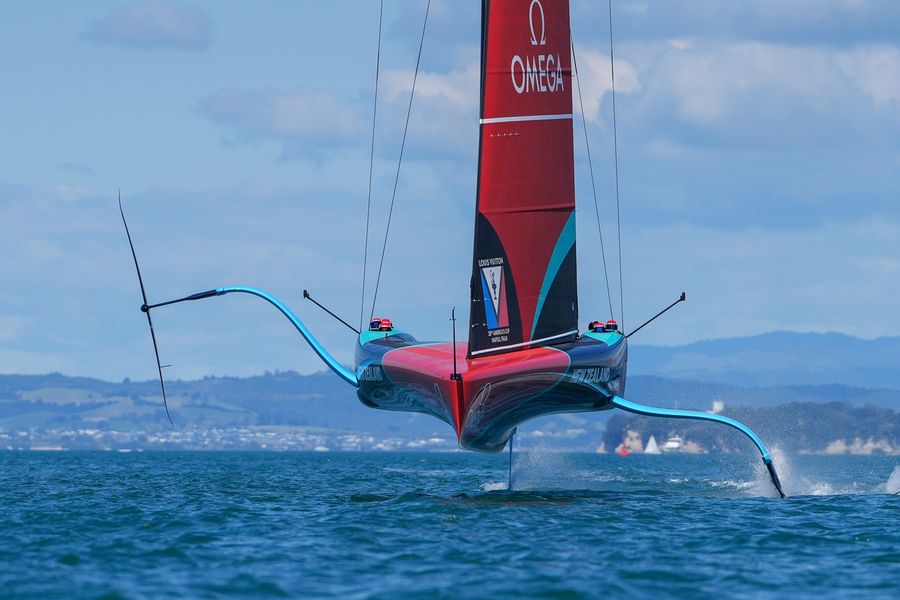
One striking visual feature of the leading Barcelona foils was their shape when viewed head-on.
Emirates Team New Zealand's winning foil package on Taihoro carried a subtle gull-wing form, tips angled slightly anhedral. That geometry has stayed visible on Taihoro right through its 2026 development programme.
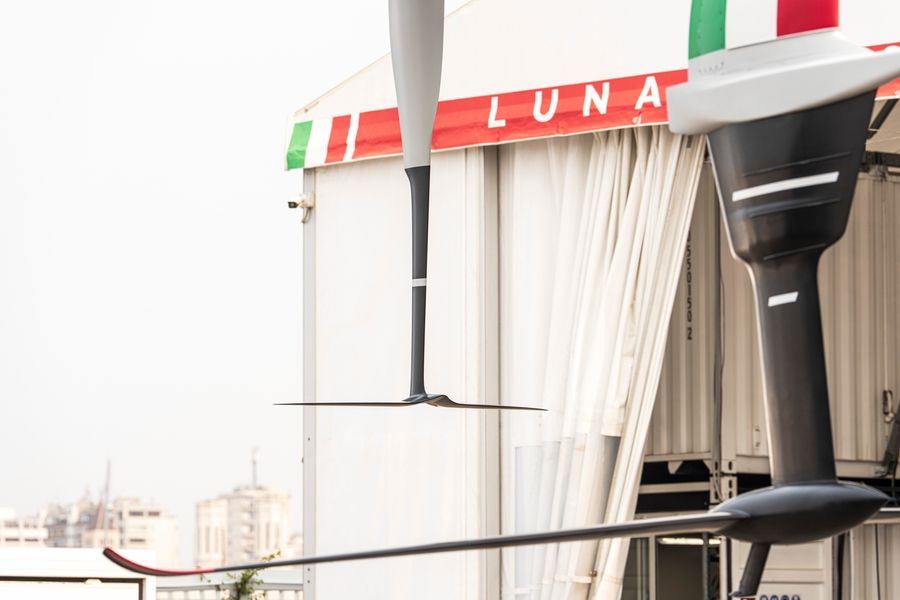
These three-dimensional shapes let designers juggle several things at once: effective span, lift distribution, tip behaviour, structural packaging, and the balance between vertical and lateral forces. There's no rule saying a foil has to be a flat, straight aeroplane wing. The geometry itself can be used to shape where and how the hydrodynamic forces are generated. Expect subtler refinements rather than wholesale redesigns from here.
**The junction is expensive**
Another battleground sits where the foil wing meets the vertical foil arm. Any junction between two hydrodynamic surfaces creates interference, a messy zone where flows collide, pressure fields clash, and drag builds.
Enormous effort goes into fairing that junction. During the Barcelona Cup, some teams built substantial fairings and ballast structures around this area. Emirates Team New Zealand's 2026 configuration showed a noticeably smaller forward-projecting structure than its AC37 equivalent, and the team confirmed weight had been stripped from the foil package too. Development has continued in this area since, pointing to a wider trend: mass distribution is now part of foil design itself, not something separate.
**Weight matters twice**
Every kilogram inside a foil wing carries two consequences. It adds to the yacht's overall weight distribution, and because the foil sits well away from the centreline when deployed, the raised windward foil's mass adds righting moment, while the leeward foil's mass works slightly against it.
Teams have traditionally packed dense ballast into foil structures to satisfy the rules while putting weight where it earns its keep. This cycle's rules change the equation, though, with cyclors gone and stored electrical energy altering the internal weight balance. Each foil wing assembly must weigh between 550 and 580 kilograms. The game now is less about the total and entirely about where that mass sits.
**Flex, the next frontier?**
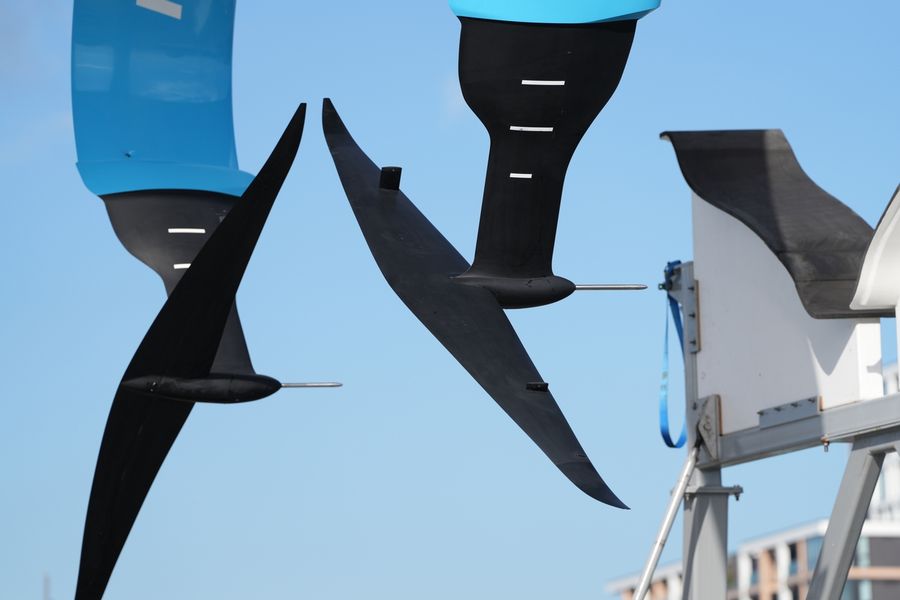
Structural behaviour is another area worth watching. No foil is perfectly rigid. Under several tonnes of load it bends and twists, and that deformation used to be something engineers simply tried to minimise. Modern composite engineering allows a different approach.
If deformation can be predicted accurately, the unloaded foil can be designed so that under a specific load it settles into a more favourable shape. Under the Class Rule, the foil flexure, the flexible region where flap meets wing, is tightly limited in chord and only allowed to deform as the flap moves. Everywhere else, the unloaded shape is closely controlled, even though the wing still bends and twists under load. The catch is that the foil has to perform across many different loads. A shape tuned to flex perfectly at 45 knots may behave quite differently at 25. Range is the challenge.
**The battle we can't yet see**
The honest truth about AC38 foil development is that we haven't seen the final answers.
Emirates Team New Zealand, Luna Rossa and La Roche-Posay Racing Team have spent 2026 learning from their legacy gear while quietly developing what comes next, and the rules practically encourage that approach. With only three new foil wings allowed, each one is precious, and nobody is keen to show their race-winning weapon before they have to. What we can see, clearly enough, is the direction of travel.
The AC75 hulls racing in Naples will look familiar. What's underneath them may not.
Dan Bernasconi's read after Barcelona was telling. He said the differences between the hulls had become almost insignificant in performance terms, with the real gains sitting in foils and systems. "The designers still felt there was performance left on the table in those areas."
How much performance is still out there remains to be seen.