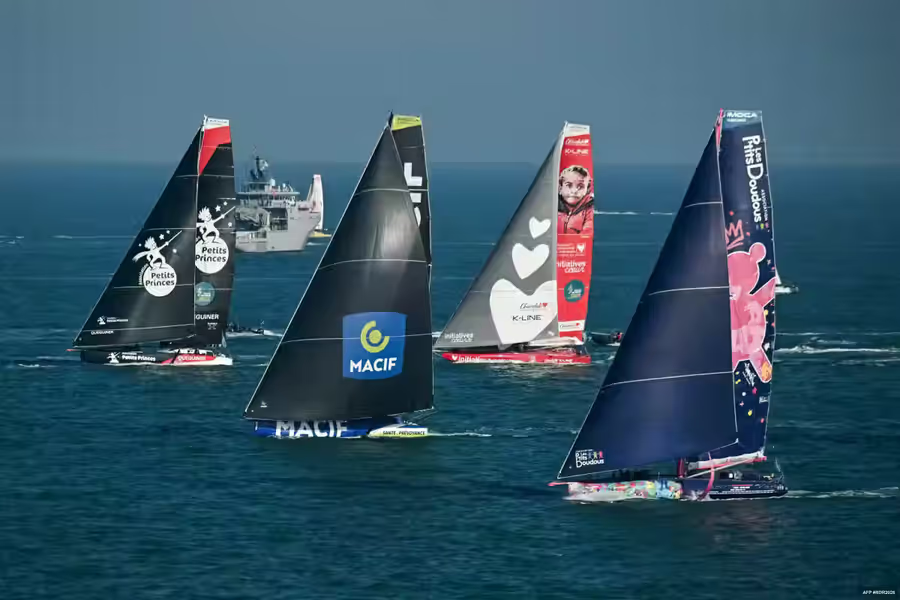
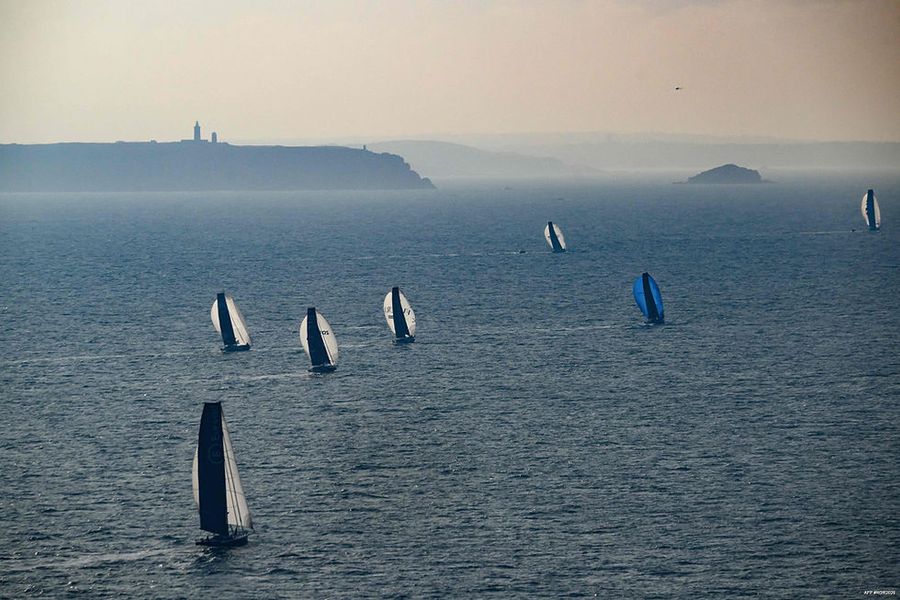
A quieter operation was running behind the scenes of the Route du Rhum, Destination Guadeloupe start, keeping watch over 115 boats as crowds lined the coast from Saint-Malo to Cap Fréhel to see them off. Race direction, holed up in a converted apartment inside the old walled city, had been at it since well before the gun.
Miranda Merron and Guillaume Evrard run that operation, backed by a wider team stationed out on the water. By midday, their lounge, reached up a granite staircase, looked more like a control room than a living space. Six screens running the Adrena navigation software tracked all 115 competitor icons as they bunched towards the line.
"The start had already begun this morning," Evrard said, pointing to a competitor helped with an engine problem as early as 9am. The pair also spent the morning checking every skipper's tracking beacon was working and that engine seals had been signed off by the technical committee.
VHF radios on the table counted down the minutes. Press boats cleared the start zone first, with support tenders following a few minutes later.
At 12.58pm the four-minute warning signal sounded. Shore crews stepped off. From that point, the skippers were alone.
At 1.02pm the countdown came through the VHF: five, four, three, two, one, go. The fleet set off in 8 to 12 knots of wind on a flat sea. Calm conditions, but with 115 solo sailors in the Channel, Merron, a former competitor herself and long-time member of Francis Le Goff's team, wasn't relaxed about it. "You have to watch the other competitors closely, the traffic, especially tomorrow night because we're on a waning moon," she said.

From that point on, Evrard and Merron fixed their eyes on their screens rather than the television broadcasting the start live. As the Ultims pushed towards Cap Fréhel, the pair worked through the fleet checking everyone had got away cleanly. The radio crackled with reports of boats over the line early, three Class40s among them, each facing a five-hour penalty to serve within 24 hours once past the course mark.
Armel Le Cléac'h and his Maxi Banque Populaire XI were through Cap Fréhel first. Tempting to watch, but there wasn't much time for that. "We stay focused, but we allow ourselves a few minutes to admire the spectacle," Evrard smiled.
By 1.25pm the last boat had crossed the line. That's when the real work starts.
Seven people will now rotate day and night, watching over the fleet. "The rule is that someone stays permanently in front of the screen, and especially the emergency line," Evrard explained. "At night we try to have two." That emergency line, known in the team as the red line, runs to a phone sitting prominently on the table with a ringer loud enough to wake half of Saint-Malo. Skippers or their team managers use that number to raise the alarm.
"When something breaks down, you'd like to manage it from start to finish, but you also have to know when to step back. Sometimes, when it's time to sleep, you hand over to the next person." Race direction works watch systems just like the boats do, covering the fleet around the clock. From Tuesday, the first of the team will fly out to Guadeloupe to set up a second base and share the watches with those still in France.
Merron put it simply: "A good watch is when absolutely nothing happens. Which is never the case."