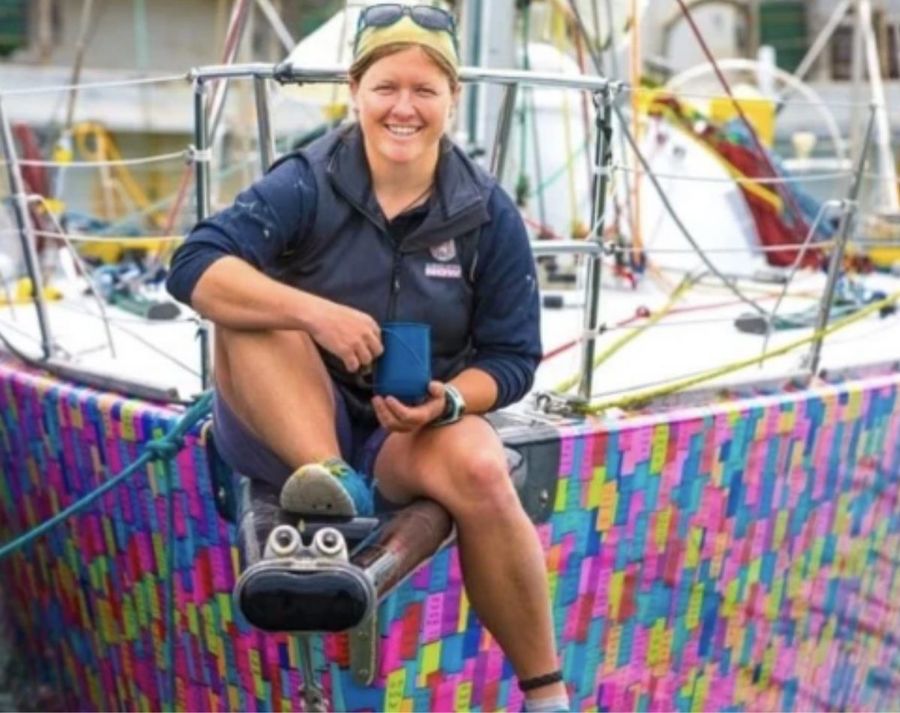
A two-year, $1.9 million research partnership is underway in Australia to investigate whether basalt fibre combined with bio-resin could become the marine industry's next standard hull material, with world-record sailor Lisa Blair OAM trialling the technology on the open ocean.
Blair has joined forces with the Australian Composites Manufacturing CRC (ACM CRC), UNSW Sydney, and boat builder Steber International on a programme called Sustainable Composites for Next Gen Boat Hulls. The project's central question is whether basalt fibre, derived from volcanic rock and paired with modern bio-resins, can deliver a high-performance, fully recyclable replacement for Glass Reinforced Plastic (GRP).
The scale of the problem the research is confronting is significant. Between 35 and 40 million fibreglass boats worldwide are approaching the end of their useful lives, and no viable large-scale recycling pathway currently exists to handle them. Within Australia alone, fibreglass accounts for the construction of more than 300,000 registered vessels.
The environmental toll is already measurable. A University of Brighton study found 11,220 fibreglass particles per kilogram in oysters and 2,740 per kilogram in mussels collected from Chichester Harbour, a waterway that hosts around 12,000 boats. Australia's coastal marine ecosystems face potential contamination on a far greater scale, and Blair argues that the full picture remains poorly understood.
"The reality is that high-volume research into the long-term impacts of fibreglass just does not exist yet," she says. "We are only seeing the tip of the iceberg."
Basalt fibre has been attracting growing interest across advanced manufacturing. Produced by crushing volcanic rock and drawing it into fine strands, it is claimed to be up to ten times stronger than fibreglass, naturally fire-resistant, and chemically inert. Being 100 percent recyclable, it also offers a direct answer to the end-of-life disposal problem that shadows conventional GRP. Paired with bio-resins, the combination could provide a genuinely circular alternative to traditional fibreglass construction at a cost premium of only 15 to 20 percent.
Steber International is building a dedicated test hull to assess how the materials perform under real marine conditions, including how readily they can be repaired. Research into the materials themselves at UNSW Sydney is being led by Scientia Professor Gangadhara Prusty, with life cycle analysis and environmental impact modelling handled by circular economy specialists SOENECS. All findings generated by the project will be released as open source.
"We are identifying the right bio-resins and basalt fibres, available in sufficient quantities and with sufficient properties, to demonstrate a solution allowing the entire boat industry to offer more sustainable products," Prusty says. "The team will open source this information so that the entire industry benefits."
For Steber International managing director Alan Steber, the commercial case for the new materials matters every bit as much as their environmental promise. "...hopefully one day we will see a complete, sustainable, reliable, affordable, and safe composite material for all industries. Hence I put my hand up to be part of the team."
Blair's involvement goes well beyond lending her name to the project. She is commissioning a new expedition yacht constructed from the basalt and bio-resin composite for her next record attempt, the Arctic Impact Project. Planned for July 2027, the voyage would see her become the first person to sail solo, non-stop and unassisted around the Arctic Circle within a single season, completing both the Northwest Passage and the Northeast Passage. The route covers approximately 8,000 nautical miles and is expected to take around three months.
"While climate change has opened the path for this record, my focus is on the solutions we can create together," Blair says. "By building my vessel from basalt fibre, I'm showing that adventure can, and must, be a vehicle for change."
Alongside the voyage, the project incorporates a global schools programme, Climate Action Now events, and citizen science activities. For the broader marine industry, the research represents a rare opportunity to get ahead of a materials crisis that has been building quietly for many years.