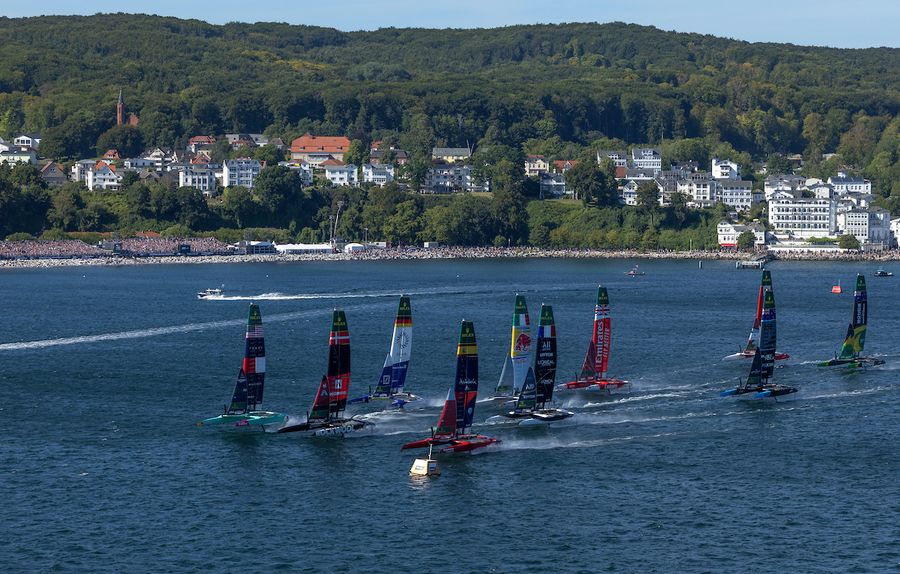
Australia's Tom Slingsby delivered a masterclass in Race 3, but it was Denmark who wrote the day's most startling headline before a single gate had been rounded. Charging into mark one, the Danish F50 registered 103 km/h, the fastest speed ever recorded in SailGP history. Commentators stumbled over their words, fans erupted, and suddenly the entire fleet knew the Baltic conditions off Sassnitz were capable of producing something extraordinary.
Spain looked sharp in the opening exchanges, France and Germany navigated the first gates cleanly on the back of strong earlier results, and Australia and the United States pressed hard in pursuit of the record-setting Danes. For the New Zealand F50, known as the Black Foils, the start held promise, but inconsistent pressure quickly closed the lanes around them and left the crew sailing reactively rather than dictating terms.
{{TABLE_1}}
Once the fleet had stretched out and the race began to take shape, Slingsby made his defining move. Rather than shadowing Denmark, the Australian crew split away and found a stronger band of breeze that the Danes had sailed past. The lead changed hands, and from that point Australia's downwind speed was in a class of its own. No one could live with them once the bow was pointed away from the wind.
France and Germany settled into a composed contest for the minor placings, both crews reading the shifting conditions accurately enough to stay out of trouble. Italy and Switzerland kept themselves in the picture through the middle stages, while Canada attempted a split tack that briefly unsettled the frontrunners before backfiring and leaving them exposed to pressure from the Americans.
The racing behind the top four turned ferocious. Passing lanes appeared and vanished within seconds, and a single mistimed manoeuvre meant conceding distance at a rate that was almost impossible to recover. Canada and the United States went stroke for stroke through the final gate, with Canfield's American crew finding just enough pace in the last sprint to edge ahead. Italy and Switzerland held on in the mid-pack, while Spain, so quick early on, faded as the race wore on.
The shocks came from Emirates GBR and the Black Foils. Both had been sitting inside the top six at the midpoint, both had the results they needed within reach, and both lost rhythm at the worst possible moment. Emirates GBR tumbled all the way to 11th, and New Zealand crossed the line in 10th, a punishing outcome that wiped out much of the goodwill built across the first two races of the day.
{{TABLE_2}}
Australia's win carried a significance beyond the points it delivered. Coming after a slow opening to the day's racing, it served as a sharp reminder of why Slingsby's crew have claimed the SailGP title three times. Their combination of raw boat speed, tactical clarity, and the composure that only comes from genuine confidence in difficult moments turned a competitive race into a demonstration. France and Germany's podium finishes keep both teams firmly relevant as the season builds, and Denmark's speed record will be remembered long after the regatta's other details have faded.
For New Zealand and Britain, Race 3 carried a different message entirely. In conditions as volatile and unforgiving as those on offer at Sassnitz, there is no safe position until the finish line is behind you. One lapse in concentration, one small error in lane selection, and the fleet rushes past without hesitation. Both teams will know the margin for error from here is razor-thin.