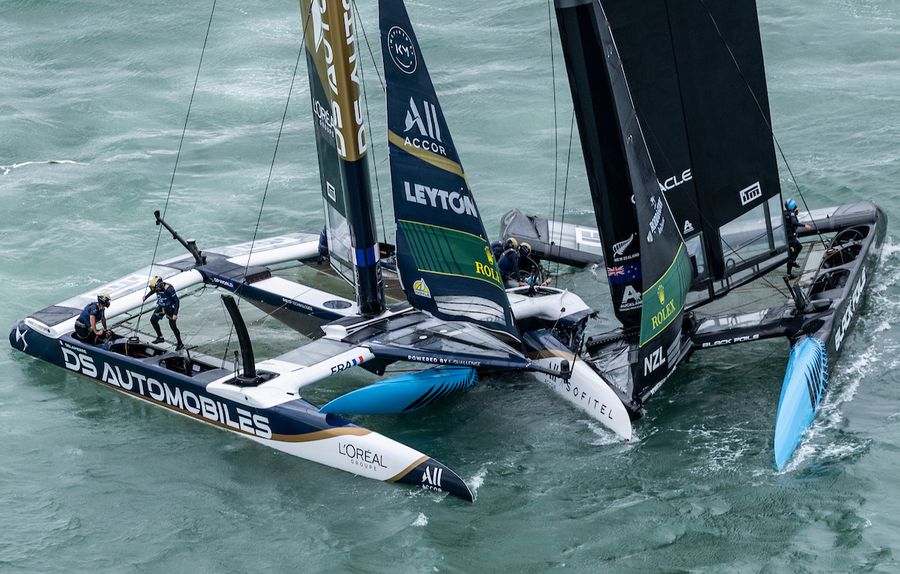
Two sailors were injured, two boats were wrecked, and a regatta was finished for both teams just 15 seconds after a race began. SailGP has published its engineering review of the collision between the Black Foils New Zealand SailGP Team and DS Automobiles SailGP Team France during Race 3 of the ITM New Zealand Sail Grand Prix in Auckland, detailing the sequence of aerodynamic and hydrodynamic events that sent both F50s into each other at close to highway speed.
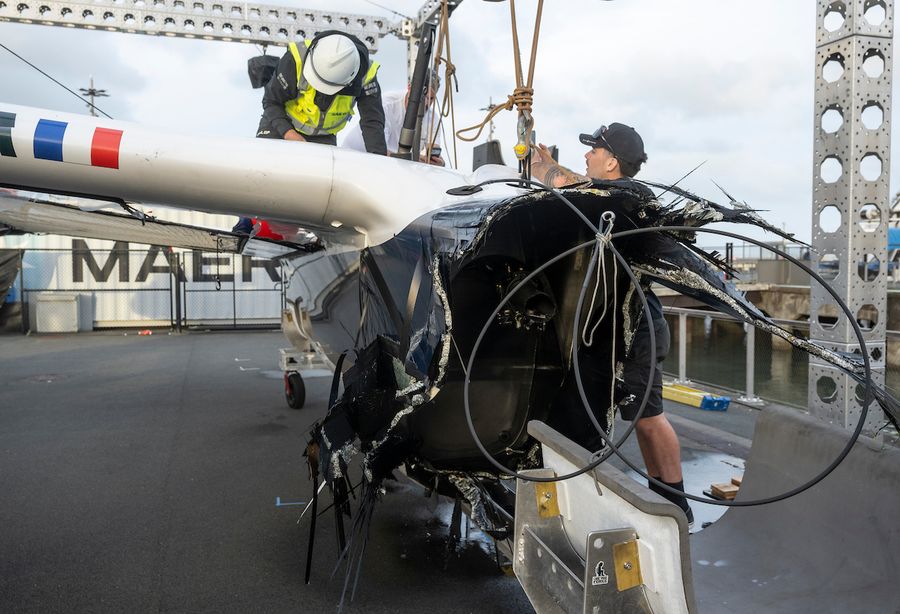
At the moment of impact, New Zealand was bearing down on Mark 1 at roughly 90 km/h, with France following closely astern at about 86 km/h. Within moments, the Black Foils had lost control and slid broadside across the French bow. The damage to both boats was severe enough to end their Auckland campaigns on the spot.
What the engineering review sought to establish was not simply that a crash occurred, but why control was lost so suddenly and so completely.
The sequence, according to SailGP's analysis, began with a gust on the first reach. That additional pressure drove the New Zealand F50 higher on its foils while simultaneously pushing its speed upward. As ride height continued to climb, the leeward foil broke the water's surface. At those velocities, even a momentary breach carries serious consequences.

When a foil draws air down from above the surface, the smooth flow of water across it is interrupted. Lift becomes unpredictable and the margins available to the crew for control shrink almost instantly. Rather than tracking cleanly toward the mark, the boat began to slide sideways.
SailGP Director of Performance Engineering Alex Reid described the shift as near-immediate. "The data shows the boat accelerated quickly and rose high on its foils," he said. "Once the leeward foil pierced the surface, the boat entered a side slip where the foil began generating unwanted lift through leeway rather than via rake."
Put simply, the foil was producing lift in a direction the crew had not chosen and could not easily counter.
From that point the situation deteriorated in seconds. The crew increased rudder angle in an attempt to recover, and flight inputs continued, but the boat was already committed to its slide. The rudder briefly shed clean flow before reattaching, and at the same moment the windward bow dipped. The F50 rounded sharply into the wind and shed speed. France, tucked in close behind, had almost no room or time to react.
Reid was clear that the review uncovered no equipment fault behind the loss of control. "There is no evidence of a mechanical or software failure in the systems leading up to the incident," he said. "What we see in the data is a very fast chain of aerodynamic and hydrodynamic events that pushed the boat beyond its controllable envelope at that moment."
The investigation drew on high-rate telemetry, a simulator recreation of the incident, and video footage. Engineers confirmed there was no structural failure and no system fault preceding the moment control was lost.
The findings fed directly into the protest process. A hearing upheld the original ruling that New Zealand had broken Rule 14, the obligation to avoid contact, and an eight event point penalty was applied. France was found to have had no reasonable opportunity to avoid the collision.
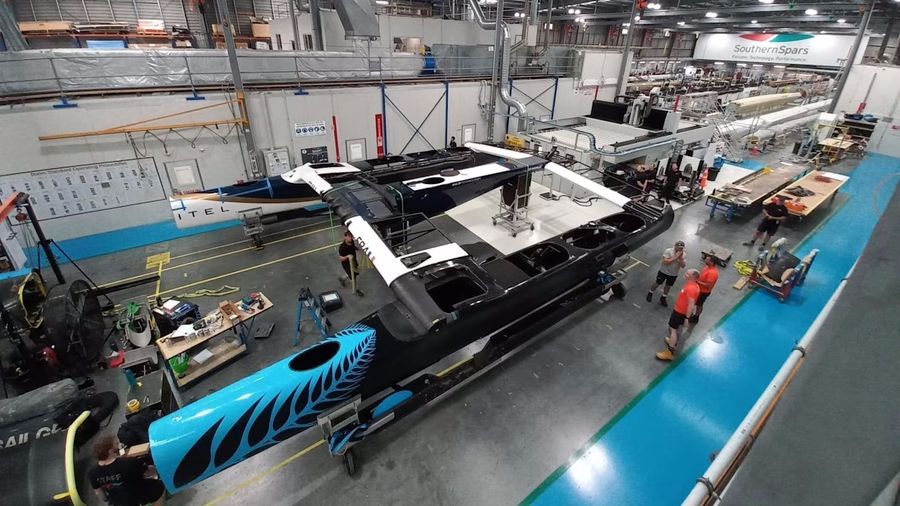
The points consequences were significant. Before the deduction, New Zealand had accumulated 18 points for the regatta, with France sitting just behind on 17. The eight-point penalty dropped the Black Foils to 10, while France remained on 17, a total that would in all likelihood have been enough to carry them into the final had they been able to keep racing.
Neither team was able to return to the water in Auckland. Both will also be absent from the upcoming KPMG Sydney Sail Grand Prix while their boats undergo repairs.
The review speaks to a reality that applies across the fleet. Foiling at speeds approaching 100 km/h leaves almost no tolerance for the unexpected. A foil breach lasting only a fraction of a second can redistribute load across the entire platform before a crew has any meaningful chance to respond. Once an F50 departs stable flight, the window for recovery closes fast.
SailGP's engineering team is now in discussion with athletes about possible adjustments that could help crews manage comparable scenarios at future events. Those conversations are ongoing ahead of the next rounds on the calendar.
The Auckland collision will not be easily forgotten by anyone inside the SailGP paddock. At these speeds, control exists in fractions of seconds, and on this occasion, those fractions simply ran out.