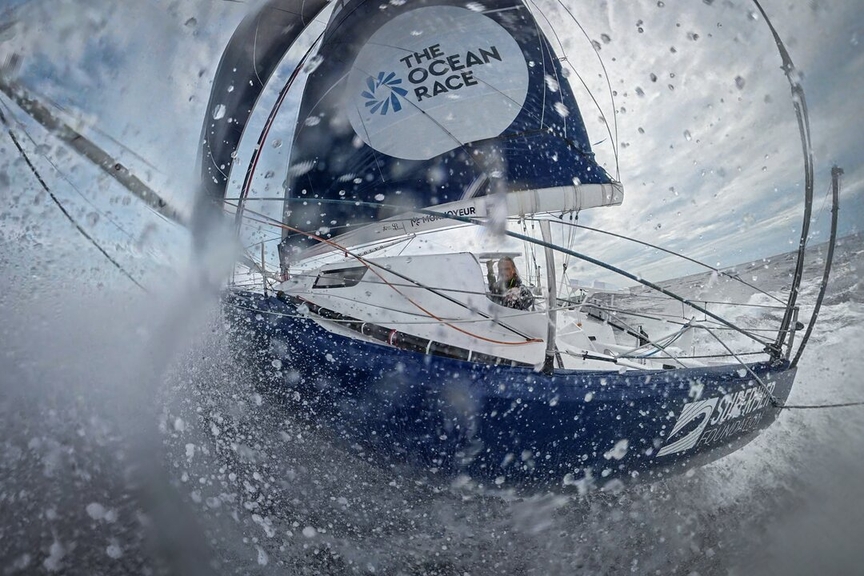
The first five days of The Ocean Race Atlantic have been brutal, and even from dry land, Sam Goodchild could see it.
"What stands out for me watching from on land, is how relentless it looks and has been," the British skipper told the IMOCA Class. "It's been non-stop strong winds and it's been really intense."
That's some statement from a sailor who knows this stretch of ocean better than most. Goodchild crossed the same course during the last edition of The Ocean Race aboard Holcim-PRB, when the crew set a new 24-hour distance record. He says this year's conditions have been in a different league entirely.
"It seems like they have had pretty difficult conditions compared to the norm," he said. "It seems like very unstable wind in front of the weather front and a very nasty sea state by the sounds of it. During the transatlantic we did on Holcim we had flat water and amazing conditions."
The 3,200-nautical mile sprint started from a virtual line 120 miles off the New York coast and finishes in Lorient. It's now entering its second phase, with 1,240 miles left for the leading boats as they trade the strong winds and big seas of a classic Atlantic depression for lighter, more complex conditions as they meet a ridge that will dominate the run to the finish.
Francesca Clapcich and her crew on 11th Hour Racing have led for the last two days, but the margin is shrinking fast. Paul Meilhat's United by the Ocean, formerly Biotherm, has cut the deficit from nearly 30 miles to just over a mile. On the tracker the two boats are right on top of each other.
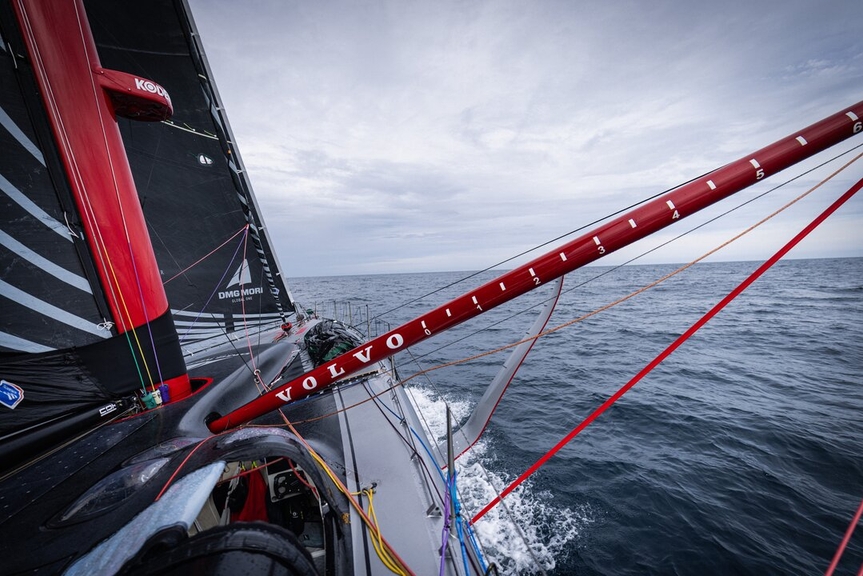
DMG MORI Global One, the new Guillaume Verdier design skippered by Kojiro Shiraishi of Japan, is closing the gap on both, just over 20 miles back. Team Malizia, skippered by Boris Herrmann, is still benefitting from the stronger winds despite damage to a foil casing after a collision, sitting 50 miles behind the leader but travelling six knots faster.
Further back, there is a gap of some 300 miles to Oliver Heer's Embrace the Challenge, which has been hobbled by serious mainsail damage sustained while reefing in the storm. Behind them, Conrad Colman and his all-New Zealand crew on MSIG Europe, the only non-foiler in the six-strong fleet, are about 110 miles further back again, but may be sensing a chance to snatch fifth place.
Goodchild, who currently leads the IMOCA Globe Series after winning the season-opening 1000 Race and finishing second in the Vendée Arctique, has been paying close attention to the two brand-new boats in the fleet. He's been particularly taken with Malizia 4, the latest design from Antoine Koch.
"Malizia has been very impressive since the boat splashed and it's their second new boat. They have got a very organised team, they have been planning this for a long time and they've done an impressive job of hitting the ground running and dealing with the little issues they have had," he said.
He pointed to the experience packed into that crew, Justine Mettraux, Julien Villion and Cole Brauer sailing alongside Herrmann. "So to see them out front wasn't a surprise. And they've got a boat that is an evolution of what we've already been sailing for the last five or six years, so they are not figuring out how to make it work. They know how to do that. In that situation you are looking at the details, but 95% of it is what you do already, so seeing them out front has not surprised me."
11th Hour Racing's charge to the front hasn't surprised him either, with a crew led by Clapcich and Will Harris, who finished second together in last year's Transat Café L'Or. As for Meilhat on United by the Ocean, Goodchild described him as a "metronome," summing up his consistent competitive pace in consecutive races.
DMG MORI Global One is harder to read. The crew, led by Shiraishi and including Nico Lunven and Sam Davies, started off the pace on their new Verdier design, which features a full-length bustle in the hull, but have gradually found their feet in this race and could yet contend for the win.
"It's an interesting boat," said Goodchild. "It's definitely pushing out there and it will be exciting to see how it goes. They were obviously pretty slow off the start going upwind. They are doing better now but they are not blowing people out of the water. Is that because the boat is not quick, or is it because the team isn't ready to push it hard or what? It's going to be interesting to follow…"
Goodchild is awaiting his own new boat, a Verdier design in MACIF colours, due to launch next spring. For now, he reckons the real test is still ahead as the fleet meets lighter, trickier air.
"It's not going to be a reach on starboard all the way to the finish," he said, "so more things are going to happen. You might start to see more performance differences because to a certain measure, it's been a little bit of survival mode, let's go the same speed as the other boats and not try to break anything, as opposed to let's go pedal-to-the-metal and see what happens. So it's when the sea state starts dropping down and the wind drops, we might see a bit more difference in average performance."