Sam Goodchild had committed to the direct line through the Celtic Sea, and in the hours after Manu Cousin crossed the Arctic Circle, the logic of that choice was beginning to be tested. Cousin had rounded at around 1 am NZST on 14 June, the last skipper to pass that symbolic threshold, and with the whole Vendée Arctique fleet now turned south, attention shifted sharply to the tactical puzzle of the return leg. Élodie Bonafous was threading the Irish Sea on a steady heading. Ambrogio Beccaria, Violette Dorange and Francesca Clapcich were pushing west toward Fastnet. The approaches to Ireland were becoming the race's defining battlefield, and depending on which weather model you trusted, the decisions made there would either look masterful or costly.
Another forecast update then arrived and rewrote the picture entirely. A broad band of light air had established itself between Brittany and the Vendée, and if it held, it would compress the fleet at the worst possible moment for anyone who had built a lead. The cards were on the table, but the final reckoning remained stubbornly out of reach.
The choice between the two main approaches had never been a simple one. The northerly line through Saint George Channel was direct but demanding, a corridor with a formidable reputation built on coastal effects, fierce tidal streams, heavy shipping traffic, and any number of traps for the inattentive. The western passage, sweeping around through the southern approaches toward Fastnet, was gentler in character but punishing in distance. Skippers who had taken that wider road had done so as a deliberate calculation: surrender the miles, sidestep the hazards, and hope the arithmetic worked out somewhere down the track.
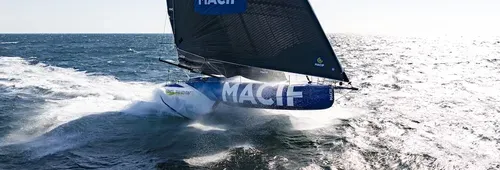
For a time, conventional thinking suggested it would not. The detour looked expensive, and those who had held to the direct route appeared positioned to collect on their bravado. New model runs then began to soften that verdict. The penalty for the conservative choice seemed to be shrinking with each updated forecast, not disappearing entirely, but no longer the race-deciding liability it had first appeared. Goodchild, having backed himself through the tighter passage, was sailing into wind patterns that suited his call, conditions threading through those critical miles in a way that justified the risk he had accepted early.
Whether it would be enough remained genuinely open. Beccaria had been held up by a high-pressure ridge sitting stubbornly off Dingle Bay, and he was not treating any outcome as settled. He knew, as every skipper in the fleet knew, that with a light-wind zone waiting between Brittany and the Vendée, the race could still be reshuffled in the final hours. The gaps accumulated over thousands of miles of Arctic sailing would count for nothing if the breeze died at the wrong moment. Everything was still in play.