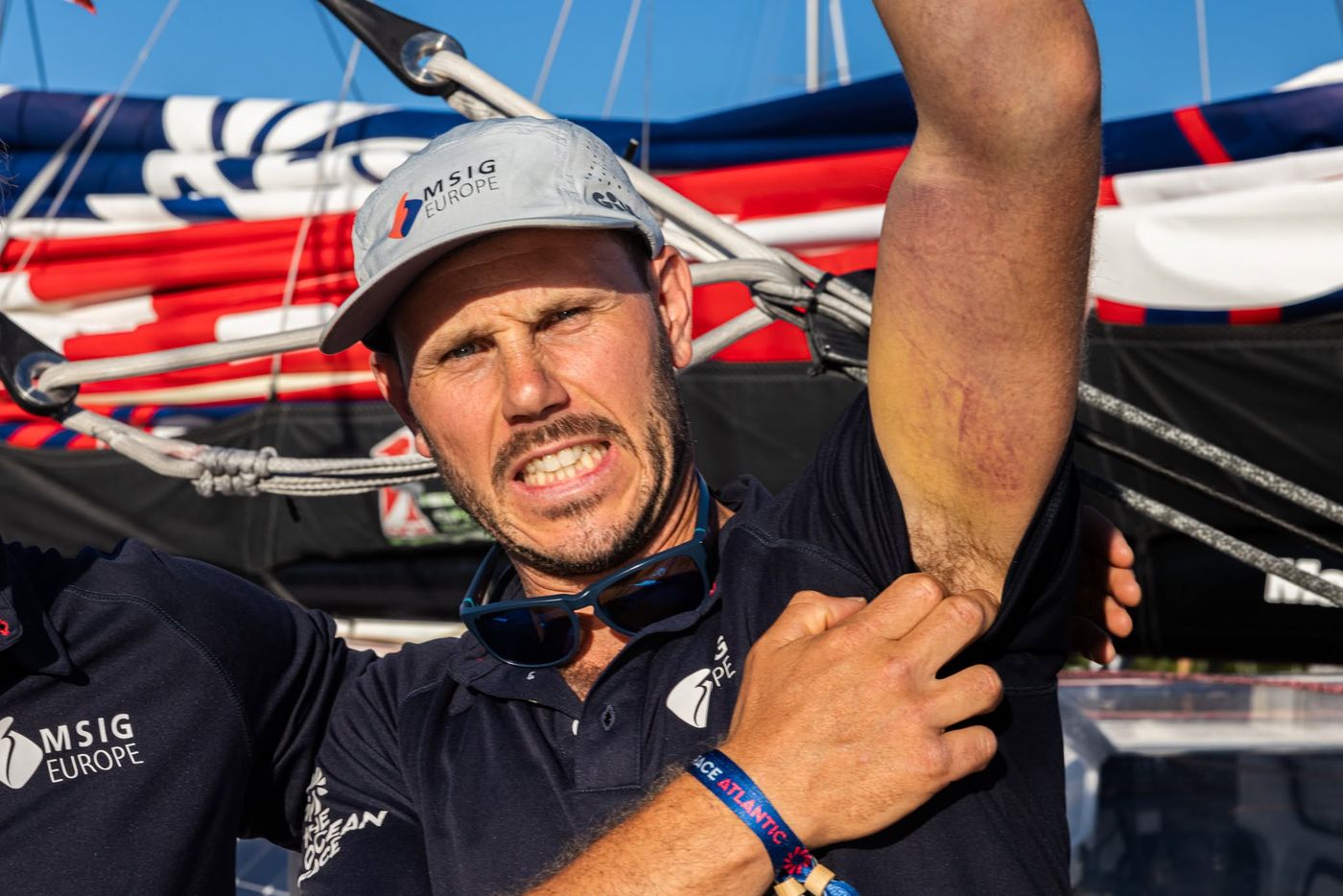
With less than a day before Aotearoa Ocean Racing's Conrad Colman leads his crew out of New York, the campaign has confirmed a major late change: Aaron Hume-Merry is out with a shoulder injury, and Belgian shore crewman Elie Pirnay is in.
Speaking to Go Boating from New York on the eve of departure, Colman confirmed Hume-Merry dislocated his shoulder during a sail drop on the delivery crossing from Europe. The team had hoped he'd recover in time to race, but a closer look at the injury ruled that out, and his focus has shifted to getting better.
"It's been sad to see him go," Colman said. "He's an incredible physical athlete, and also just emotionally and enthusiastically a spectacular human being. It's been a pleasure to sail with him, and we hope we get the opportunity to sail together again in the future."
Hume-Merry joined the campaign alongside Anna Merchant and Megan Thomson back in July, as one of three young New Zealanders brought in to learn IMOCA racing at Colman's side. Stepping into his berth aboard MSIG Europe is Elie Pirnay, who has worked as the team's Belgian technical and shore crew member but has never raced a Transat or an IMOCA. Colman was upfront about what that means for the crossing.
"We're introducing a new X-factor," he said. "At least initially, we're going to have to carry Elie a little bit, because he just doesn't have the same degree of experience, either recent or in other classes. He's never raced offshore before in any class. But he's somebody who has impressed me with his dedication to doing a really good job looking after the boat. He knows the team, he knows the boat, he understands the mechanics of getting sails up and down."
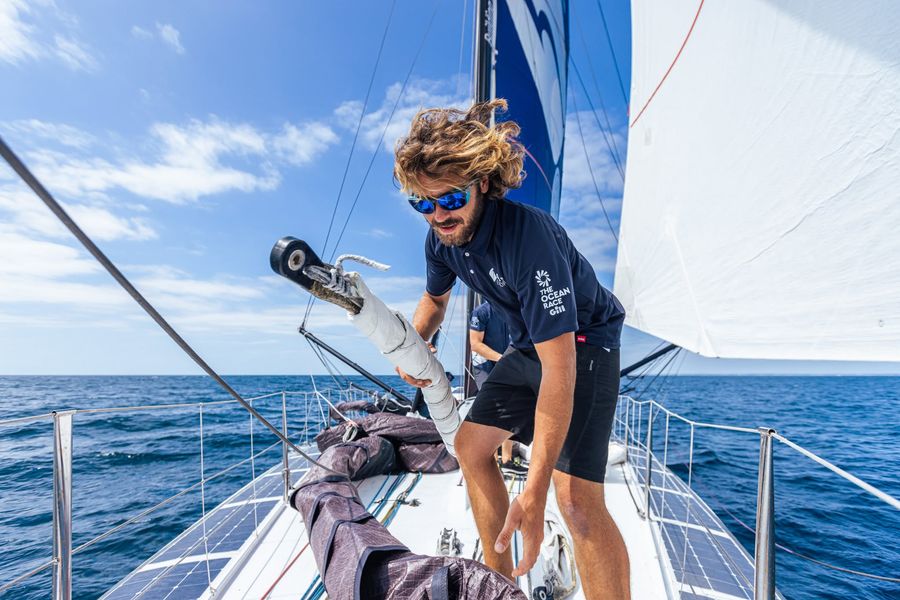
"We decided to go with somebody that we knew," Colman said, "rather than trying to fly somebody in at the last moment who would present more uncertainty."
Pirnay hails from French-speaking Belgium and currently lives in Concarneau, in Brittany, France. His arrival keeps Aotearoa Ocean Racing compliant with the Ocean Race Atlantic's new mandatory 50-50 gender split, joining skipper Colman, co-skippers Anna Merchant and Megan Thomson, and On Board Reporter Georgia Schofield.
Hume-Merry's next steps, whether that's returning to New Zealand, heading to France to meet the team on arrival, or something else, are yet to be determined. What is clear, Colman said, is that he won't be staying in the United States for further treatment.
A hairdryer, a scissor lift and an 18-hour deadline
The all-Kiwi crew had already fought through heavy weather on the delivery leg from Europe before MSIG Europe suffered a rudder and bearing failure, forcing an emergency two-hour repair at sea. The impact also cracked the bottom of the hull and pierced the trunk housing the bearing box.
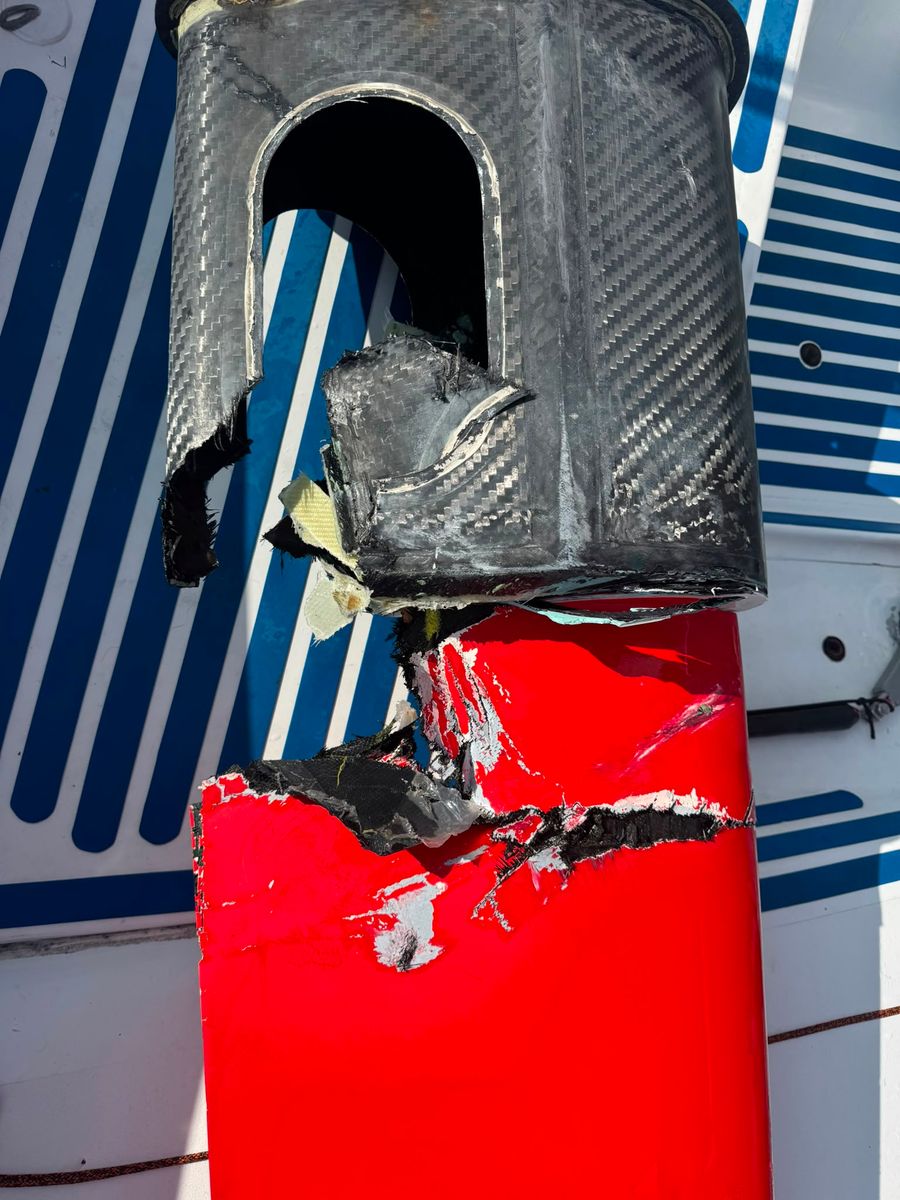
"The genius of the boat is that trunk goes through the ballast tank, so the leak was contained by the ballast rather than causing further issues," Colman explained. "But the consequences remain in that we were filling up a 900-litre ballast tank, and it's not the best look when you're trying to go fast."
Once in Newport, the team had just 18 hours to haul out, patch the hull, make the bearing trunk watertight, and fair and paint the repair before relaunching. Cold overnight temperatures threatened to derail the schedule when the epoxy refused to cure at the right speed.
"I went back to my Airbnb, got the hairdryer, went back to the boatyard, plugged it in, taped it to the top of a scissor lift, and sent it on its merry way up to the hull at five metres of height. Then we had to sit there and make sure that neither the hairdryer nor the boat nor the ferry caught on fire."
By 4am the epoxy had cured enough to sand and apply bearing compound. By 8am the repair could be sanded and painted, and by 10.30am the rudder was reinstalled. MSIG Europe was back in the water at 11am, inside the window the team had planned for.
The hull now carries a high-tech racing anti-foul from New Zealand company Nautix, a hard compound with just enough biocide to stay clean while keeping a slippery surface.
Four sailors, one very tight watch system
With only four sailors aboard the 60-footer, plus Georgia Schofield filming and reporting, two are on watch at any time while two rest, eat or navigate. Colman said the watch pattern is designed to keep fresh energy on deck rather than swap the whole crew at once.
"We're on a four-hour watch cycle, four on, four off, but we change one pair on the off cycle," Colman said. "That way we get fresh blood coming up on deck, and that allows us to maintain the energy and enthusiasm. It's better than changing all four people every four hours, because then you lose the continuity and the feel of the boat, and the feel of what's making the boat go fast."
Colman said the boat is also kept scrupulously clean throughout, and it's a habit with a practical purpose. "If you do see a screw or a washer running around, you need to start looking for where it came from, because it wasn't there three days ago. The same goes for carbon fibre dust or any sign of friction or wear. If you start each passage with the boat super clean, you can diagnose any problems a lot more efficiently."
An offshore start, for the whales' sake
The Ocean Race Atlantic won't actually begin at the New York shoreline. Colman confirmed the fleet will transit roughly 130 nautical miles offshore at a speed limit of 10 knots before racing starts, a measure introduced after consultation with marine mammal biologists who identified no-go zones and migratory routes along the early stages of the course.
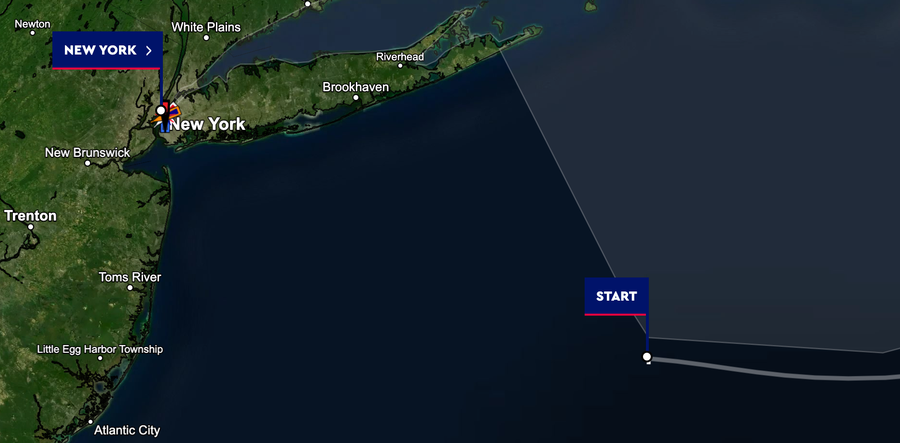
"That takes us to a certain point off the continental shelf that should put us in the clear, according to their statistical analysis of where the whales are," Colman said. From there, the fleet will run toward a waypoint and a marked exclusion zone, both visible on the official race tracker, before setting a beeline for France.
Colman's own routing has the crossing done in around eight days at close to 20 knots, with a single depression expected to track across the Atlantic alongside the fleet, delivering south-based wind for around two-thirds of the crossing before it clocks through the southwest, west and northwest.
As the slowest boat in an otherwise all-foiling fleet, MSIG Europe may not hold the same weather system as long as her rivals. But Colman said the routing currently shows no blocking high-pressure ridges in the way, which should mean speed the whole distance to Lorient. It's a fast fleet chasing an existing 24-hour distance record of 641 nautical miles under the class's first mandatory 50-50 gender split, though a record run is more likely to come from one of the five fully foiling entries than the daggerboard MSIG Europe.
Aotearoa Ocean Racing isn't chasing that record. As Colman put it earlier this year, the point of the Atlantic campaign is building the team and the practices needed to work together, ahead of a fuller Ocean Race assault when the fleet returns to Auckland in 2027. A dislocated shoulder, a hairdryer taped to a scissor lift and a Belgian shore hand thrown in at the deep end weren't part of the plan. They're part of the learning now.
Go Boating will carry daily updates on Aotearoa Ocean Racing's progress across the Atlantic as they become available.