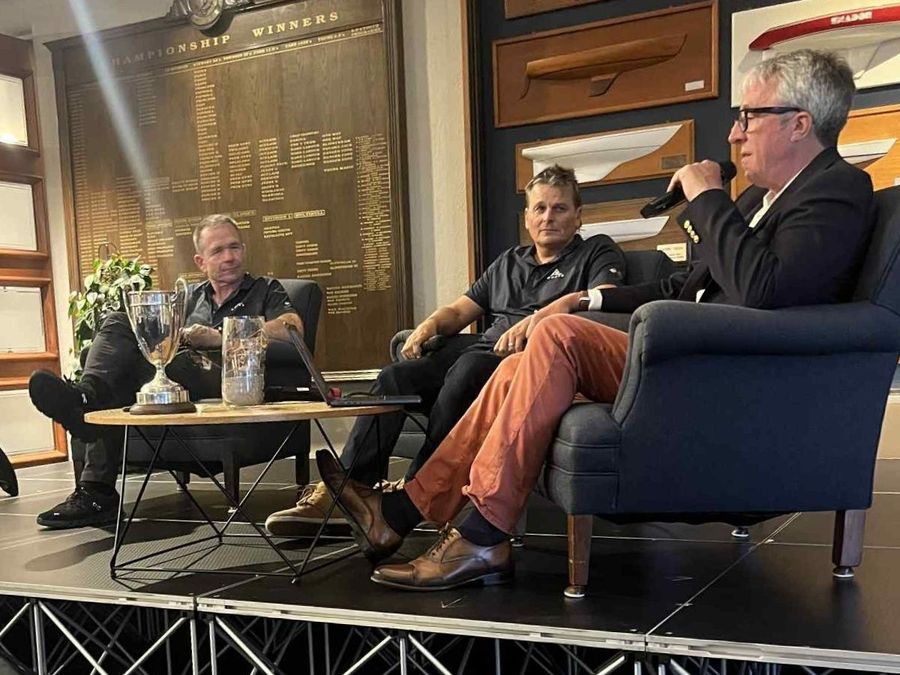
Few nights at the Royal New Zealand Yacht Squadron feel genuinely historic, but the recent gathering billed as "An Evening with Callisto and the story of the Admiral's Cup and the Fastnet Race" had every right to the description. The packed room had assembled to hear about one of New Zealand's most accomplished offshore campaigns in years, and the three men on stage, skipper Jim Murray, key helmsman Dean Barker, and Mike Sanderson of Doyle Sails, delivered a story worth every minute.
The Callisto programme competed under the RNZYS burgee in the AC2 division, partnering with Caro in AC1 to complete the two-boat team. Together they formed an international partnership that captured something of the Admiral's Cup's long-awaited return to prominence. Murray summed up what the experience meant to him with characteristic directness: "It was the most fun sailing of my life — and the honour of a lifetime to sail for the Squadron."
In Europe, Callisto took the form of a Botin 42 Fast 40 that had been substantially modified for offshore work, converted to twin rudders and tuned for long-range reaching. The boat was quick, by all accounts, and brutally wet. Getting it to that point required painstaking preparation in partnership with Doyle Sails NZ, with the sail plan and hull configuration still being refined almost up to race week. In moderate to strong breezes the setup paid dividends, the twin-rudder arrangement giving the crew the control they needed to pull clear of heavier competitors.
The campaign's defining moment came in the Channel Race. "It unfolded exactly as the briefing said," Murray told the audience, "a rare thing in offshore sailing." Disciplined tactical execution, backed by a sail inventory developed across Doyle's New Zealand and European lofts, proved the decisive edge.
“We’re not going to beat Lucky on the water,” Jim quipped, “but if the weather lines up, we might just get them on corrected.”
All three speakers returned repeatedly to the culture built within the team, one anchored in humility and a genuine willingness to keep learning. Barker spoke about what the event itself meant to his generation: "Anyone of our generation grew up with posters of Admiral's Cup boats on the wall. To be back there, representing the Squadron, meant a huge amount." Sanderson kept the focus on the technical work underpinning the campaign. "We were pushing development right up to the start line," he said. "That's the level required now in modern offshore racing." The data loop running between Doyle's design teams in Auckland, Palma, and Cowes was a point of particular pride.
The evening also gave room to a topic generating real debate across offshore sailing right now: the Admiral's Cup's new requirements for both a female sailor and an under-27 sailor on every competing yacht. Murray and Barker addressed it without hedging. "Offshore sailing is the ultimate social network," Murray said. "You build trust over time, and that's what creates opportunity. If we want the sport to thrive, youth and women have to be part of that network." The Callisto team's approach made that philosophy tangible. Sailor Rebecca, along with shore team members Alicia and Isabel, were recognised on the night for their professionalism and the genuine contribution each made to the campaign's success. The emphasis was squarely on capability and culture, not box-ticking.
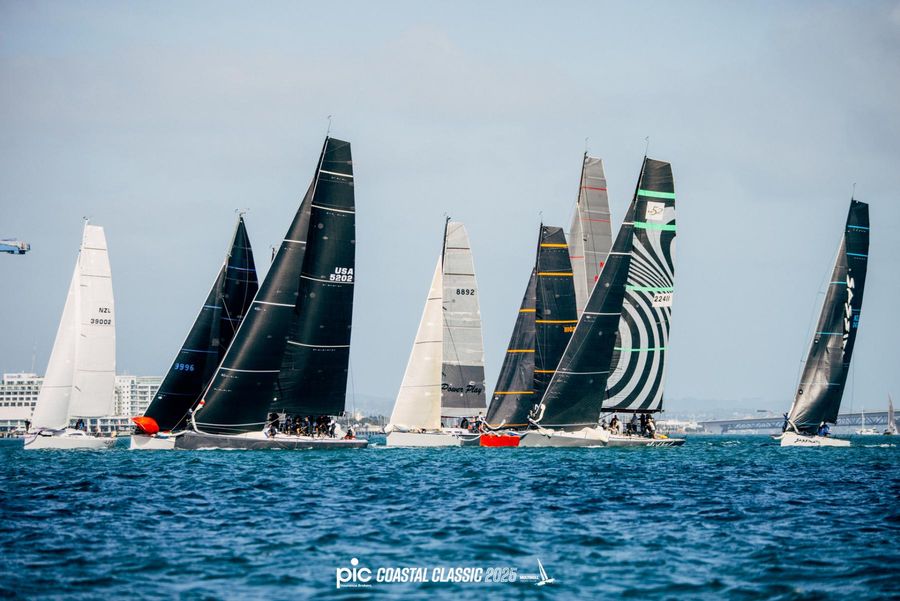
With the Botin 42 Callisto from the Admiral's Cup campaign now under the ownership of Team Garm of Sweden, attention had already shifted to the next challenge. Jim's TP52 Callisto has arrived in New Zealand ahead of this weekend's PIC Coastal Classic, setting the scene for a compelling rematch with Bryon Ehrhart's Lucky, the American rival whose name drew more than a few knowing laughs during the evening. Barker, Sanderson, and several members of the Admiral's Cup crew will be back on board for the 119-mile run from Auckland to Russell.
The formal proceedings closed with a standing ovation as Murray, Barker, and Sanderson presented the Channel Race Trophy to Commodore Blakey, placing the silverware in the Squadron's care. The moment gave physical weight to everything the campaign had achieved, proof that a programme conceived on the Great Lakes and built in Valencia could carry New Zealand sailing's spirit to the other side of the world and bring something back.
One line from the stage stayed with the crowd as they headed out into the Auckland night: "To add a page to the Squadron's story, that's why we do it."