The America's Cup is no stranger to legal controversy, but the challenge now taking shape has nothing to do with rival syndicates jostling for position on the racecourse.

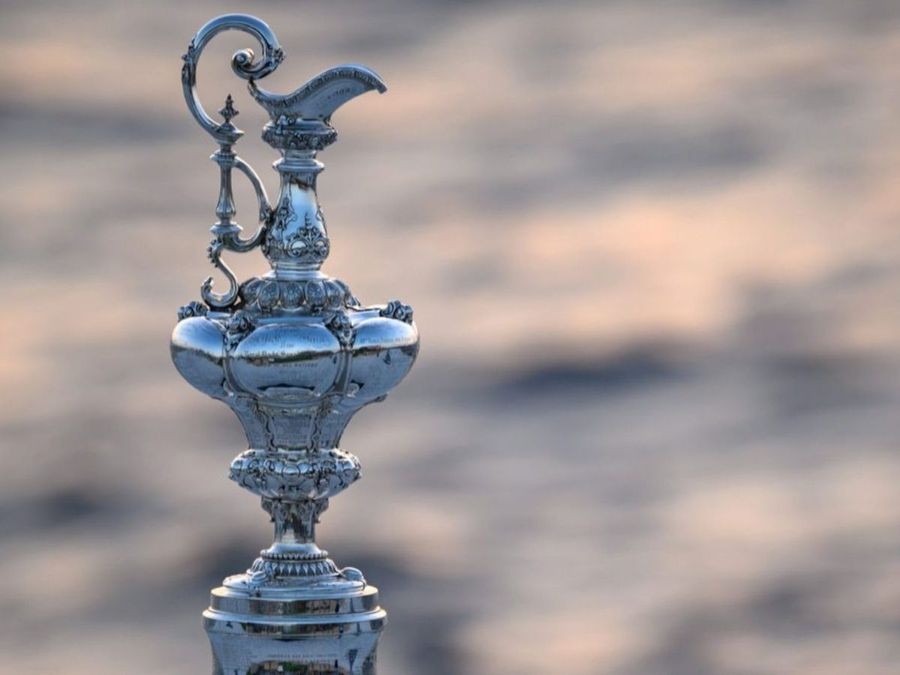
On 12 February 2026, a formal complaint was filed in New York against the Royal New Zealand Yacht Squadron, assigned case number 26-020937 by the New York Attorney General's Charities Bureau. The complainant is John Sweeney, former Cup sporting director, and his target is RNZYS in its capacity as trustee of the America's Cup Deed of Gift, a permanent New York charitable trust that has governed the trophy since 1857. The allegations are serious: Sweeney contends that RNZYS has committed material breaches of the very document it holds in trust.
A significant second voice has since entered the argument. Thomas F. Ehman Jr. brings considerable standing to the debate, having served as executive director of the America's Cup organisation under both the San Diego Yacht Club and the Golden Gate Yacht Club. In a statement dated 28 March, Ehman described RNZYS as "without doubt the worst trustee in the history of the Cup" and called on New York authorities to remove the squadron from the trusteeship and return it to the New York Yacht Club.
Central to both men's case is a passage written into the Deed in 1857 and undisturbed ever since: "It is distinctly understood that the Cup is to be the property of the Club subject to the provisions of this Deed and not the property of the owner or owners of any vessel winning a match."
Sweeney's complaint contends that RNZYS has done precisely what that clause forbids. Rather than exercising its trustee responsibilities through the club itself, RNZYS handed effective control to Emirates Team New Zealand, the racing syndicate. ETNZ then transferred commercial authority over the trophy to a newly incorporated entity, America's Cup Properties, known as ACP, created by its own description for the purpose of commercially exploiting the Cup. Two violations compound one another: the Deed vests ownership in the Club, not in a racing syndicate, and certainly not in a for-profit corporation.
America's Cup Properties came into existence following the 37th Cup in Barcelona, established jointly by RNZYS and the Challenger of Record, the Royal Yacht Squadron. The stated rationale was continuity of a kind the event has historically lacked. The Cup has long been hampered by a disjointed commercial model in which sponsorship arrangements and broadcast deals must be rebuilt from scratch whenever a new defender emerges. Emirates Team New Zealand's Grant Dalton has argued for years in favour of something closer to the Formula One structure, where commercial rights belong to the event itself rather than passing to whoever last crossed the finish line.
Sweeney's complaint takes a considerably less sympathetic view of what ACP actually represents. He argues that it substitutes for-profit corporate governance in place of yacht-club governance, and that its structure would bind every future Cup winner, whoever they may be and wherever they choose to compete, to rules written by RNZYS in perpetuity. The New York Attorney General's office has reportedly sought a response from RNZYS. Ehman raises a further point: ACP is run by the racing teams rather than by the clubs themselves, which he identifies as a separate and independent violation of the Deed.
Because the America's Cup trust is domiciled in New York as a charitable trust, private litigation cannot proceed without the Attorney General's involvement. The AG's office may investigate on its own motion, bring its own enforcement action, or authorise Sweeney to act as a relator on behalf of the state.
The legal terrain is well mapped. A 1990 ruling by the New York Court of Appeals in Mercury Bay Boating Club v. San Diego Yacht Club drew a clear boundary: the Deed's mutual consent clause allows the parties to agree on practical race arrangements, but it cannot be used to alter the fundamental character of the trust or override its core requirements.
Ehman points to another uncomfortable reality. The Deed has been lawfully amended on precisely two occasions, in 1956 and in 1985, each time through a formal court petition submitted with the approval of the Attorney General. Measured against that standard, the changes overseen by RNZYS since 2017 are extensive. Racing has been conducted aboard AC75 foiling boats that cannot be measured under any version of the Deed. Barcelona and Naples were selected as venues. ACP was established without any application to the courts. Not one of those steps followed the process that New York courts have previously recognised as legitimate.
It would be easy to dismiss all of this as wounded American pride. The United States does not currently have a team entered for the 38th Cup, and if that situation does not change, it will mark the first time in 175 years that an American boat has been absent from the start line.
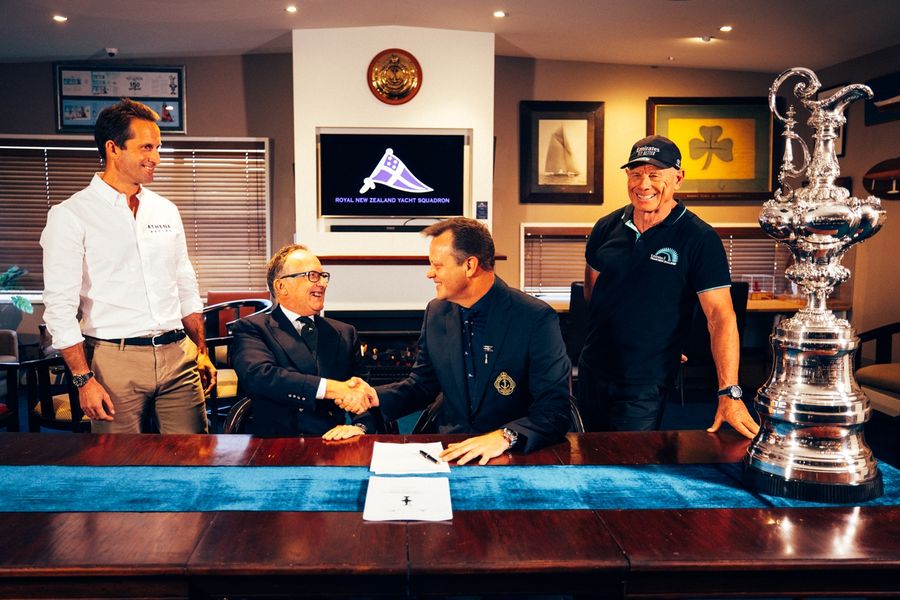
The dissatisfaction, though, runs well beyond American shores. Alinghi's parent club, Société Nautique de Genève, a two-time Cup winner and former trustee, has separately written to RNZYS raising governance concerns, arguing that Team New Zealand sold something it had no right to sell. That kind of accusation, made publicly by a club with that history, is not a minor footnote.
The Attorney General holds the decisive hand. He may pursue the matter, open a formal investigation, delegate proceedings to Sweeney, or elect to do nothing at all. With the Cagliari preliminary regatta approaching and teams already working through their preparations for Naples, the timing sits awkwardly across the event's planning. RNZYS and Emirates Team New Zealand find themselves fielding questions that, mid-cycle, they would plainly prefer to leave unanswered. The Deed of Gift carries a long institutional memory, and it has rarely shown patience for commercial arrangements concluded without its blessing.