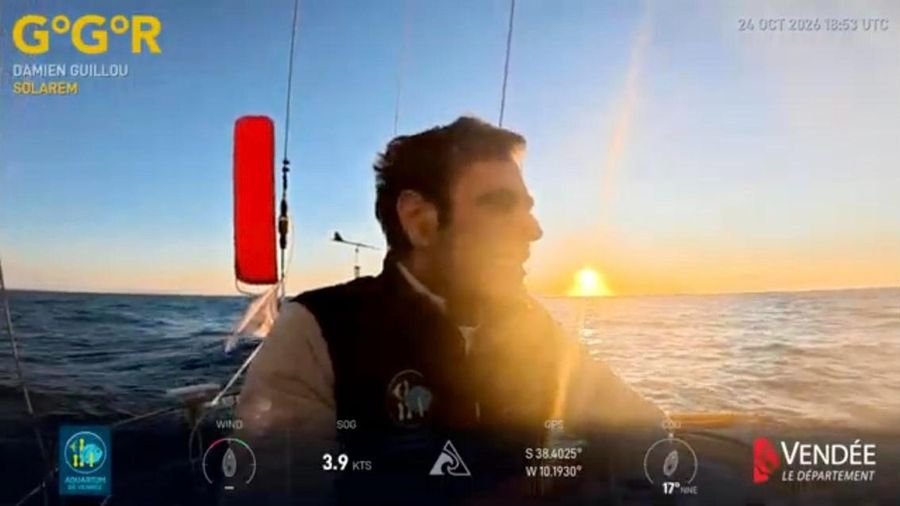
Damien Guillou has spent days sailing away from the finish. In Solarem he has run about 260 miles north-east, giving up course distance to stay clear of a storm due on Sunday evening UTC. At the latest report he was near 39 degrees south, roughly 60 miles short of the 38 degree line race chairman Don McIntyre wants him to cross. Behind him most of the fleet is crawling through light air, and the skippers have used their live broadcasts this weekend to talk about the wait.
Golden Globe Race 2026: distance sailed
Tracker snapshots, start to Day 48
Source: Golden Globe Race live tracker (Yellow Brick)
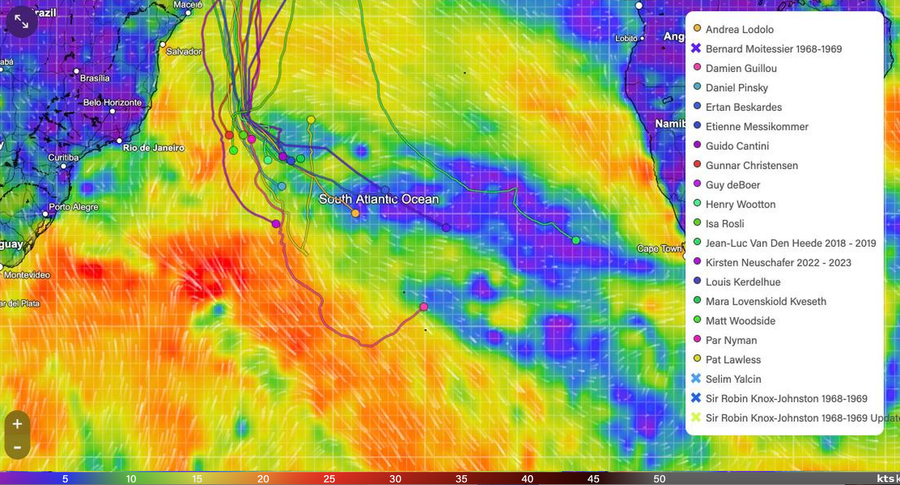
The diversion makes sense once you see the weather. McIntyre describes a front about 2,500 miles long, driven by a South Atlantic high leaning on a strong south-westerly flow. It should reach Guillou on Sunday evening UTC, stay for about a day and swing the wind from north-west to south-west. The outlook has eased since earlier in the week. Guillou can now expect five to six metre seas, where further south he might have met ten, though forecast material shown on the broadcast still put gusts near 68 knots around his expected position. McIntyre's advice is to keep heading north-east for as long as the wind allows.
Most of the fleet gets a lesser version. A northerly builds through Sunday toward 30 knots, gusting about 40, for 12 to 18 hours, with seas of four to five metres, and the northernmost boats should miss the worst. Our own check of the PredictWind models points to a second depression around 27 and 28 October as the bigger threat for the middle of the fleet. It looks larger than the first and sits closer to them.
Alone, but live
Ertan Beskardes gave the week's best broadcast. Becalmed at sunset under a full moon in Miss Beagle, he spent two hours swapping sails to find a few knots that were not there, then settled in for a long chat with his audience. Nobody was within hundreds of miles, he said, and he felt lucky and rather proud to have the ocean to himself. In the same breath he noted that he was beaming into people's lounge rooms, cars and aeroplanes by Starlink. What he hoped viewers would take from it was the real shape of the race, which is mostly a hunt for wind and very little fast sailing.
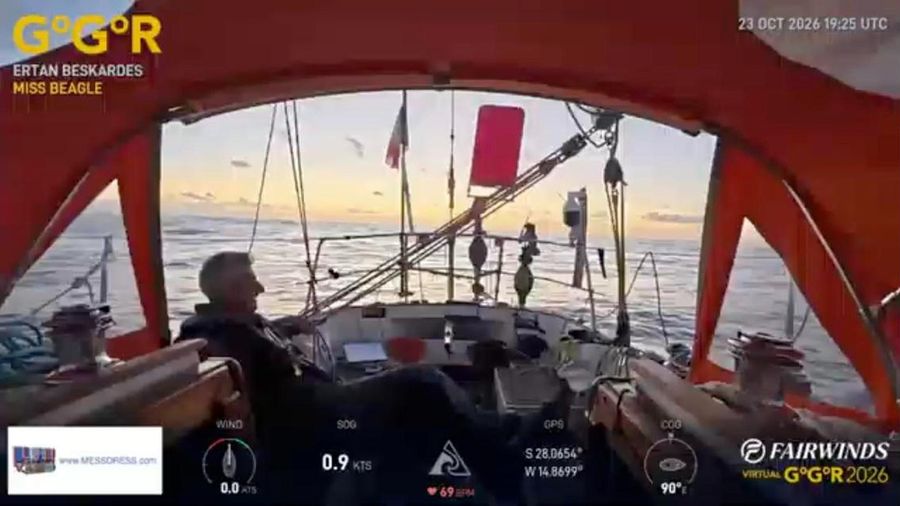
His storm plan is short. He turned east as soon as the first warning arrived to hold his line near 28 degrees south. For Sunday he will lash down the spray hood, tie in the reefs, lower the boom, secure the poles and sit it out in wet-weather gear. Each skipper will feel the storm differently, he pointed out, because 3,000 miles separates front from back, about a month of sailing. Between jobs he talked about the family business, flat out making medals for Remembrance Sunday, and thanked the Window Live crew for building the broadcast boxes at speed for a first of its kind event.
A phone call from the back
At the other end of the fleet, Gunnar Christensen in Pompoen and Matt Woodside in Tipi Haere both puzzled over a race update saying conditions would swing north-west. Neither could tell whether that meant the wind or the storm itself. Christensen rang McIntyre, who told him it was the wind and that nothing extreme was heading for the back of the fleet. Christensen said on air his mood lifted at once. With the old weather fax stations gone quiet, the back markers get very little else to go on.
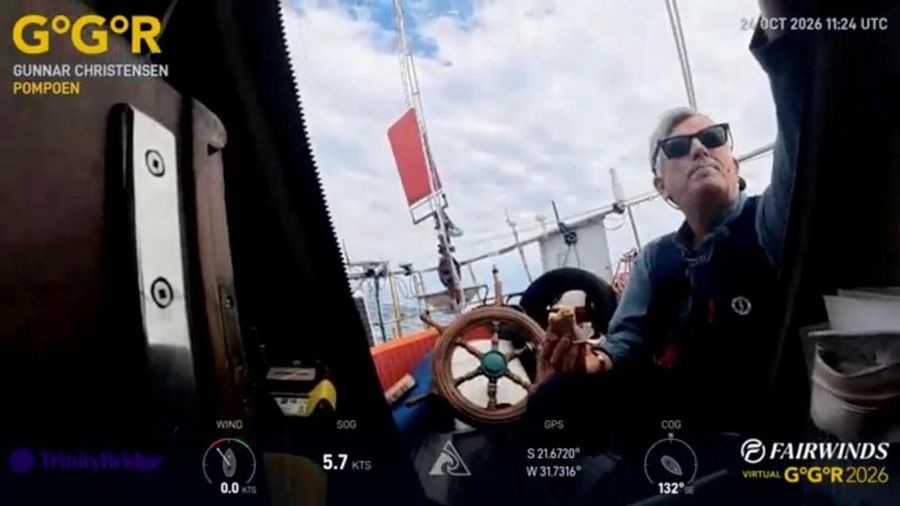
Christensen is working hard on his own morale. Earlier in the week he caught himself grumbling and told himself off: he has sailed non-stop from France, passed Trindade and had plenty of help getting there. He knows he is a long way behind Guillou and would settle for finishing. Over the last day he has cleaned out the galley, finding flies breeding in a dry locker that is no longer dry, and he is saving a bottle of maple syrup for porridge in the Southern Ocean. He has also drawn comfort from Joshua Slocum, who managed with far less. Sailing as if it were 1968, he decided, is not so bad. His broadcasts close with thanks to viewers, since talking to people lifts him.
Lifelines, letters and an omelette
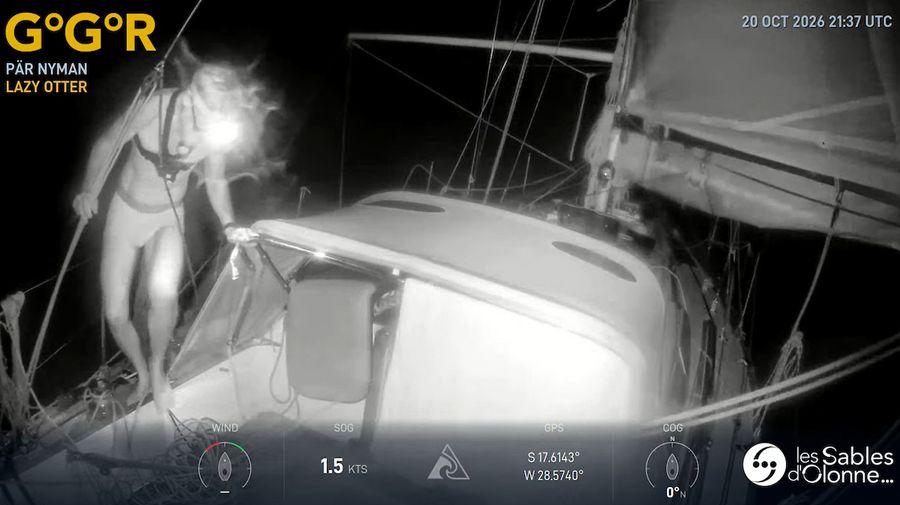
Pär Nyman, in Lazy Otter, spent his storm preparation day on small, careful jobs. A stranger who helped him in Les Sables had spotted chafed lifelines, and he has replaced them, added reef lines and lashed down the spinnaker booms and the anchor. Breakfast was an omelette with chilli, garam masala and thyme, with crispbread and cheese. He expects a small gale rather than a real storm and looks forward to some wind.
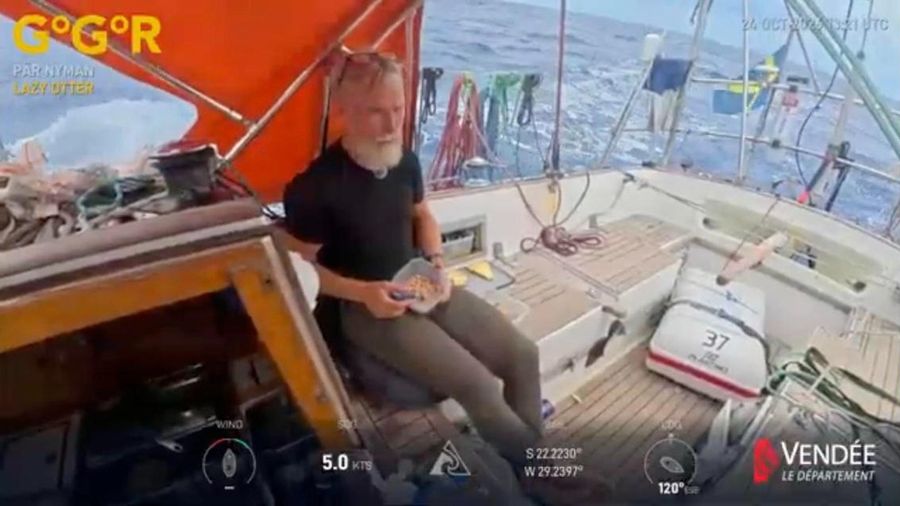
He also described rounding Trindade. He woke expecting to be miles off, saw the island ahead, and found his sun sights, after some early slips in the sums, landed exactly on his plotted position. When he needs a lift he reads letters from home. He likes being alone in what he calls his own little box, out of touch with the world, and has stopped trying to control the weather.
Up the mast at night
The best story from the front is Guillou's own. While he slept in light wind and swell, his spinnaker wrapped itself around the genoa. He went up the mast in the dark to clear it, working fast so he would not overthink it, and admitted afterwards he had felt invincible. Nothing broke. He climbed again at sunset to free the rest in calm conditions. For the storm he will set the small orange Tourmentin jib early, because he is not out to perform, only to find the angles where Solarem suffers least.
On his noon radio schedule he also reached Etienne Messikommer, about 1,000 miles away near 25 degrees south, and said it was good simply to hear another competitor.
Navigating by hand, without a forecast
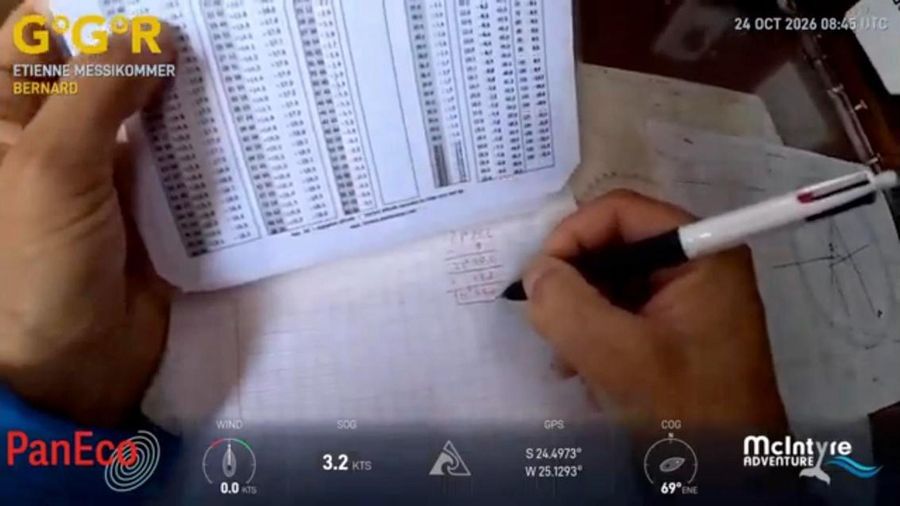
Messikommer, in Bernard, used his dawn broadcast to take viewers through a full sun sight with sextant and almanac, step by step. It is not magic, he said: you need the right time, the right angle and the right numbers, and you must not mix up west and east. He is also the fleet's loudest voice on the weather problem. He calls the lack of forecast information the hardest and most dangerous part of the race, a world away from the weather fax days, and says it turns the whole thing into a lottery. He has spent three days close-hauled in a south-east wind, setting an alarm every hour at night to check the compass and look for squalls.
Across the fleet
Beskardes remains second, slowed by light winds through Saturday, though his northerly position should help him avoid the worst. Andrea Lodolo in BiBi is racing hard and told McIntyre he is not worried. Sitting near the edge of the stronger weather, he could see 30 to 35 knots, gusting 40 to 45. Daniel Pinsky in Exodus was almost becalmed at 0.1 knots on the 08:00 UTC report, drifting rather than choosing his heading.
Through the middle, Mara Kveseth in Showgirl is making about 4.5 knots on the favoured tack and has gained on Messikommer, who was stuck in a calm and has since started moving again at about 3.6 knots. Guido Cantini's Hannah of Cowes covered 69 miles in 24 hours. Henry Wootton's Privateer is making 6.1 knots and closing on the boats ahead, and McIntyre rates it as a Southern Ocean boat. Woodside is moving freely at about 5.5 knots after light winds at Trindade, Nyman is making about 5.1 and Christensen 4.4. The 347 and 365 mile days showing on the tracker for those two are glitches.
Isa Rosli in Olleanna spent eight hours in the water scraping barnacles off the hull and has more to do. McIntyre is unsure he can clear all of it, or keep it clear, so the effect on his race is hard to call.
Louis Kerdelhué reached Recife overnight in IE Charge and picked up a mooring unassisted. He is staying aboard while customs and immigration wait, and he woke to find another boat tied alongside after it broke free in the wind. His manager arrives on Sunday, and a restart as early as Monday is possible but not settled. Guy deBoer is making about 5.3 knots in Spirit, in good spirits, with roughly 1,000 miles and about a week to go to Trindade. Pat Lawless is heading north-west at about 4 knots, well clear of the storm after his race ended with a failed rudder fitting. Our earlier report on his retirement has the detail.
What to watch
Guillou's next 24 hours decide how hard the storm hits him. If he reaches the 38 degree line before the wind turns, the forecast suggests a demanding but manageable blow. The wider fleet should get through the Sunday northerly without trouble, and attention then moves to the second depression due around 27 and 28 October. Our previous report on the lead shows how the gap at the front has shrunk, and our report on Mara Kveseth's penalty covers the earlier Showgirl story.