Sailing a multihull solo offers a particular kind of freedom that is hard to replicate any other way. No crew to coordinate, no watch schedules to negotiate. Just a sailor, a boat, and open water. For a growing number of multihull enthusiasts, that combination represents the purest expression of seamanship. It also happens to be far more practical on a catamaran than most people assume, thanks to the stability, speed, and liveable space that twin hulls provide.
Anyone who has tried to pour a hot drink on a heeling monohull in building breeze will immediately grasp the appeal. Catamarans sit upright. Life below decks stays manageable. Gear stays where you put it. For a sailor managing everything alone, those qualities shift from convenient to genuinely important. That said, the wide beam brings its own demands at the dock and in the sail-handling department, and the extra canvas needs to be respected. More and more sailors are making peace with those trade-offs and stepping confidently into single-handed multihull cruising.
*Finding the right boat*
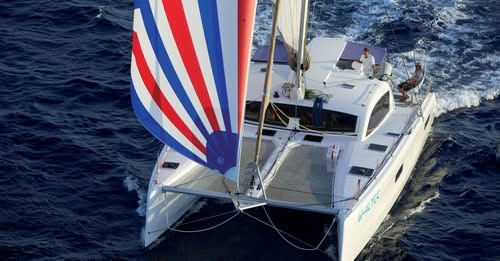
The broad consensus among solo multihull sailors is that somewhere between 10 and 14 metres (35 to 45 feet) is the practical sweet spot. Big enough to carry gear and provisions for an offshore passage, and to handle deteriorating conditions, but small enough for one person to manage physically. Modern production cats have come a long way toward making that achievable. The Lagoon 42 and the Leopard 40, for example, are typically rigged with lines led aft to a single helm station, electric winches, and autopilots as standard equipment. Some models even include remote sail controls or touch-screen management systems, turning what once required three crew into a one-person operation. Also worth considering is the new Lagoon 38, which is smaller again and designed with those who aspire to live and work on the water firmly in mind.
Performance-oriented multihulls from builders such as Outremer or HH raise the bar for the sailor but deliver rewarding speed in return. They ask for a more sophisticated understanding of reefing and balance. With solid boat knowledge and a habit of reefing early, they can be sailed safely solo, though they are not the logical starting point for everyone. The Outremer 45 has attracted particular attention as a design conceived with the solo sailor in mind from the outset. Its ergonomic helm layout, 360-degree visibility, and low boom height for easy sail access have made it something of a benchmark. Whether held on autopilot or sailed actively, it offers a combination of comfort and control that confident cruisers find hard to fault. When in doubt about any boat choice, simpler systems and fewer complications will always serve the solo sailor better.
*Preparation*
Good preparation is not optional. At sea alone, everything takes more time, and any developing situation becomes more serious without another set of hands. Route planning forms the bedrock: harbours, hazards, and bolt-holes identified and memorised before departure, waypoints already loaded into the GPS, and the route familiar enough that no one is flicking through pilot guides in a deteriorating situation. Reefing and sail changes should be practised at anchor until they are second nature. And if the autopilot goes down, a plan needs to be ready before that happens, not after.
Brieuc Maisonneuve, a seasoned sailor who recently delivered a Neel 43 trimaran from France to Venice, chose to complete the first leg of that journey single-handed. His view on preparation is straightforward: "You have to know your boat before you leave. I made a route plan, checked every system, and carried AIS and a PLB. Once you're alone offshore, there are no shortcuts."
Heavy weather strategy for solo multihull sailors tends toward the conservative. Trailing warps can take the edge off surfing and reduce the risk of bow-diving. On a performance cat with daggerboards, using the windward board to help pinch upwind is a useful tool. On a production cat without boards, running the engine can assist in keeping the bow where it needs to be. The most important discipline, though, is straightforward: reef early. If it feels like it might be time to reef, it almost certainly already was.
*Safety*
Staying aboard is the first and most fundamental safety task. Falling overboard alone leaves no one to turn the boat around. Solo sailors operating in exposed conditions should always be tethered, and a lifejacket fitted with both an AIS MOB beacon and a PLB provides the most reliable safety net if the worst does happen. AIS beacons alert other vessels within five to six miles. PLBs trigger international rescue coordination. Together they cover a wide range of scenarios, but neither is a substitute for the tether.
Autopilots are indispensable, but they are not a complete solution. Sleeping close to the helm, something that pilothouse-equipped boats make much easier, allows quicker response to anything unusual. Radar proximity alerts can wake a sleeping sailor when another vessel comes within range. Some single-handers set 20-minute alarms through the night to prompt a quick horizon check. Fatigue is consistently one of the greatest threats on a solo passage. A simple list of daily tasks, posted at the cockpit or nav station, is an idea borrowed from military practice and used by many experienced solo sailors to stay on top of critical routines even when running on limited sleep.
*Lessons from experience*
Those who have actually lived this sailing life offer the most instructive perspective. James Frederick, sailing solo in the Pacific, found himself soaked and exhausted in the middle of a night squall, questioning every decision he had made. The following morning, running under tradewind skies on gentle seas, he understood precisely why he had chosen it. Holly Martin, who grew up on boats and now cruises the Solomons solo aboard her Grinde 27, puts it simply: "Being at sea alone is a joy. I bought small and kept things simple. It's more a mindset than an inconvenience." From Kiana Weltzien's quiet passages with her Wharram catamaran in the Atlantic, to YouTubers documenting tiller upgrades and solo wind-shift management, the recurring theme is consistent. Solo sailing is less about isolation and more about being genuinely in command.
*Getting started*
Before pointing the bows offshore, a solo day sail is the logical first step. Alternatively, heading out with crew who agree to keep their hands off the sheets provides a useful controlled test. Reefing, tacking, and anchoring all feel different when you are the only person doing them. The blind spots reveal themselves. The time each operation takes becomes clear. The load on halyards becomes something you understand through your hands rather than in theory.
Confidence in solo multihull sailing is built through experience: making a night landfall under sail, crossing a bar without the safety margin a crew would have provided, or managing drone retrieval while the autopilot holds course. None of that is heroic. It is simply the accumulation of competence, one passage at a time. The reward, when it all comes together, is the sound of the wake, wind across the beam, and the quiet understanding that you have this completely in hand, even if there is nobody else aboard to share the moment.