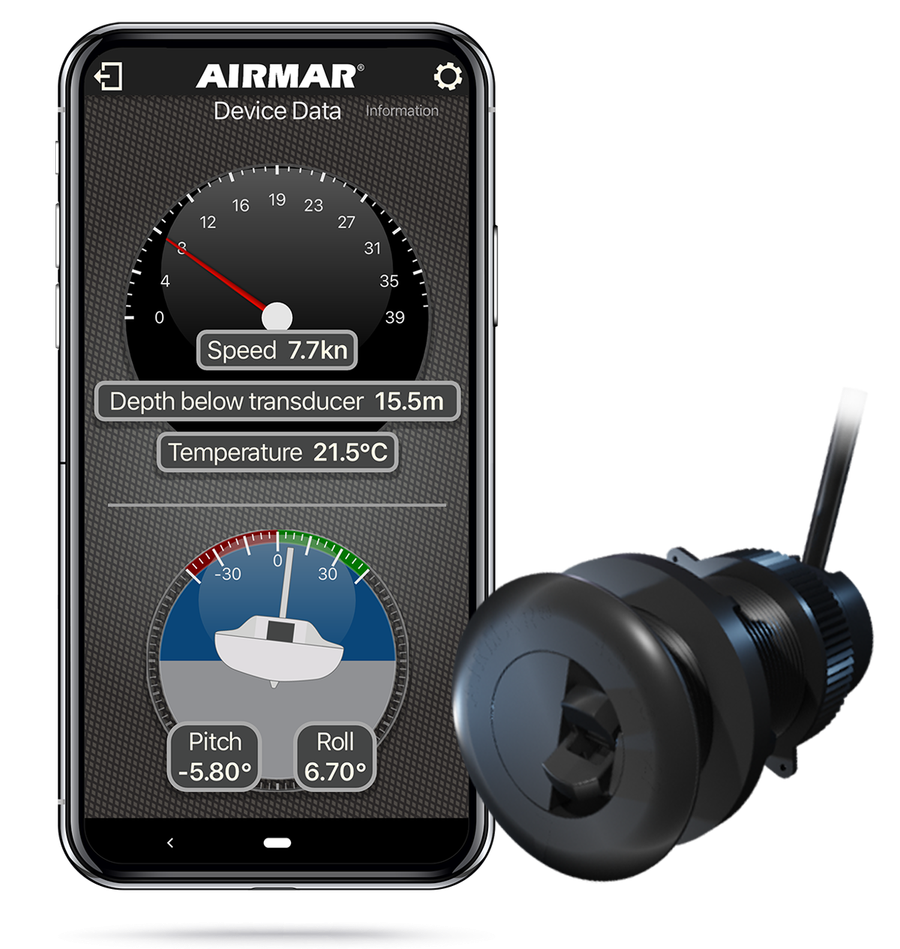
For anyone who has already spent time installing the DST810, the new DST820 will feel immediately recognisable under the skin. The same 2-inch thru-hull fitting carries depth, speed-through-water, water temperature, and heel and trim data across the NMEA 2000 network, and the Gen2 paddlewheel that drives the speed readings performs just as it did before, returning usable figures below 0.3 knots, reaching linearity at 0.6 knots, and holding accuracy right through to 45 knots.
What separates the DST820 from its predecessor has less to do with sensing technology and more to do with a new layer of regulatory compliance. The UK's Product Security and Telecommunications Infrastructure Act, known as the PSTI Act, came into force in April 2024. It places specific obligations on networked consumer devices covering password security, vulnerability reporting, and the publication of defined support periods. Rather than retrofitting compliance onto an existing product, Airmar built the DST820 to satisfy those requirements from the ground up.
At the installation stage, this compliance requirement takes the form of a QR-code setup step. Scan the code, provide a one-time password via your phone, and the process is done. Skipping it does not disable the sensor itself. Depth, speed, and all other core data continue to pass through to your instruments without interruption. Access to the full feature set within Airmar's CAST app remains locked until setup is completed.
The CAST app has received meaningful new capabilities alongside the new hardware. Users can now enable or disable depth output independently of other data streams, adjust update rates for individual outputs, and manage both firmware updates and fault logs through a single interface. The CAST app also serves as Airmar's official channel for security vulnerability reporting, a requirement that sits at the heart of the PSTI framework. Raymarine, B&G, and Garmin all took part as OEM partners during the compliance development work.
On the physical side, the modifications are modest. The sensor's Load Equivalency Number on the NMEA 2000 backbone falls from 3 to 2, and it ships with NMEA database version 3. The 2-inch thru-hull footprint matches the DST810 exactly, so a direct replacement requires no additional hull work.
The DST820 is available in bronze, stainless, and plastic versions, priced at the same level as the outgoing DST810. A US production phase-out date of 1 June has been set for the DST810, though the transition in this part of the world is expected to be more gradual. Airmar ANZ will manage the changeover according to its own existing DST810 inventory levels. Any DST810 stock that remains in circulation continues to be covered by a three-year warranty.
Craig Cushman, Airmar's Director of Marketing, was direct about the company's commitment to this region: "Airmar has long recognised the strength of the sailing market in NZ and Australia. We continue to innovate new technologies and develop platforms that are built for future-forward use."
Airmar has offered to supply a test unit to a New Zealand dealer, and a hands-on assessment from local waters may follow in due course.