When researchers monitoring the eastern Pacific noticed something unusual early this year, it stopped them in their tracks. The Gulf of Panama's upwelling current, one of the most reliable oceanographic features in the region, simply never formed. Where cold, nutrient-rich water would normally be pushed toward the surface to fuel plankton growth and sustain the local food web, the water remained warm and undisturbed. It was the first time since records began that the upwelling had failed to appear, and for climate and ocean scientists, the implications were immediate and unsettling.
Was this a temporary aberration, or an early indication of something far more significant unfolding beneath the surface of the Pacific?
[gallery td_select_gallery_slide="slide" ids="160392,160401"]
Answering that question demands more than remote sensing from orbit. Satellite data provides a broad thermal picture, but it cannot replace physical measurements taken at sea. That is where a sailing vessel has an important role to play.
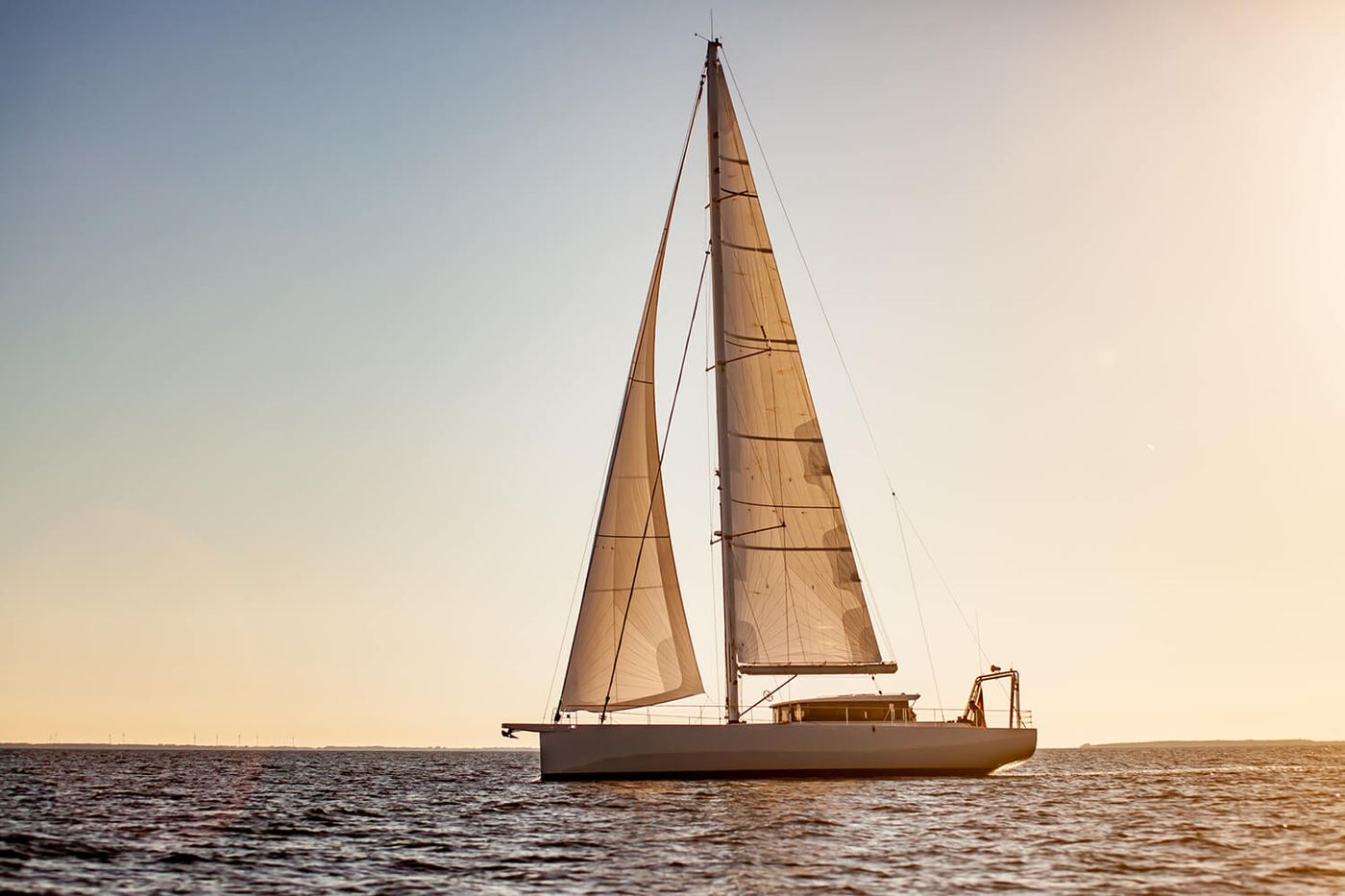
Eugen Seibold was commissioned by the Max Planck Society and constructed by YYachts under its custom build programme. Construction was completed in 2018, the vessel was launched and christened that same year, and she entered full scientific service before the year was out. At 22 metres, the design brief called for something quite specific: a long-range sailing platform capable of offshore research work with only a small crew on board.
[gallery td_select_gallery_slide="slide" ids="160384,160404,160381"]
From the outside, Eugen Seibold presents as a well-proportioned bluewater cruiser. Below decks and aft, however, she carries the kind of working infrastructure normally associated with vessels many times her size. A compact clean laboratory, dedicated dry storage for scientific equipment, and a functional working deck aft allow the team to process samples and instruments almost as soon as they come aboard. Her composite hull keeps displacement low, while a hybrid drive system reduces engine noise and exhaust contamination near sampling stations. Since entering service, she has completed crossings of both the Pacific and Atlantic, carrying two professional sailors and a rotating team of five or six researchers on each passage.
El Niño sits at the centre of this scientific mission. As one of the most consequential climate patterns in the Pacific basin, it begins when a body of warm water builds north east of the Philippines, weakening the trade winds and allowing that warmth to drift eastward. The knock-on effects reach far beyond the tropics, altering rainfall, fisheries, and weather patterns across a wide range of regions.
Despite decades of study, the mechanics of El Niño still hold significant unknowns. Scientists want to understand more precisely how individual ocean layers interact, how local dynamics feed into basin-wide behaviour, and how a warming ocean may reshape the pattern's timing and intensity going forward.
Eugen Seibold is well suited to addressing those gaps. Her capacity for sustained, repeated sampling across open ocean stretches that research ships cannot easily reach on constrained schedules gives her programme a distinctive value. Because El Niño forms in the same eastern and central Pacific waters where she collects data, her measurements directly inform the global models that NIWA, MetService, and New Zealand marine scientists draw on when forecasting weather, ocean temperatures, fishing seasons, and coastal conditions. Events originating off Panama can influence New Zealand's climate within a matter of months.
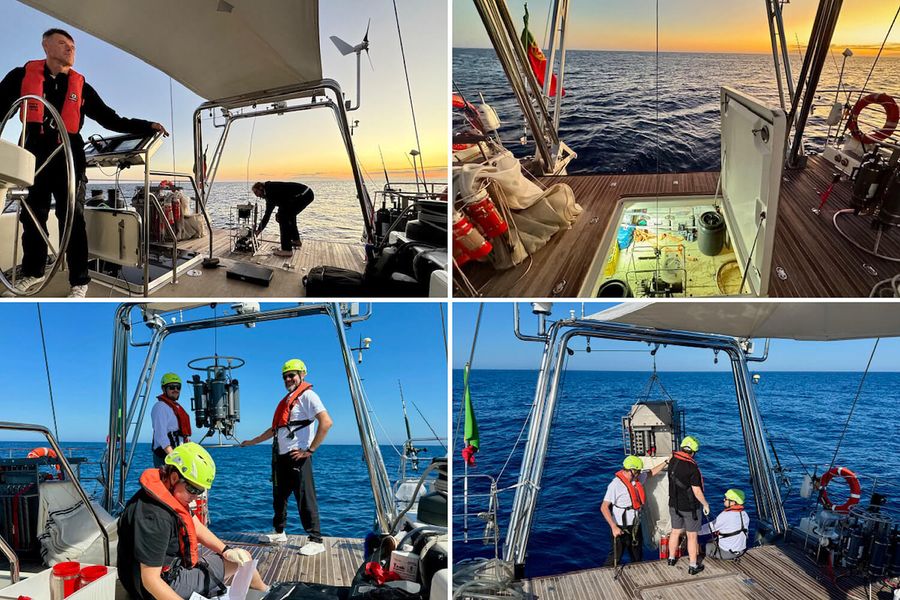
The scientific capability built into the yacht is considerable for a vessel of her size. A deep water winch installed beneath the aft deck lowers sampling gear to depths of 3,000 metres. A keel intake draws clean surface water into the onboard laboratory while the vessel is underway. There, researchers measure temperature, salinity, fluorescence, oxygen levels, and light penetration. Plankton communities are also recorded, giving the team a biological dimension to complement the physical and chemical data.
Climate scientist Dr Ralf Schiebel leads the research programme.
“Our aim is to build a broad record of El Niño conditions,” he says. “We measure CO₂ in the atmosphere and in the ocean, and we take water at depth to see how everything connects.”
The ability to move slowly under sail or silent hybrid power gives the team an additional advantage: samples gathered without the interference of heavy exhaust and mechanical vibration are cleaner and more reliable than those taken close to large conventional engines.
When Panama's upwelling failed this year, Eugen Seibold was positioned to document exactly what that failure looked like through the water column. Rather than the expected cool layer rising from depth, the team encountered warm, stratified water with low nutrient concentrations. Plankton communities shifted in response almost immediately.
[gallery td_select_gallery_slide="slide" ids="160380,160379"]
Whether this anomaly reflects an emerging El Niño event or something happening specifically within regional circulation patterns is still under active investigation. The physical samples gathered on board are giving researchers a level of detail about what actually occurred that satellite temperature maps alone could never provide.
The connections to New Zealand are direct. Shifts in the Panama upwelling zone can signal changes in the strength and timing of El Niño, which in turn may shape summer rainfall, wind patterns, cyclone risk, and marine conditions in New Zealand waters. For those who spend time boating or fishing around the New Zealand coast, a better understanding of these upstream signals translates into more reliable seasonal outlooks and more informed coastal planning.
Measurements from Eugen Seibold flow into international modelling efforts, where oceanographers and climate scientists use them to refine predictions about how a warming Pacific may influence future El Niño events. The practical value of those improved forecasts reaches across farming, fisheries, emergency management, and coastal communities. Continuous long-term records from vessels purpose-built for this kind of work are difficult to replace.
The work is not quick. Interpreting water, plankton, and air samples from each voyage involves searching for subtle relationships between chemical signals, biological responses, and temperature gradients across different depths. Those connections gradually reveal how the system functions and which indicators might serve as early warnings of change. It will be several more years before the current run of results has been fully analysed, but the programme already demonstrates what a relatively modest research vessel can achieve when her design has been built around the requirements of the science she supports.
The Pacific continues to warm, and patterns that once seemed predictable are becoming less so. Whether the Panama upwelling failure turns out to be an isolated event or the first sign of a more fundamental shift will only become clear with further data. Eugen Seibold keeps working across tropical and temperate waters, lowering instruments into the deep, collecting samples, and contributing piece by piece to a clearer understanding of an ocean in flux. Purpose-built sailing research platforms remain few, and Eugen Seibold shows how effective they can be when endurance, precision, and simplicity of operation are built into a hull from the keel up.