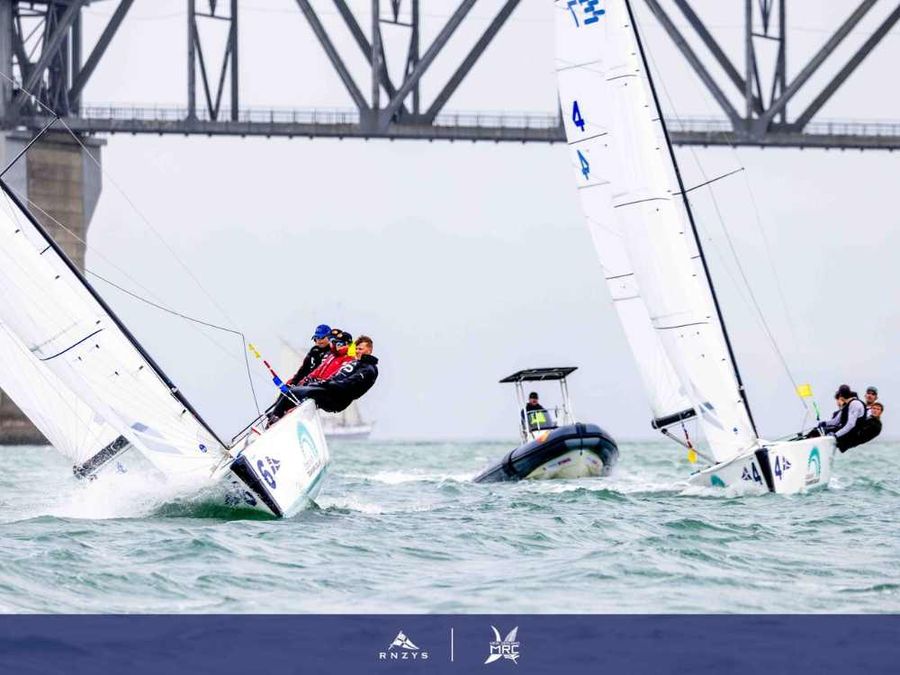
New Zealand's match racing season reached its headline event this morning when the New Zealand Match Racing Championship 2025 got under way at Westhaven. The breeze was steady, the tide clear, and race officers pushed through the opening flights with confidence. One of the signature regattas on the Royal New Zealand Yacht Squadron calendar, this championship sits at the top of the national match racing pathway. With just eight teams in the field, there is nowhere to hide.
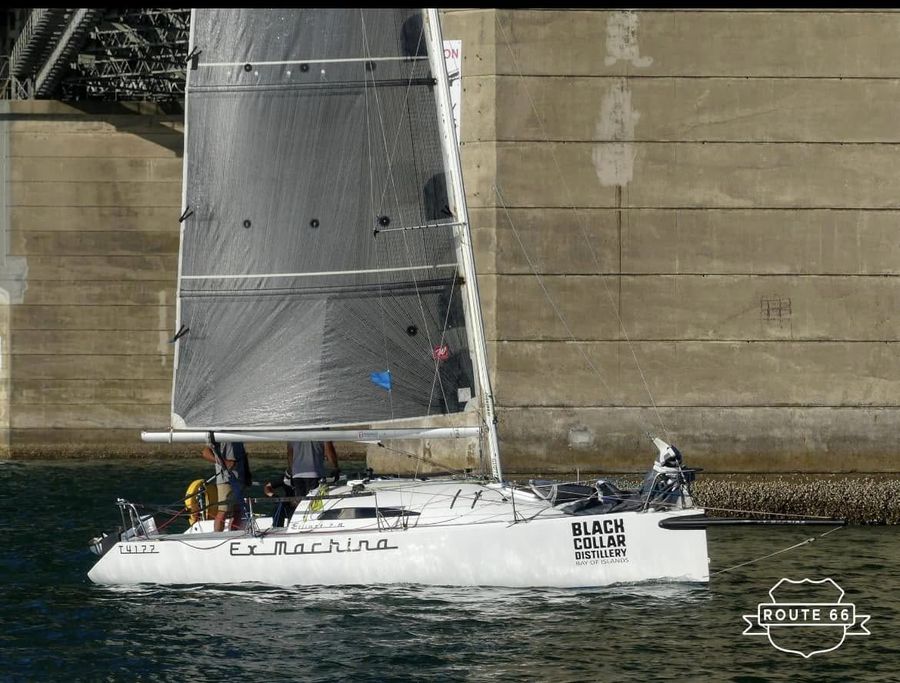
The fleet races on the RNZYS Elliott 7s, a one-design keelboat that has become synonymous with match racing development in New Zealand. As a brief point of interest, the Elliott 7 has a wider presence in local sailing than the national championship alone. Jamie Caisley's Ex-Machina, which has appeared on the offshore circuit including the 2025 Route 66 yacht race and the 2025 PIC Coastal Classic, is a 2004 Elliott 7.
Four days of racing lie ahead, with a 1700hrs latest attention signal on Sunday. The national title remains genuinely open.
New Zealand's match racing pathway runs through three events, all hosted by the Royal New Zealand Yacht Squadron. Together they form a structured progression from youth competition through to the senior national title, and on into the international circuit.
The New Zealand Match Racing Championship, held this November 2025, is the flagship. It draws senior and elite sailors, welcomes invited overseas teams, and feeds directly into world ranking lists. A strong result here carries real weight.
The Oceanbridge New Zealand Youth Match Racing Championship, held in August 2025, is the principal national title for younger sailors and the key event for identifying the country's next match racing generation. The 2025 edition was fiercely contested. Noah Malpot delivered an 8–0 round robin and then won a tightly fought five-race final over Lucas Day. Ethan Fong took third, beating Robbie Wooldridge in straight wins, while Samuel Scott topped the second tier with four wins from four. A number of those sailors have since moved directly into this week's senior fleet.
The NZL Youth Match Racing Worlds Trials, held in May 2025, determines New Zealand's representative at the Youth Match Racing World Championship. Josh Hyde was the standout performer, winning every stage and sweeping the final three–nil over Ethan Fong. Malpot reached the petit final and beat Samuel Scott two–one for third. Strong performances from Charley Cates and Robbie Wooldridge further underlined the depth in the current youth group. Almost half of this week's senior field raced at the trials, and several bring knockout-stage experience directly into the Elliott 7s.
The progression is deliberate: develop match racing skills at youth level, compete for national youth honours, and then graduate into the senior championship to measure up against the country's best. The New Zealand Match Racing Championship 2025 is the top rung of that ladder.
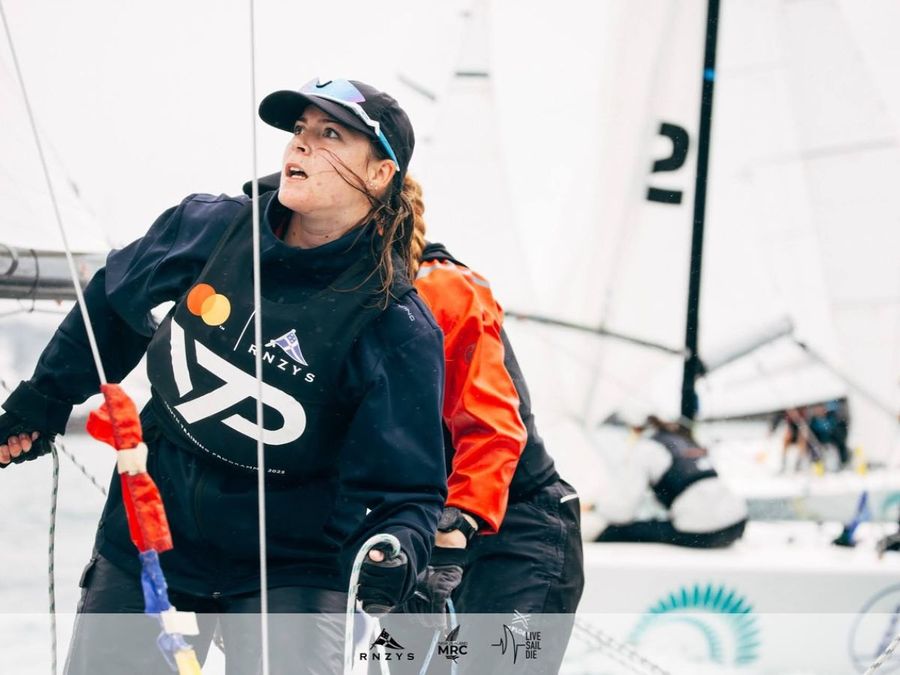
Mastercard Youth Training Programme fields Robbie Wooldridge (NZL) as skipper, with crew Dominic Lilley, Oliver Davidson, Josh Hilder, and Lewis Snape. Wooldridge brings months of focused training through the Squadron's Youth Programme. He reached the top four at the Oceanbridge Nationals, made his mark at the Worlds Trials, and finished seventh at the 2024 championship, an impressive return against a field of seasoned campaigners. That senior experience sharpened his starting discipline and his downwind mode control. With a full additional season of Youth Programme work behind him, he arrives considerably more settled. His team handles the Elliott 7 with tidiness, and they tend to thrive in close pre-start exchanges.
VMG Racing lines up with skipper Noah Malpot (NZL) and crew Will Mason, Luca Smith, Tayne Haag, and Sophia Morgan. Malpot placed fifth in 2024, showing genuine speed but dropping a handful of close matches late in the round robin. His 2025 form has since been exceptional, headlined by his dominant win at the Oceanbridge Youth Nationals. He reads wind shifts well and has the composure to engage in prolonged tacking duels. VMG Racing enters this week as one of the leading title contenders.
Hauraki Racing brings skipper Leo Jeffery (NZL), joined by Apikera Baker, Georgia Howlett, James West, and Robyn Ashton. Jeffery finished seventh at the Youth Nationals but improved visibly throughout the season. His crew is measured and well-organised. They are likely to play the shifts patiently upwind and keep their errors to a minimum.
Quest Racing is skippered by Ethan Fong (NZL), with Hugo McMullen or Henry Angus, Maddie Rist, Harry McMullen, and Lucas Day making up the crew. Fong finished seventh equal in 2024, tied with Hayden Smith at the back of the second tier. He showed bursts of real speed but could not sustain consistency across the full schedule. His 2025 record tells a different story entirely. He reached the final of the Youth Worlds Trials and claimed third at the Youth Nationals after losing to Hyde. His ability to perform deep into knockout series makes him a genuine danger once the fleet rounds down to the top four.
Jam Hot Racing fields skipper Charley Cates (NZL), with crew Jacob Furniss, Jolly Koska, and Chris Kenrick. Cates produced strong results across the 2025 Youth Worlds Trials, defeating several higher-ranked opponents in critical races. Jam Hot Racing races with a bold, attacking style that can disrupt teams with considerably more experience.
True Blue Racing is the most compelling international entry. Gavin Brady (USA) skippers the team, with Rye Brady, Megan Thomson, Phoebe Buckland, and Florence Sharpe as crew. Brady was born in New Zealand and is one of the most decorated match racers of his generation, with four Congressional Cup victories and more than 30 years at the top of the sport. Competing for the USA with True Blue Racing, he has maintained a consistent presence on the World Match Racing Tour, finishing second at the 2023 WMRT Final in Shenzhen. His career encompasses six America's Cup campaigns, the Volvo Ocean Race, Olympic representation for New Zealand, and numerous offshore championship wins. Several of his crew members carry strong Squadron connections. If True Blue Racing find their rhythm early, they will be difficult to stop in the knockouts.
Black Sheep Racing enters as defending champion. Skipper Reuben Corbett (NZL) is joined by Guy Pilkington, George Angus, and Oliver Lloyd. Corbett is a highly experienced New Zealand match racer and former national champion who reclaimed the title at the 2024 New Zealand Match Racing Championship, beating Cole Tapper in a commanding final and demonstrating clear tactical superiority over a younger field. Black Sheep Racing starts the week as the team to beat, though the 2025 fleet is meaningfully more experienced than the one Corbett faced twelve months ago.
Gage Roads completes the line-up, with Xavier Bates (AUS) skippering and Vass Katsaieis, Will Mcaully, and George Elms forming the crew. The sole Australian entry, Bates hails from the Royal Freshwater Bay Yacht Club and is still competing in the youth divisions while steadily building his senior credentials. His recent programme has included skippering his own team in the JESS Match Cup and gaining international experience with Cowes Match Racing Blue in the UK. He is also an accomplished ILCA dinghy sailor. His team is well drilled and quick through manoeuvres, and they are capable of unsettling at least one or two of the more established local crews.
The depth of the 2025 field becomes clearer when you trace it back through the youth results of the past six months.
At the Oceanbridge Youth Nationals, Malpot produced one of the more complete youth campaigns seen in recent seasons. His 8–0 round robin gave him a platform from which he never looked back, and the five-race final against Day went the distance before Malpot secured it. Day was fast and fearless throughout, winning two matches off Malpot in that final and eliminating Fong in the semi-finals. Fong's path to third was hard-earned. He pushed past Day in a tough semi-final and then delivered a clean petit final display. Wooldridge, Jeffery, Clarke, and Scott all accumulated tactical miles across a schedule that included brief squalls and fast repair turnarounds between flights.
At the Youth Worlds Trials, Hyde was in a class of his own. He led the round robin, controlled both his semi-final and his final, and secured the New Zealand berth with a three–nil sweep of Fong. Fong had beaten Malpot three–nil in his semi-final before falling to Hyde. Malpot ground out a two–one win over Scott in the petit final. Cates, Clarke, and Wooldridge traded results through the second tier, each picking up valuable repetitions in the precise timing that Elliott 7 match racing demands.
The result is a senior championship where several of the leading skippers have already sailed full round robins and knockout series against each other within the last six months. The form lines are unusually well established before a single gun has fired this week.
The Elliott 7 has earned its central place in New Zealand match racing through straightforward virtues. Greg Elliott designed it as a small keelboat that responds quickly, rewards accurate teamwork, and stays predictable under pressure. Those qualities have kept it at the heart of the Squadron's programmes for years.
At seven metres, it is light and picks up speed readily, holding pace through tacks and gybes in a way that makes every manoeuvre count. A fraction of mistiming shows up immediately. Get the trim right, and the boat moves with a crispness that rewards the effort.
The cockpit is close quarters and purposeful. Everything a crew needs sits within arm's reach, but there is no excess space. Movement must be deliberate, and the layout quickly exposes whether a team has genuinely trained together or is still finding its shape.
Upwind, the keel delivers a firm, settled feel, and the helm holds its line even when the breeze is inconsistent. That reassurance helps developing sailors build trust in the boat without removing the sensitivity that keeps experienced crews sharp.
Downwind, the boat carries a gennaker off a retractable bowsprit. A well-executed mode change can open up a lead quickly. Crews who shift their weight precisely, keep the hull flat, and work the sheet with discipline can turn a small margin into something far more comfortable.
The one-design rules are strict. Every hull, spar, and sail set sits within tight limits, so any edge on the water comes from decisions, not from gear. That is precisely what makes the Elliott 7 such an effective match racing tool. A won dial-up, a successful cross, or a penalty earned in the pre-start reflects the quality of the sailors, nothing more.
The boats are also built to handle hard use, daily racing programmes, fast turnarounds between flights, and the inevitable contact that close-quarters match racing brings. Rudders can be swapped quickly, and the control systems stand up to repeated loading across a full regatta.
For sailors new to match racing, the Elliott 7 is often where the learning really starts. For the more experienced crews, it still presents enough challenge to keep the racing honest. It remains one of the most effective platforms in the country for finding out who can think faster, push harder, and hold their nerve when the gap between winning and losing narrows to a matter of metres.