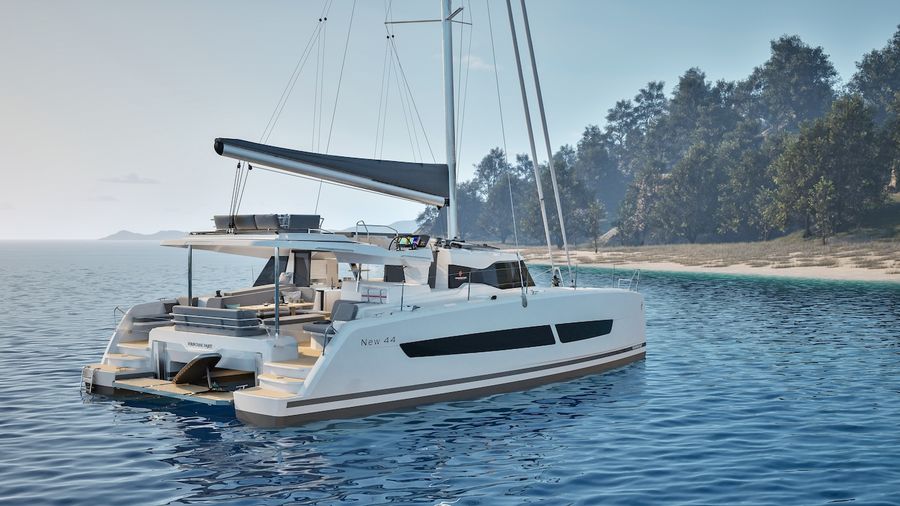
The Fountaine Pajot 44 has been carefully positioned within the French builder's growing sailing catamaran lineup, sitting between the popular Fountaine Pajot 41 and the Elba 45. Unveiled ahead of the 2025 show season, the new model is set to make its public debut at major European boat shows from European autumn onwards. It draws directly on the design language and systems developed for the Tanna 47 and Aura 51, with a strong focus on interior volume, helm visibility, and cabin layout flexibility. Like those stablemates, the New 44 can also be specified with Fountaine Pajot's fully electric ODSea+ drivetrain, bringing sustainable propulsion to the mid-40s catamaran market without sacrificing practical range.
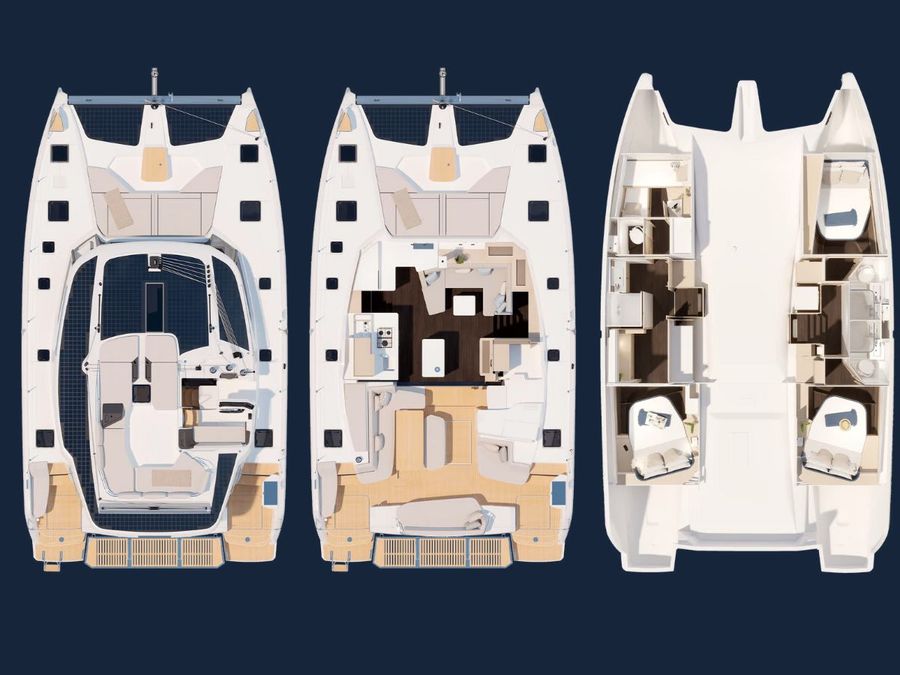
The hull and deck were shaped by Berret-Racoupeau, the design studio responsible for several of the yard's recent models. The result is a boat that reads as considerably larger than its 13.26-metre length overall, with fluid lines and generously proportioned living spaces working together to create that impression. Buyers can choose between a conventional diesel powertrain or the ODSea+ electric alternative, and two cabin arrangements are on offer. The Maestro layout prioritises an expansive owner's suite alongside two guest cabins, while the Quatuor configuration adds a fourth cabin to suit charter operations or larger crews needing the extra berths.
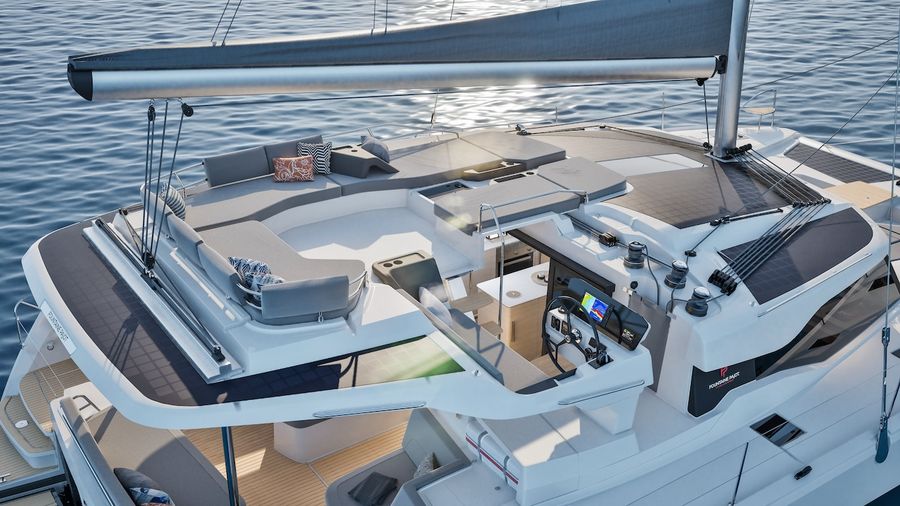
From the outside, the New 44 presents a distinctive profile built around a slightly inverted deck sheer, a restrained coachroof, and hull portholes framed by an elongated visual stripe running along each hull. Subtle chines above the waterline serve a dual purpose, improving both hydrodynamics and usable interior volume without disrupting the catamaran's overall visual balance. The helm station sits at mid-height, offering commanding sightlines over the rig and forward deck, and the layout cleanly separates navigation duties from lounging space, mirroring the approach taken on Fountaine Pajot's larger models. A forward sunbathing area and spacious flybridge complete the social zones on deck, and solar panels of up to 2000W can be specified for owners keen to reduce reliance on diesel generation.
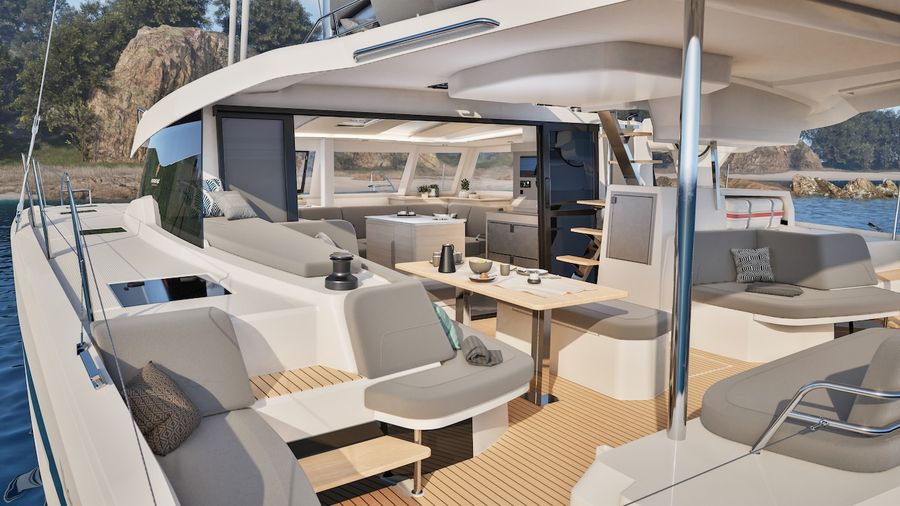
Down below, the New 44 balances practical cruising functionality with an interior that can be personalised to suit different owners. The saloon is organised around a central island galley, with a full-width opening connecting it to the aft cockpit and a forward serving hatch that softens the boundary between interior spaces and the deck. In the Maestro configuration, the owner's cabin to port comes with a private ensuite, and the forward area of that hull can be fitted out as a workspace, nursery, or additional storage depending on preference. Aft berths are angled to ease access, and the hull chines contribute meaningful extra beam to the forward cabins. Throughout the accommodation, natural light is generous, storage has been thoughtfully handled, and the finishes are suited to extended liveaboard use.
The New 44 measures 13.26 metres in length overall and 7.44 metres across the beam, providing a stable and well-proportioned cruising platform. The sail plan comprises a 78-square-metre mainsail and a 45-square-metre genoa, a pairing that delivers useful performance even in lighter conditions. Diesel-powered versions come with twin 30hp engines as standard, with an upgrade path to 57hp units available. The ODSea+ electric variant substitutes those with dual 25kW motors drawing power from a 42kWh lithium battery bank, backed by hydrogeneration capability, a 24kW generator, and options to expand battery capacity further. Water capacity stands at twin 300-litre tanks, and the diesel version carries 350 litres of fuel to support extended passages. Unladen displacement is 15.2 tonnes.
The Fountaine Pajot 44 marks a logical step forward in the yard's progression towards catamarans that are lighter, better lit, and more attuned to environmental considerations than their predecessors. The combination of performance, comfort, and design refinement makes a compelling case for sailors seeking a capable liveaboard or a serious long-distance cruiser. Whether the brief calls for offshore bluewater passages under sail or quiet electric cruising through coastal anchorages, the New 44 arrives with a well-rounded answer. First hulls are expected on the water later this year.