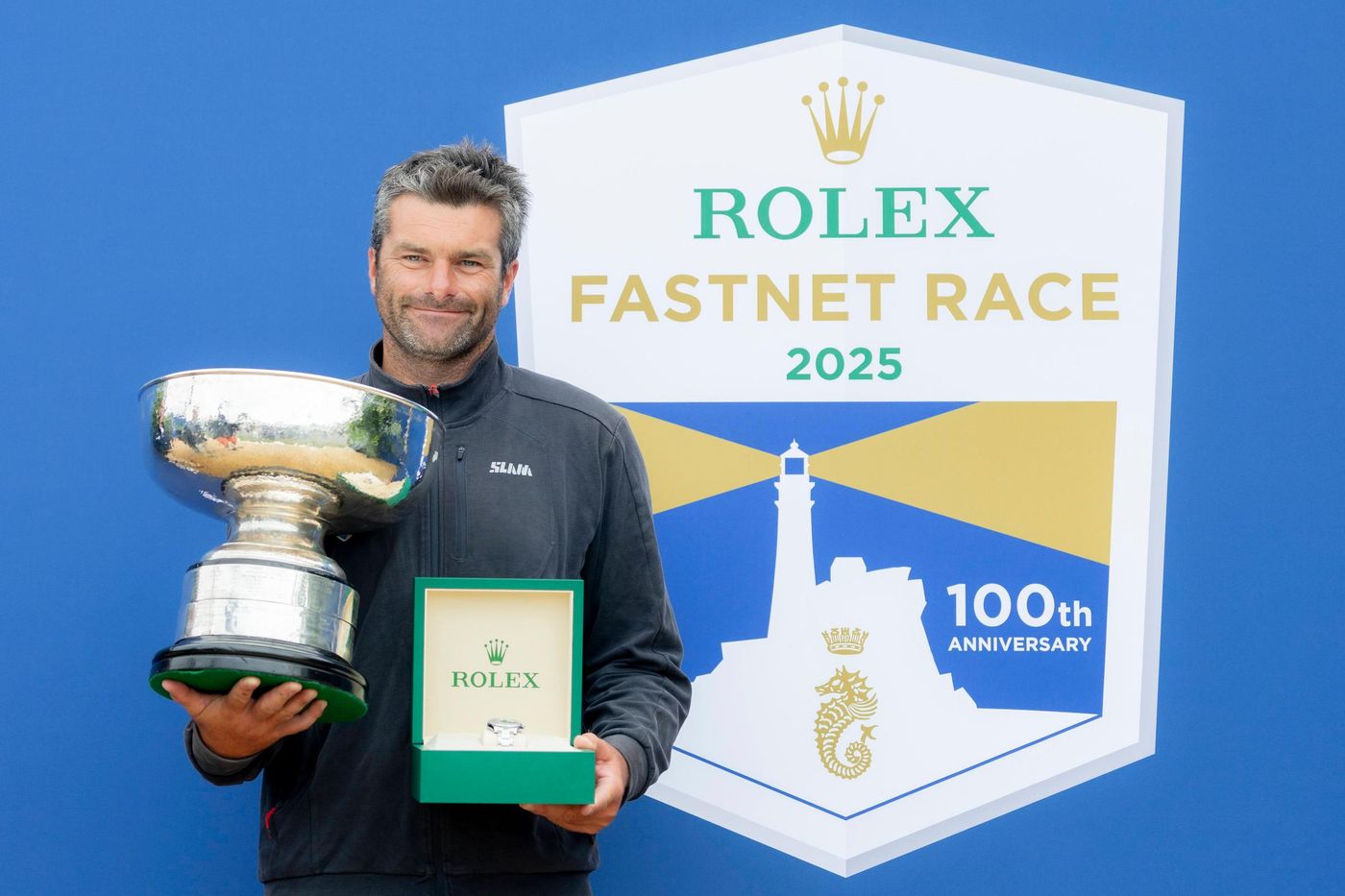
Just after 11am local time, Léon slipped across the finish line in Cherbourg, her low silhouette cutting cleanly through the final swells of the 695-mile Rolex Fastnet Race. The breeze had faded, the sea lay quiet, and a crowd gathered along the seawall stirred to life as her bow kissed the line. In a centenary edition that had drawn more than 400 starters, it was this compact 10.5-metre French-built sloop that had claimed the top prize, IRC Overall victory in one of offshore sailing's most storied tests.
Skipper Alexis Loison stood at the finish alongside co-skipper and boatbuilder Jean-Pierre Kelbert, still absorbing the scale of what they had done. His phone had not stopped. "It's crazy," he said, scrolling through the messages. "Hundreds since yesterday. To win again, here, at home, it's hard to describe."
The victory carried particular weight for Loison. Back in 2013, he had raced double-handed with his father Pascal aboard the JPK 10.10 Night & Day and claimed IRC Overall honours in Plymouth. That result made history. This one made it personal. Cherbourg is his hometown, and the race now finishes there.
Léon completed the course in just under four days, navigating shifting breeze and slack water with restraint and tactical clarity. She did not overpower the fleet. Precision, clean sailing, and smart decision-making sustained across four days at sea delivered the result. On corrected time, she edged out all 380 IRC-rated entries, and the margin of victory owed everything to the quality of those decisions.
Léon's arrival brought the IRC story to its close, but the race's most dramatic passage had unfolded well before dawn, a day and a half earlier.
At 04:38, the foiling trimaran SVR Lazartigue crossed the line under a bruised pre-dawn sky to claim Multihull Line Honours, finishing in a little over 1 day and 17 hours. Skippered by Tom Laperche and carrying Black Foils helm Peter Burling among her crew, the 105-foot machine made a bold early move, hugging the English coast and finding an edge where others could not. That call proved decisive. SVR Lazartigue outmanoeuvred Banque Populaire through a combination of speed and bold decision-making.
Monohull Line Honours went to the RP100 Black Jack 100, owned by Remon Vos and skippered by Tristan Le Brun. Built in 2005 and extensively optimised since, Black Jack 100 stormed through the course in 2 days and 12-and-a-half hours. Her crew blended French, Dutch, and Kiwi talent, including Edwin de Laat, proving that a well-prepared older hull driven by a sharp team can still lead a modern fleet home.
In the Fastnet, the first boat to the finish is not the winner. That distinction belongs to the boat that performs best on handicap. In this centenary year, it belonged to Léon.
"It's just as special as the first time," Loison said quietly, looking out across the grey water. "Maybe more."
*A century in the making*
That win carried more than local pride. It completed a circle stretching back nearly a hundred years, to a race that was itself first won by a French boat.
The Rolex Fastnet Race was born in 1925, when British yachtsman Weston Martyr proposed a new offshore test: a 600-mile passage from Ryde, around Fastnet Rock, to Plymouth. Seven boats lined up for that inaugural edition. The winner was Jolie Brise, a rugged yet graceful 56-foot French pilot cutter launched in 1913, which completed the course in just under six days. From that first race grew the Royal Ocean Racing Club, whose centenary the 2025 edition was held to celebrate. The overall prize returning to a French boat felt entirely fitting.
The race has grown well beyond those seven starters. In 2021 the finish shifted from Plymouth to Cherbourg, adding miles and a new kind of spectacle. The core challenge remains unchanged: unpredictable weather, tidal traps, navigational complexity, and the raw resilience demanded by one of the world's most changeable stretches of water.
*444 stories at sea*
This year, 444 boats crossed the start line at Cowes, the largest and most diverse fleet in the race's history. Carbon-fibre foilers lined up alongside timber-decked cruisers. Professional syndicates shared start times with family double-handers. Staggered starts, governed by tide, sent the fleet streaming along the south coast of England toward the western edge of Ireland.
The early conditions tested everyone. Forecasters had warned of high-pressure traps and patchy transitional breeze, and boats discovered what that meant around Portland Bill, where some stalled entirely while others found pressure and ghosted through. The race rewarded sharp eyes and clean routing from the outset.
In the Class40 fleet, Faites Un Don Sur SNSM.org held the lead as the race developed. Among the IMOCA 60s, Association Petits Princes – Quéguiner, skippered by Elodie Bonafous, sailed a near-faultless campaign. Inter Invest led the Ocean Fifty division with comparable composure.
The soul of the Fastnet has always lived in the IRC fleet, and with more than 380 boats racing on handicap, the stories spread across every class. Tschüss 2, a refitted Volvo 70, claimed IRC Super Zero. Enderpearl, a CNB 76, won IRC Zero. Long Courrier, helmed by the ever-consistent Géry Trentesaux, topped IRC 1. Lann Ael 3, a Manuard Nivelt 35, secured IRC 2A. Whimjy 99, a J/99, won IRC 3, and Abracadabra 2, a JPK 1010, took IRC 4.
Not every boat arrived chasing a class prize. Sunstone, a 1972 Sparkman & Stephens cutter with more than 100,000 offshore miles under her keel, returned to the course in IRC 4B under helm Will Taylor-Jones. Her brightwork gleamed beside the carbon decks of more modern boats. Her race was not for position. It was for presence, and for the particular satisfaction of sailing a classic offshore course aboard a classic offshore boat.
For others, this edition may have been a farewell. Pyewacket 70, owned by Roy P. Disney, and Oystercatcher XXXV, racing her 25th Fastnet under Matthew Richards, are both now listed for sale. If their campaigns do not continue, two long-standing participants will leave the race behind.
At the other end of the spectrum, dozens of first-timers arrived in Cherbourg, many racing double-handed from Ireland, Belgium, and Scandinavia. Some arrived grinning. Others arrived exhausted. All of them had completed something most people never will.
Seventeen boats retired from the race. Among them were Foggy Dew, the JPK 10.10 campaigned by Noel Racine, forced out by sail damage near Portland Bill, and Canada Ocean Racing, which withdrew with technical issues. At the very back of the fleet, Cariberia, a Class 40, crossed the line just under six days after the start.
*A race for the ages*
By the time the last boat arrived, the rhythm of the Fastnet pulsed through Cherbourg.
An Admiral's Cup overlay added further dimension to the competition, with all 30 boats from the AC1 and AC2 divisions having started at Cowes, their Fastnet results carrying national significance. Among those drawing particular attention were the two entries from the Royal New Zealand Yacht Squadron: Caro, a Botin 52, and Callisto, a Cape 31. Both delivered solid results in their respective classes, representing New Zealand with composure in a fleet of giants. Kiwi sailors also featured throughout the wider entry list, contributing as navigators, tacticians, helmsmen, and grinders across a range of international campaigns.
Behind every boat in every fleet sat an infrastructure of effort that never appears on the results sheets: shore crew, families, friends, and quiet supporters who met their teams at the dock with hot food and the kind of welcome that only comes after days of watching a tracker and counting down the miles. The Cherbourg docks filled steadily through the final hours and days of the race, each arrival carrying its own story, told in the faces of tired sailors and the people who had been waiting for them from shore.