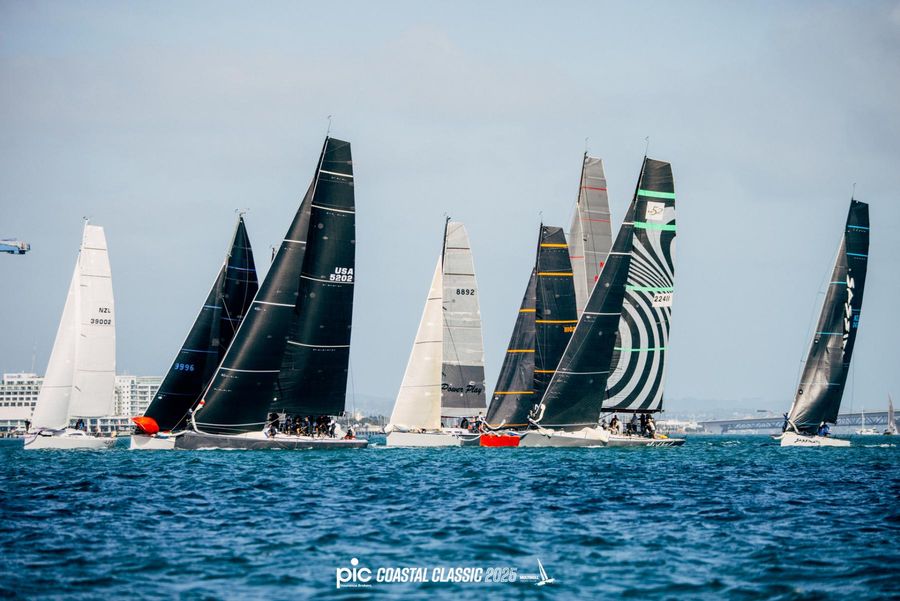
Since 1982, Labour Weekend has belonged to this race. The PIC Coastal Classic has spent more than four decades forging legends, humbling overconfident crews, and redefining what Kiwis consider a brisk trip north. Now a firm fixture on the sailing calendar, the 2025 edition covers 119 nautical miles from Devonport Wharf to Russell Wharf, a sprint that pits innovation and seamanship against one of New Zealand's most demanding stretches of coastline.
A race with deep roots
The whole thing began with Roger Dilley and the Auckland Multihull Sailing Association, who sent a dozen boats north in 1982. The fleet ranged from the 62-foot Fidelis to a 24-foot trimaran called Gulf Chariot. It was Krisis, skippered by Duncan Stuart, that crossed the Russell finish first, completing the inaugural race in 18 hours.
That first edition set the template: fast, direct, and never short of drama. Through the 1980s and 1990s fleets swelled past 200 yachts, and revolutionary designs such as Split Enz and Afterburner kept pushing expectations of coastal speed. The race also became a proving ground for the sport's future greats. Sir Peter Blake raced aboard Krisis in 1987, and more than a few America's Cup names earned their stripes rounding Cape Brett before the wider world took notice.
Records have punctuated the history with satisfying regularity. Alfa Romeo stunned the fleet in 2009, posting a time of 6 hours 43 minutes. Team Vodafone Sailing went sharper still in 2011, breaking the six-hour barrier at 5 hours 44 minutes. Then in 2014 the same boat, later rebranded as Frank Racing in 2016, lowered the mark again to 5 hours 13 minutes, a record that has not been touched since.
What happened in 2024
Last year's running was a timely reminder that the Coastal Classic rewards neither complacency nor ambition unchecked by judgement. Over fifty yachts left Devonport, from grand prix multihulls to family campaigners hoping for a clean run north.
Early drama arrived when the restored Formula 40 Fat Freddy surged to the lead as far as Sail Rock, then retired with beam damage. Highline, another fancied contender, also withdrew before the finish. Both retirements shifted the complexion of the race considerably.
Into the breach sailed the Rapido 60 trimaran Romanza, skippered by Dougall Love, which controlled the night run north and crossed the line in an elapsed time of 14:46:45 to claim line honours. Levity, a Schionning CM46 catamaran, followed at 17:18:54. The Marten 55 Botin Carkeek monohull Equilibrium came close behind, with Clockwork, Zephyrus, and the much-loved Steinlager II rounding out the leading group.
On handicap, the beautifully built Warwick 50 Fez stole the spotlight, showing that clever, disciplined sailing can outpoint raw boat speed. Of the full starting fleet, only 39 made it to Russell, a completion rate that underlines just how seriously the race should be taken.
What to expect in 2025
The 2025 PIC Coastal Classic gets under way on Friday 24 October, with the skipper's briefing scheduled at the Royal New Zealand Yacht Squadron the evening before. Three start sequences are planned off Devonport. Divisions 4, 5, 8, and Solo leave at 0930. Divisions 2 and 3 follow at 0945. Divisions 1, 6, and 7 get away at 1000. The finish cut-off is 1400 on Saturday.
The course itself has not changed and is not likely to. Leave Devonport, head north, and keep both Little Barrier Island and the Poor Knights to starboard. Thread through Cape Brett and then run into the Bay of Islands for the final charge to Russell Wharf. Simple to describe, demanding to execute.
Divisions are structured broadly enough to give every type of boat a genuine contest. Monohulls are separated by size, multihulls by length, and a No Extras division caters for those sailing on main and headsail alone. Beyond the primary divisions, add-on categories include IRC, Classic, Women's, Two Handed, and Solo, with popular class groups covering Farr 1020s, Young 88s, and Open 8.5 multihulls all finding a home in the entry list.
A new format for the cruising fleet
Not every crew arriving at Devonport has the red line buried in mind. For 2025, organisers have refreshed the PIC Coastal Classic Rally format under new sponsor Charlie Bravo Boat Co, creating a more defined pathway for cruising sailors.
Two options are on offer. The first is a straightforward Friday departure north with the race fleet, heading direct to Russell. The second allows sailors to leave on Thursday, stop overnight at Marsden Cove with berths and a social gathering available, then rejoin on Friday for the final run to Russell. Both rally options require Cat 3 certification. The addition broadens the event's appeal without diluting its character, sitting comfortably alongside the Coastal Classic's long history of community participation.
Reading the weather and the water
Labour Weekend weather carries its own set of complications and demands genuine respect. Tactical decisions frequently revolve around timing the seabreeze against the gradient wind, and around managing the transition as conditions change across the Hauraki Gulf. Three checkpoints, Flat Rock, Sail Rock, and Cape Brett, each test crews in different ways and at different moments in the race.
Cape Brett in particular has a well-earned reputation as a leveller. Promising leads built over many miles can dissolve in the dead air that sometimes settles there, and rivalries that seemed settled can flip in a matter of minutes. Some crews push offshore looking for pressure, others stay coastal for cover and cleaner lanes. At night, maintaining boat speed while navigating around traps is the precise, patient craft that most often decides who reaches Russell first. For rally participants, the Marsden Cove overnight stop provides rest and positions crews well for the morning breeze on the final leg.
The 2025 PIC Coastal Classic shapes up as another chapter in a story New Zealand coastal sailing has been writing since 1982. The boats are faster, the tracking technology is digital, and the safety standards are sharper than anything Roger Dilley's original fleet would have recognised. The spirit, though, has not moved an inch.