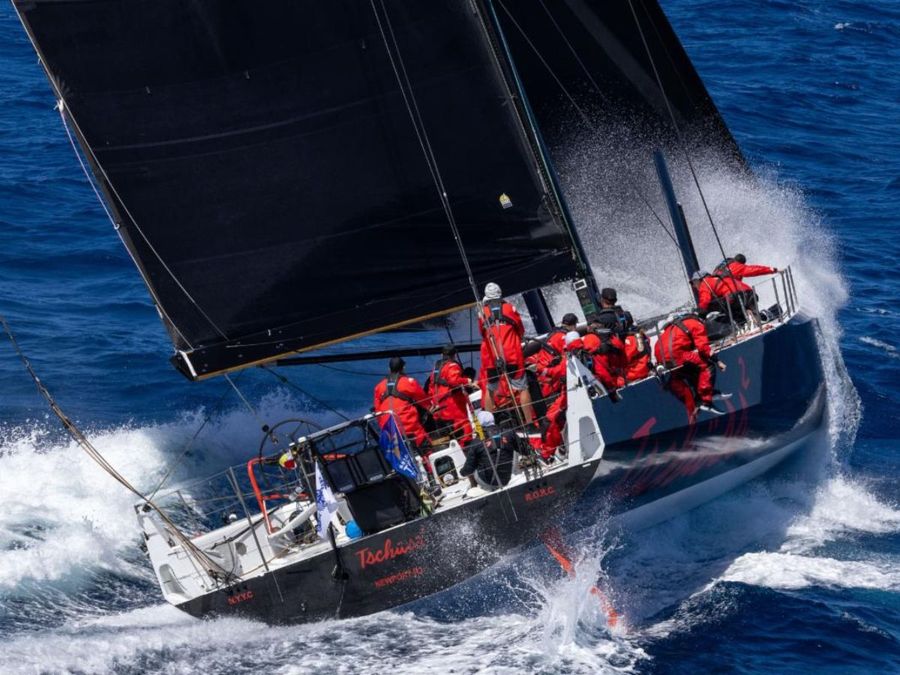
Christian Zugel's upgraded VO70 Tschüss 2 has been one of the more compelling stories of the offshore season. Campaigned by a crew led by Johnny Mordaunt, the boat has claimed overall honours in the RORC Transatlantic Race, the RORC Caribbean 600 and the Newport-to-Cowes Transatlantic Race, all within the same year. That run is only slightly less striking when you recall that in 2019 her previous owners, brothers Peter and David Askew, also took the Caribbean 600 and Transatlantic Race before going on to win the Rolex Fastnet Race. The boat has deep pedigree: she began life as Franck Cammas' Groupama 4, winner of the 2011-12 Volvo Ocean Race and widely regarded as the finest of the final VO70 generation.
Zugel is measured about his prospects in the Fastnet. "The Rolex Fastnet Race would be the icing on the cake, but it will be very difficult," he admits. "Very light airs are forecast and obviously a VO70 does especially well in stronger wind and reaching, which we won't have. My personal view is that probably a TP52 might be fastest, although the maxis could do really well, ie Pyewacket 70, Leopard 3 or the two 100 footers which will be very slippery too. It's going to be a tough race."
For Zugel personally, this will be his first Rolex Fastnet Race. "As a kid, you read about it and heard about it, all the stories etc, so being able to do it now is marvellous. We're thinking we might take almost three days to complete it, hard to believe after we covered 3,000 nautical miles crossing the Atlantic in seven days and 16 hours."
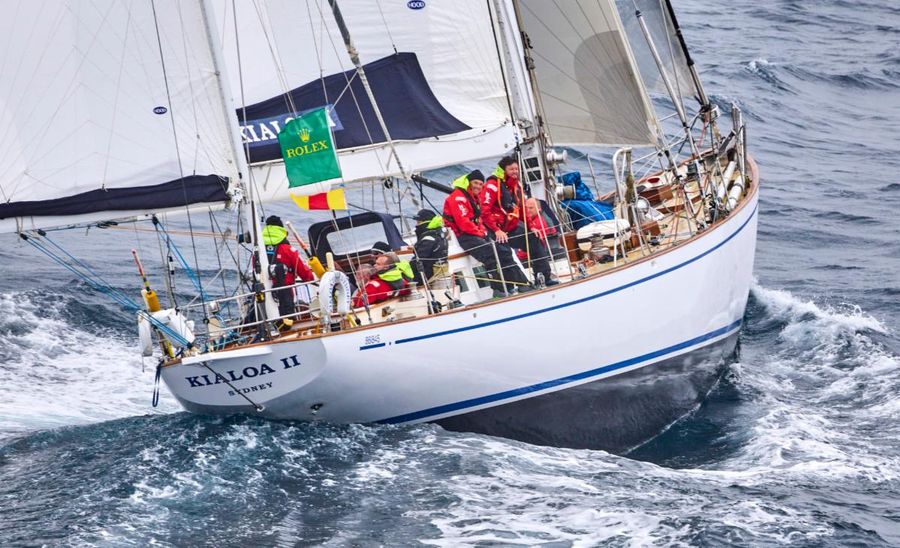
Among the other notable starters is Kialoa II, the 1963 Sparkman & Stephens maxi originally skippered by Jim Kilroy. This will be the third time Paddy Broughton has brought her to the Rolex Fastnet Race. "We wanted to do the 50th Rolex Fastnet Race, and we've always wanted to do the 100th anniversary one," he explains. "We've got a mix of crew. Some did it last time like Lindsay May (3x Sydney Hobart winner). We've got some new people who've sailed the boat in various events, and some brilliant youngsters, hopefully this will help them with their professional careers."
The lighter conditions in this year's forecast present a particular challenge for a boat of Kialoa II's dimensions. "She's 45 tonnes whereas a more modern 70 footer would be 14 or 18," Broughton notes. "So upwind she is much calmer, much less noisy and doesn't slam, but downwind we don't plane. The game for us will be to get home before the wind shuts down." Broughton is also looking forward to renewing acquaintance with Stormvogel, the line honours winner of the 1961 Fastnet Race.
At the other end of the experience spectrum, the RORC's Griffin, a Sun Fast 3600, is set to give most of her seven crew their first taste of the Rolex Fastnet Race. The squad spans ages 21 to 27 and will race under the guidance of coach Hugh Brayshaw, with Nicole Hemeryck as skipper. Her crew includes Abby Childerley, Barbara Guth, Emma McKnight, Hebe Hemming, Olivia Bracey-David and Rachael Cross.
Hemeryck came through a selection process that began several months ago. "I applied to the Griffin project back in October and attended trials," she explains. "Based on my experience and how I got on with the crew, I was chosen as the skipper for the season. We did a couple of JOG races, then Myth of Malham and the Morgan Cup and both went pretty well. We're happy with how we got on and what we learned."
Growing up racing dinghies out of the National Yacht Club in Dun Laoghaire, Hemeryck cut her teeth in Optimists, Toppers and Lasers before graduating to keelboats. She learned of the RORC's Griffin programme, led by Jim Driver and designed to bring young sailors into offshore racing, through other Irish sailors who had been part of it. "It is a great opportunity to move my sailing to the next level, to get more coaching in big boats, to be part of a team and take responsibility for running a campaign," she says.
Another Irish sailor preparing in Cherbourg alongside the French grand prix and IRC fleets is Pamela Lee, who arrived this morning for registration with her Class 40 #EMPOWHER. Fresh from finishing 14th out of 27 boats in Les Sables-Horta-Les Sables, she is Ireland's sole Class40 entry. "The Class 40 pontoon is pretty full. I can see all the Ocean Fiftys are here and the IMOCAs are trickling in," she said. "There are also quite a lot of IRC boats. We'll leave on Friday night and head over, dip the start line and go."
Lee's campaign is built around a broader mission: promoting empowerment through sport, role models, leadership and storytelling. "And empowering people to work together to make change, whether it's about equality or sustainable energy, etc." Half her campaign budget is covered by ferry and logistics company DFDS, which is opening a new route from St Malo to Jersey, and she is still seeking backing for the remaining half. Her boat is a Pogo S4, the former Team SNCF, in which Xavier Macaire twice won the Drheam Cup.
This is Lee's fifth Rolex Fastnet Race overall, but her first in a Class40 and her first as skipper. She previously competed aboard Richard Matthews' Oystercatchers.
While many French competitors are gathering in Cherbourg, others have already crossed to Cowes, including Yann Jestin, whose 2023 race came to an abrupt and alarming end when his Sun Fast 3600 Vari sank shortly after leaving the Solent. The crew were fortunately recovered quickly by the Yarmouth lifeboat. "It was a very strong experience," Jestin recalls. "We passed the position where she sank when we came in from the La Trinité race. It was better it happened there than at 3am in 40 knots further offshore."
Jestin, who runs the Chateau Vari in Monbazillac et Bergerac, is back this year alongside co-skipper Romain Baggio, this time aboard the JPK 1010 Papillon IV. "The race is looking a bit lighter this time, especially arriving in Cherbourg, which will be challenging. We are back and this time we want to finish the story," he says. "The Fastnet is an outstanding race, and it's very interesting to sail along the English coast and to go to the Fastnet Rock and finish in France. The level of competition is incredible, especially when you realise how many champions are in it."
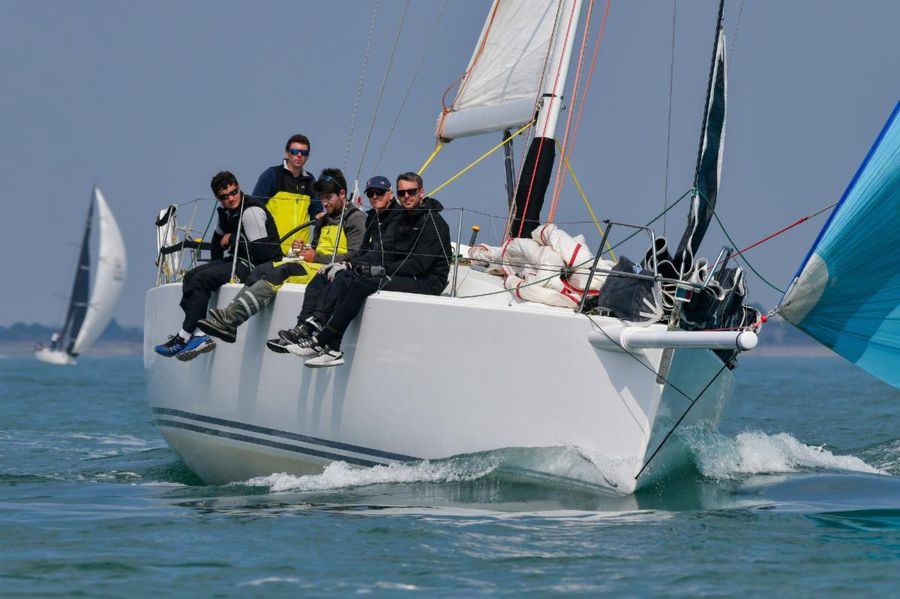
François Charles and his crew return to the Rolex Fastnet Race aboard Sun Hill IV, a J/133 that represents a significant step up from the Dehler 33 Sun Hill III on which they won IRC Four in 2023, having also placed third in class on two previous occasions. The new boat arrived on Tuesday from Charles' home city of Morlaix, where he works as a rigger. Morlaix has a distinguished record of producing top French offshore talent, among them Solitaire du Figaro winners Jérémie Beyou, Armel le Cleac'h and Nicolas Troussel. Troussel called tactics aboard Sun Hill IV for much of the season before moving across to race on Sodebo Ultim. Despite having taken ownership of the boat only this year, the team have already scored a second place in the Cervantes Trophy in IRC One, behind Dawn Treader.
Charles is under no illusions about the challenge ahead in class, where Géry Trentesaux and his fully developed Sydney GTS 43 Long Courrier will be formidable opponents. "We want to use this to discover the boat, it's much faster than our last one, which I'm very happy about," he says. Charles' campaign is backed by Cabinet Bourhis insurance. "That's good because it allows us to buy more sails." He is racing with five crew aged between 22 and 65.
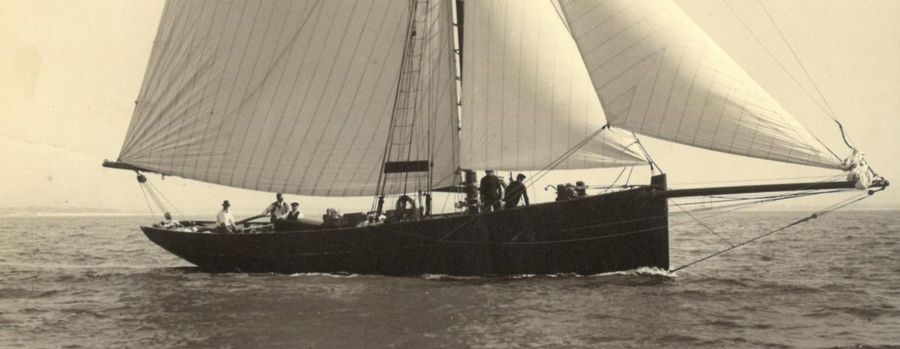
A century ago, roughly at this point in the countdown to what was then simply called the Ocean Race, the man who would become both its inaugural winner and the first Commodore of the RORC, Lt Cmdr E G Martin OBE, RNVR, was walking Cowes High Street organising provisions for Jolie Brise.
The victualling list makes for vivid reading: six four-pound pieces of salted beef silverside intended for slow cooking in the fo'c'sle galley, one-pound pats of butter, 36 loaves of bread that rapidly went mouldy, 140 green bananas that all ripened simultaneously but were nonetheless consumed, a box of apples, tinned sausages, Heinz baked beans and spaghetti, and French tinned vegetables including petit pois. Bath chaps, the cheek and tongue of a pig pressed into shape then boiled, skinned and breaded, were a popular choice. The cheese selection was substantial: Swiss gruyere cut into segments and wrapped in lead paper, two pots of Maclaren's Imperial cheese and two four-pound round Dutch cheeses. For biscuits, the stores included a nine-pound box of digestives and a tin of Bath Oliver crackers. Terry's bitter chocolate featured, alongside a well-stocked pickle shelf covering Military, Pan Yan and Escoffier's piccalilli, French mustard, anchovies, Gentleman's Relish and Shippam's potted meat.
Jolie Brise carried a crew of six after two originally selected crew failed to appear, and among them was a cook. Even so, the most popular item on the menu turned out to be Martin's own onion soup. Mealtimes followed a structured rhythm: Bovril at the 0400 watch change, eggs, potatoes, bacon or sausages for breakfast at 0800, lunch at noon, tea at 1600 and dinner at 1930.
On the question of drink, the crew proposed that Jolie Brise sail dry for the race. Martin did not share this view. Beer and wine were aboard, one crew member contributed whisky, rum and what was described as "a most excellent old brandy", and the whole party got through considerable quantities of coffee and Kia Ora lemon squash, a brand launched in the UK in 1917.